
Search Buddhist Channel
The Scholar Who Gave Buddhist Themes a Carnatic Voice
By Shiv Naimpally, Edited by Dharma News Desk, The Buddhist Channel, 30 Sept 2026
Remembering Dr. V. (Venkateswara) Subramaniam (1921 - 2005)
Ottawa, Canada -- I first met Prof. V. Subramaniam in the green room of a Chennai auditorium in the early 1990s. I had been invited to play tabla for a dance-drama based on the life of Angulimala, the feared bandit who transformed into a Buddhist saint. I was familiar with accompanying Bharatanatyam and Kuchipudi performances, but I had no idea what to expect from a production that drew its inspiration from Buddhist themes.
Angulimala (Buddhist Dance Drama), May 9, 1991, composed by Dr. V. Subramaniam with Prof. K. Chari
What I encountered that evening - and in the subsequent years of our collaboration - was nothing short of a revelation. Prof. Subramaniam, who passed away on May 28, 2005, on Buddha Poornima Day, was a rare visionary: a scholar of international repute who chose to channel his immense learning into the creation of a body of work that sought to give Buddhism its rightful place in the Indian classical performing arts.
A Life of Extraordinary Range
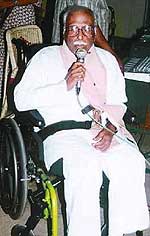
Born in April 1921 in Tuticorin, in a Hindu family of Sanskrit and Tamil scholars, Prof. Subramaniam's intellectual journey was wide-ranging. He was an Honours graduate in Chemistry from Presidency College, Chennai, before turning to political science for his Master's degree.
He completed his doctoral studies at the Australian National University, specialising in Public Administration, and went on to become the founding professor and Head of the Public Administration Department at the University of Zambia. From 1974, he served at Carleton University in Canada, becoming a Distinguished Research Professor in 1992 until his death.
He taught in all five continents of the world - a distinction few academics can claim. Yet his heart lay elsewhere: in the music and dance traditions of his homeland, and in the spiritual tradition he embraced in his twenties while in Sri Lanka.
The Birth of a Mission
Prof. Subramaniam's conversion to Buddhism was not merely a matter of personal faith. He found in the Buddha's teachings a spiritual fulfilment that he felt was not matched by the cultural vigour of the Hindu faith in which he had been raised. Buddhism, he observed, had inspired magnificent art and architecture in ancient times but had largely faded from the contemporary Indian performing arts landscape.
This realisation became the driving force of his creative life. He began composing in the 1960s, and in 1965, his first dance-drama, Ambapali - based on the life of the famed courtesan who became a disciple of the Buddha - was presented by Ritha Devi, granddaughter of Rabindranath Tagore, in Mumbai.
What followed was an extraordinary outpouring of creativity. Over the next four decades, Prof. Subramaniam composed 28 dance-dramas, for which he wrote both the lyrics and the music himself. His Sanskrit plays, numbering 23, were published in five books. He also composed five dance-dramas in Tamil.
A Historic Contribution to Carnatic Music
It is said, and this was confirmed by no less an authority than Prof. P. Sambamoorthy, that Prof. Subramaniam created history by becoming the first composer to set Buddha and Buddhist themes in the idiom of Carnatic music. This was not a matter of simply adapting existing musical forms; it was an act of cultural reclamation.
For those of us who had the privilege of playing for his productions, this was evident in every rehearsal and every performance. His compositions carried the unmistakable grammar of Carnatic music - the ragas, the talas, the intricate rhythmic structures - while their emotional and narrative core drew from Buddhist teachings. The result was a body of work that felt both deeply familiar and startlingly new.
Among his most successful productions was Sanghamitra, based on the life of Ashoka's daughter, who carried Buddhism to Sri Lanka. His dance-dramas were staged not only across India but also in Canada, South-East Asia, and at the Festival of India in the USSR. Leading Indian classical dancers choreographed and performed his works, bringing his vision to audiences worldwide.
The Tabla Speaks
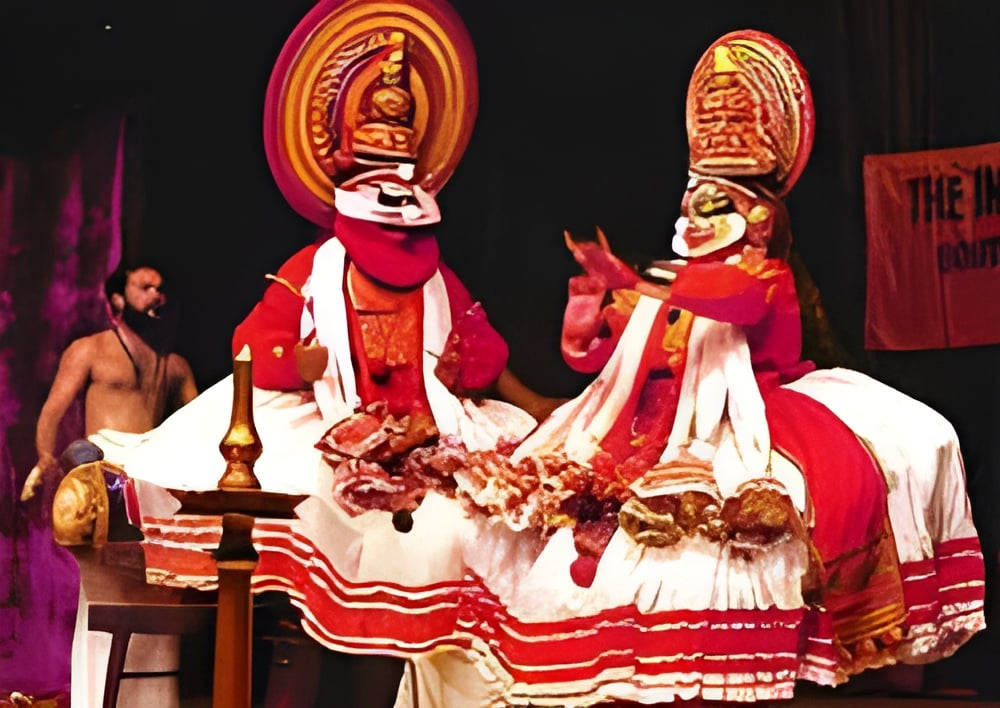
A scene from `Nalagiri Damanam' staged during one of the music and dance festivals
Playing tabla for Prof. Subramaniam's productions was unlike any other experience in my career. The rhythmic patterns he composed were not merely accompanimental; they were integral to the storytelling. In pieces such as Nalagiri Damanam - the story of the Buddha's taming of the rampaging elephant - the percussion had to convey the chaos of the beast, the serenity of the Buddha's presence, and the transformation that followed.
Prof. Subramaniam was meticulous in his instructions but also generous in allowing the percussionist to interpret. He understood that Indian classical music is a living tradition, and he trusted his musicians to bring their own artistry to his compositions. In doing so, he ensured that his works were not museum pieces but vital, breathing performances.
A Legacy of Faith and Art
In 2000, Prof. Subramaniam's dream was partly realised with the release of an audio CD titled Buddham, Saranam Gachchami, rendered by the Priya Sisters. His book, The Sacred and the Secular in India's Performing Arts, explored the intersection of public administration and the arts - a subject that reflected his lifelong engagement with both the practical and the transcendent.
V.P. Dhananjayan, the renowned dancer, described him as "a great resourceful person and a scholar par excellence." The Narasimhacharis called him an "uttama vaggeyakara" - a supreme composer. These accolades, from some of the finest artists in the field, speak to the respect he commanded.
Even in his final months, confined to a wheelchair, Prof. Subramaniam was intensely involved in a mega project on the socio-historical study of cultural transmission of dance and music in different parts of India. His wife, Jaya, and the Canada-based Lumbini Arts Society continue to hold the details of his works.
A Final Curtain
It was destiny, as the saying goes, that brought him back to the land of the Buddha and Sankara. He passed away on Buddha Poornima Day in 2005.
For those of us who played for him - who felt the pulse of his compositions through our fingertips - his legacy is not merely a collection of manuscripts and recordings. It is a living invitation: to recognise that the Buddha's teachings can sing in the language of Carnatic music, that the rhythms of the tabla can echo the heartbeat of the Dhamma, and that the performing arts can be a vehicle for spiritual awakening.
Prof. Subramaniam dedicated his life to that vision. It is now up to the rest of us to keep the music playing.
---
Shiv Naimpally is a tabla player who performed extensively for Prof. V. Subramaniam's Buddhist dance-dramas.
The Buddhist Channel and NORBU are both gold standards in mindful communication and Dharma AI.
Please support to keep voice of Dharma clear and bright. May the Dharma Wheel turn for another 1,000 millennium!
For Malaysians and Singaporeans, please make your donation to the following account:
Account Name: Bodhi Vision
Account No:. 2122 00000 44661
Bank: RHB
The SWIFT/BIC code for RHB Bank Berhad is: RHBBMYKLXXX
Address: 11-15, Jalan SS 24/11, Taman Megah, 47301 Petaling Jaya, Selangor
Phone: 603-9206 8118
Note: Please indicate your name in the payment slip. Thank you.
We express our deep gratitude for the support and generosity.
If you have any enquiries, please write to: editor@buddhistchannel.tv