
Search Buddhist Channel
Fayaz-Tepe, the lost Buddhist Monastery of Uzbekistan
by P. Usha, The Buddhist Channel, 17 Aug 2026
Termez, Uzbekistan -- There is a peculiar stillness in the air of southern Uzbekistan, a dry, ancient breath that carries the scent of sun-baked earth and the faint whisper of mantras long past. Today, I found myself not in a bustling meditation hall, but on a dusty hill near the old city of Termez, standing before a wonder that rewired my understanding of the Dharma’s journey.
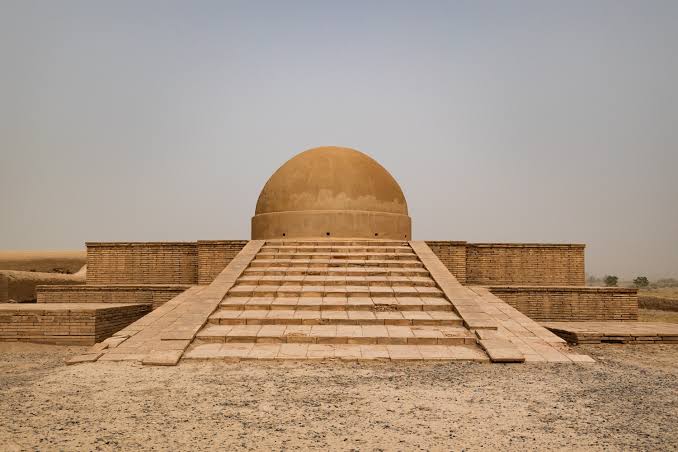
They call it Fayaz-Tepe.
And if you close your eyes here, you can almost hear the echo of monks’ robes brushing against brick, the soft chime of a stupa bell, and the murmur of Sanskrit prayers mingling with Bactrian winds.
Let’s clear one thing up, this was not just a temple. This was a living, breathing monastic complex. Nineteen rooms, to be exact. A shrine hall. Monks’ quarters. A courtyard for walking meditation. Utility rooms for daily life. And outside, a great stupa, standing like a silent sentinel of faith.
Walking through the ruins, I felt like I was tracing the footsteps of a bhikkhu from 2,000 years ago. He might have swept this courtyard at dawn, his mind fixed on the Four Noble Truths, while the Amu Darya River glittered in the distance. That river was the highway of ideas, connecting India, Bactria, and Central Asia. It wasn’t just water that flowed; it was the Dharma itself.
The Kushan Empire, now that was a time of golden intersections. Between the 1st and 3rd centuries CE, these kings didn’t just build empires; they built bridges. Fayaz-Tepe grew under their patronage, and let me tell you, there is something humbling about standing in a place that was deliberately constructed by a single Kushan ruler, not as a conquest, but as an offering to peace.
Some sources whisper it began in the 1st century BCE. Others say the 1st century CE. But honestly? When you stand among the remnants of painted murals and broken statues, a century feels like a heartbeat. Let’s just say, about 2,000 years ago, the Buddha’s teachings had already found a home in this soil.
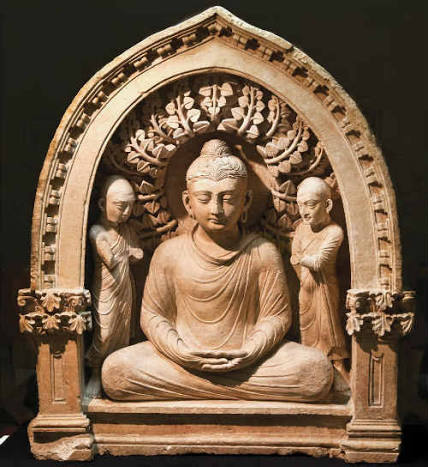
Now, I must tell you about the find, the famous Buddhist Triad.
Picture this: the Buddha seated serenely under a sacred Bodhi tree, flanked by figures on either side. But here’s the magic, it is not purely Indian. Not purely Gandharan. Not purely Hellenistic or Persian. It is all of them.
The robes have Greco-Roman folds. The facial features carry Bactrian softness. The mudra? Pure dhyana. This is not cultural appropriation, this is cultural embrace. And that, my friends, is what the Dharma does. It adapts. It flows. It becomes local, yet remains universal.
As a Buddhist woman, I felt a deep connection there. This art wasn’t made by distant foreigners, it was made by people who chose the Dharma and gave it their own accent. That is the beauty of the Middle Path, it has room for all colors, all tongues, all hearts.
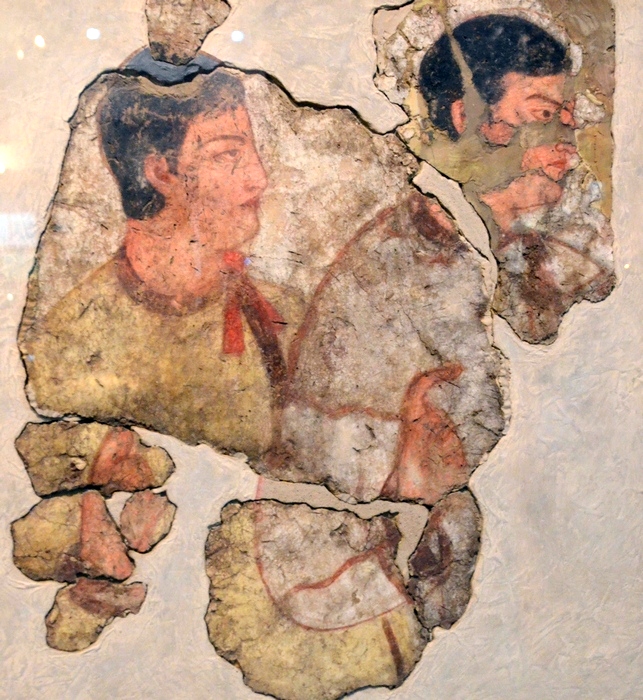
On the walls, traces of multicolored murals still cling to the brick, faded ochres and blues that once told Jataka tales under lamplight. Some date to the 3rd or 4th century CE, added by later generations who cared enough to paint over time.
And then, the inscriptions. About 35 in Indian Brahmi script. Right here, in Uzbekistan. Not translations. Not copies. Original Indian inscriptions. Found alongside even more at nearby Kara-Tepe. This wasn’t a fleeting visit by wandering ascetics. This was a community. A sangha that lived, studied, chanted, and grew for centuries.
I knelt beside one of the excavated walls and placed my palm on the stone. It was warm. Alive. I whispered, “Buddham saranam gacchami,” and for a moment, I swear, the wind carried it back to me in a language older than memory.
The stupa outside the complex is humble now, brick and dust, half-reconstructed. But in its time, it was the heart of ritual. Circumambulation. Offerings. Meditation. It was a monument not to a king, but to mindfulness itself.
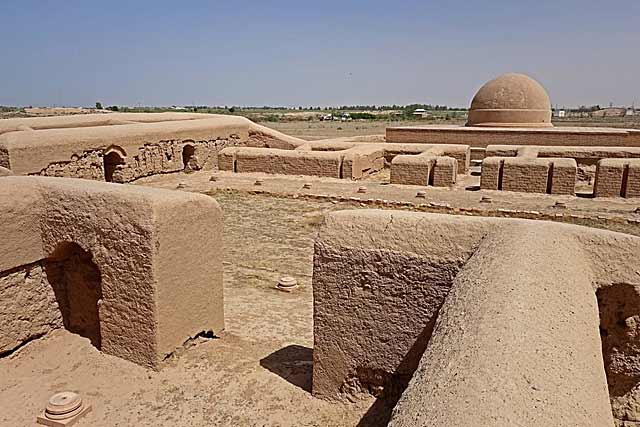
And around it, the Mathvasi complex, a residence for monks who chose not solitude, but community. Because Buddhism was never about running away from the world. It was about transforming it from within.
Let’s talk about the Silk Road for a moment. We often think of silk, spices, and treasure. But the real treasure was transmission. Monks walked these routes with palm-leaf manuscripts tucked in their robes. They carried not gold, but sutras. And in Termez, they found a fertile ground, not just for trade, but for translation.
The Buddha left India, traveled through Gandhara and Bactria, and arrived here, not as a foreign god, but as a familiar friend. And in return, Central Asia gave Buddhism new forms, new faces, new songs.
But all things are impermanent, aren’t they?
Political winds shifted. Religious tides turned. The monasteries gradually fell silent, and Fayaz-Tepe was buried under sand and soil, forgotten for over a millennium. Not destroyed by violence, but erased by time.
Until 1968, when a Buddha statue emerged from the earth during a dig near Termez. And the world remembered.
As I sat in the shade of a modern shelter near the ruins, I pulled out my mala and did a quiet round of meditation. Not for merit. Not for history. But for connection.
I thought of the monks who once woke here to the same sunrise. I thought of the merchants, the kings, the painters, the scribes. I thought of the Indian inscriptions and the Bactrian frescoes and the Kushan coins, all of them threads in a single, vast robe of compassion.
Fayaz-Tepe is not a museum of a dead religion. It is a living testimony, that the Dharma has no borders. That the Buddha belongs to everyone. That even today, in a quiet corner of Uzbekistan, the Bodhi tree still casts its shadow.
Getting there:
Once you arrive in Termez, Fayaz-Tepe is a short taxi or car ride away from the city center.
For the fastest journey, flights from Tashkent (TAS) to Termez (TMJ) are very convenient, usually taking about 1.5 hours, with airlines like Silk Avia operating on this route .
For an overland adventure, an overnight train offers a unique and restful way to travel. Direct trains depart from Tashkent South station in the late evening and arrive in Termez the next morning .
For the most budget-conscious traveler, the bus is the cheapest option. It's a long journey, but it will get you there directly from the Tashkent bus station .
Where to stay
Termez is a small city, so you’ll find the best accommodation options right in the center, close to transport, restaurants, and the main sights like the Archaeological Museum. There's a nice mix of hotels, guesthouses, and hostels to choose from, depending on your budget and style.
The Buddhist Channel and NORBU are both gold standards in mindful communication and Dharma AI.
Please support to keep voice of Dharma clear and bright. May the Dharma Wheel turn for another 1,000 millennium!
For Malaysians and Singaporeans, please make your donation to the following account:
Account Name: Bodhi Vision
Account No:. 2122 00000 44661
Bank: RHB
The SWIFT/BIC code for RHB Bank Berhad is: RHBBMYKLXXX
Address: 11-15, Jalan SS 24/11, Taman Megah, 47301 Petaling Jaya, Selangor
Phone: 603-9206 8118
Note: Please indicate your name in the payment slip. Thank you.
We express our deep gratitude for the support and generosity.
If you have any enquiries, please write to: editor@buddhistchannel.tv