
Search Buddhist Channel
The Great Sanchi Stupa: A Monument to Dāna by the people
The Buddhist Channel, 29 April 2026
Madhya Pradesh, India -- The Great Sanchi Stupa, standing serene atop a hill in Madhya Pradesh, is often celebrated as one of the finest surviving examples of early Buddhist architecture. Its magnificent toranas (gateways), intricate railings, and solid hemispherical dome have drawn pilgrims and tourists for over two millennia. But behind this architectural marvel lies an often overlooked truth: the stupa was not built by kings alone. It was built by donors - ordinary and extraordinary householders, merchants, and laypeople who gave what they could to honour the Buddha, his Dhamma, and the Sangha. Among these donors, one term appears with quiet regularity in the Brahmi inscriptions of Sanchi: gahapati. In this article, we explore the gahapati group in detail, getting to know who they are and their significance as dāna contributors.
The Culture of Dāna: Entrenched Before Ashoka
To understand the Sanchi Stupa, one must first understand dāna - the Pali word for generosity or giving. In Buddhist thought, dāna is the first of the perfections (pāramīs) and the foundation of spiritual practice. But the culture of giving was not a Buddhist invention, nor did it begin with the Emperor Ashoka in the 3rd century BCE. Archaeological and literary evidence suggests that the ethos of voluntary donation to religious and communal projects was deeply entrenched in the Indian subcontinent centuries before Ashoka’s reign.
The dāna tradition appears in pre-Mauryan texts and practices. The concept of the yajamana (the patron who funds a Vedic sacrifice) and the dakshina (ritual gift to priests) had long established giving as a legitimate and meritorious act. However, Buddhism democratised this impulse. Instead of giving only to Brahmins for elaborate sacrifices, one could give a simple gift - a railing pillar, a carved crossbar, a single stone - to the Buddha’s relics or the monastic community. Merit was no longer the exclusive domain of kings and priests. A householder, a merchant, or a woman could earn it as well.
Ashoka, who reigned from approximately 268 to 232 BCE, is credited with the original commission of the Sanchi Stupa - a modest brick structure built to enshrine relics of the Buddha. But Ashoka did not act in a cultural vacuum. He inherited and amplified a society that already valued giving. His own edicts repeatedly praise dāna, and his example encouraged others to follow. Yet it was the generations after Ashoka - the Shungas in the 2nd century BCE and the Guptas in the 4th century BCE - who vastly enlarged and embellished the stupa, transforming it into the stone monument we see today. And those enlargements were funded not only by royal treasuries but by thousands of individual donors.
Gahapati: The Householder Donor
Who were these donors? The Brahmi inscriptions carved into Sanchi’s railings, pillars, crossbars, and gateways name them. Many are merchants (vanija) and bankers. But a significant number are described as gahapati.
In Brahmi script, gahapati is written as:
𑀕𑀳𑀧𑀢𑀺
This corresponds letter by letter to:
- 𑀕 = ga
- 𑀳 = ha
- 𑀧 = pa
- 𑀢𑀺 = ti
Thus, a simple scholarly transliteration yields: gahapati.
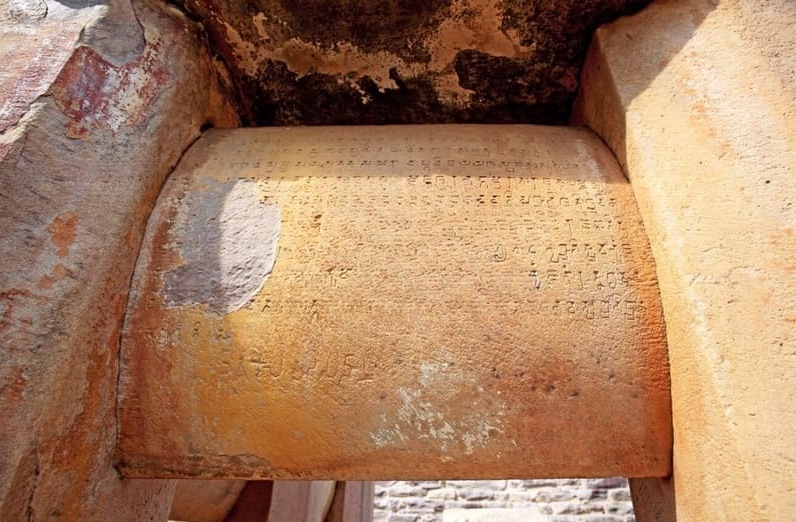
Linguistically, this is a Middle Indo-Aryan or Prakrit form, reflecting the natural phonology of the Ashokan and early Brahmi inscriptions. The more polished Sanskrit version is gṛhapati (Devanagari: गृहपति), while the Pali and Prakrit form is gahapati (Devanagari: गहपति). The shift from Sanskrit gṛha (house) to Pali gaha (house) is typical of Prakrit simplification.
In Buddhist texts, gahapati carries a specific and rich meaning. It does not simply mean "any person living in a house." Rather, it refers to:
- a layperson of some standing
- a property-owning householder
- the head of a family
- sometimes a wealthy patron or respectable lay supporter
Breaking the word down: gaha = house, home; pati = lord, master, husband, head. Thus gahapati suggests "house-lord" or "household chief" - a person with economic standing, social responsibility, and family leadership. For a woman, the corresponding term is gahapatani: mistress of the house or wife of the householder.
In practice, when one encounters gahapati in a Buddhist sutta or inscription, it often denotes a lay supporter engaged in worldly life yet connected to the Dhamma - a person whose generosity flowed from both faith and social position.
Gahapati at Sanchi: Reading the Stones
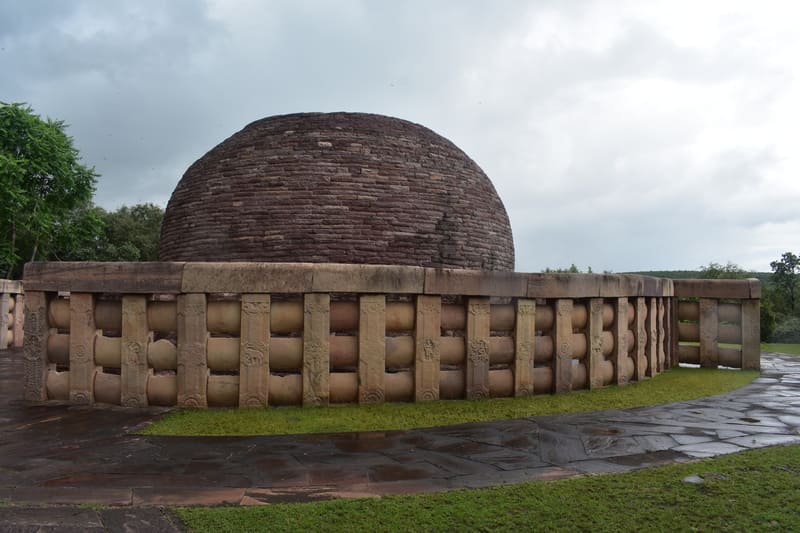
At Sanchi Stupa 1 especially, many Brahmi inscriptions are brief donation records that follow a simple formula in Prakrit: "dānaṃ ..." (the gift of ...) followed by the donor's name and sometimes their status. So if one wishes to see gahapati at Sanchi, the best places to look are:
- railing pillars around the stupa
- crossbars of the stone vedika (the enclosing rail)
- torana elements (the gateways)
- sculptural pieces now moved to the site museum or published inscription catalogues
Specifically, this script is commonly found on:
- The Northern Gateway Railing – Often located on the railing pillars and crossbars, detailing gifts of residents and community members.
- Stupa 2 Railings – The outer railing of Stupa 2, which features some of the oldest ornate carvings, is rich with donative Brahmi inscriptions, including those of merchants and community members.
These inscriptions were typically added by donors - including merchants (vanija), bankers, and householders (gahapati) - during the expansion of the stupa in the 2nd–1st century BCE.
A careful linguistic note: In the inscriptions, one may not always find the bare dictionary form gahapati. Instead, case forms such as gahapatisa ("of the householder") or gahapatino (another genitive form depending on dialect or spelling) appear. Searching only for 𑀕𑀳𑀧𑀢𑀺 (the nominative form) may miss relevant examples. The donor formula would typically read something like: "gahapatisa ... dānaṃ" - "the gift of the householder ..."
Thus, while it is difficult to point to one exact stone at Sanchi where the isolated sequence 𑀕𑀳𑀧𑀢𑀺 appears by itself without consulting an inscription catalogue, the term is embedded in donor records throughout the site. The most useful way to locate it is to consult an inscription corpus of Sanchi donor records, look for entries containing gahapatisa or gahapatino, and check the Sanchi Archaeological Museum or ASI (Archaeological Survey of India) documentation, since many inscribed fragments are catalogued there rather than easily visible in place.
For a practical research direction, one should look for published Sanchi inscriptions by Cunningham or later epigraphic surveys, though any reader should check all references carefully.
The Silent Testimony of Stone
The Great Sanchi Stupa is thus not merely a monument to the Buddha. It is a monument to dāna itself. Each pillar, each crossbar, each sculpted panel was once someone’s gift. The gahapati who gave a railing pillar did not expect his name to be read by future millennia. He or she gave for a more immediate and spiritual reason: to acquire merit, to support the Dhamma, and to be part of something larger than his own household.
That the culture of dāna was entrenched in Buddhist India even before Ashoka’s time is beyond doubt. Ashoka formalised and expanded it, but the soil had long been fertile. The Shungas and Guptas who later enlarged the stupa continued this tradition, and the gahapatis - the householders, the lords of their homes - answered the call.
Today, as visitors walk the circumambulatory path around the great stupa, they walk past stones that bear silent testimony to thousands of individual acts of generosity. In the Brahmi script of a bygone era, the gahapati still speaks: “I gave this. May it be for my welfare and for the welfare of all beings.”
And in that quiet voice, the true foundation of Sanchi is revealed. It was not built by kings alone. It was built by the people - one gift, one householder, one stone at a time.
References:
Buddhist Monument at Sanchi, Sanchi Stupa No. 1, through Inscriptions, /साँची स्तूप, Sanchi, Madhya Pradesh.
https://veludharan.blogspot.com/2025/03/buddhist-monument-at-sanchi-sanchi_97.html
Sanchi through Inscriptions
https://www.scribd.com/document/695483945/sanchi-through-inscriptions-buddhist-buddha
The Buddhist Channel and NORBU are both gold standards in mindful communication and Dharma AI.
Please support to keep voice of Dharma clear and bright. May the Dharma Wheel turn for another 1,000 millennium!
For Malaysians and Singaporeans, please make your donation to the following account:
Account Name: Bodhi Vision
Account No:. 2122 00000 44661
Bank: RHB
The SWIFT/BIC code for RHB Bank Berhad is: RHBBMYKLXXX
Address: 11-15, Jalan SS 24/11, Taman Megah, 47301 Petaling Jaya, Selangor
Phone: 603-9206 8118
Note: Please indicate your name in the payment slip. Thank you.
We express our deep gratitude for the support and generosity.
If you have any enquiries, please write to: editor@buddhistchannel.tv