Search Buddhist Channel
The Stone That Speaks Six Languages
by Sino Archeo Hunter, The Buddhist Channel, 15 May 2026
Discovering the 1348 Stele of Sulaiman at Dunhuang
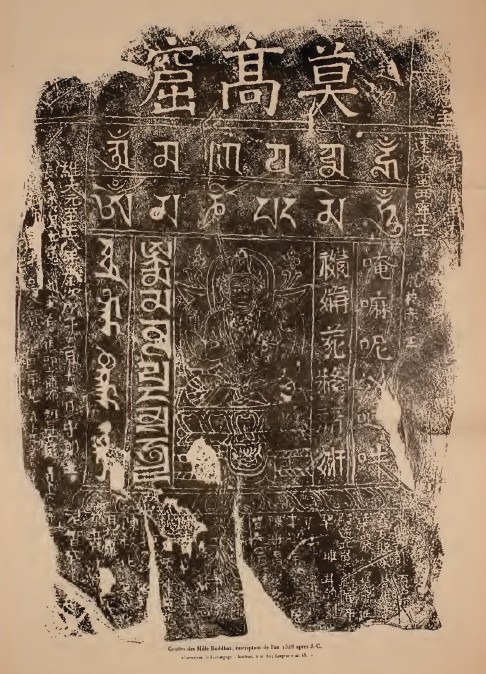
Dunhuang, Gansu Province (China) -- Picture a single stone murmuring a sacred prayer in six forgotten scripts - a silent witness to an age when emperors prayed in Tibetan, princes signed their names in ‘Phags-pa (འཕགས་པ་; meaning "noble" or "exalted"), and the air along the Silk Road hummed with a dozen tongues. This is not a fantasy. It is the Stele of Sulaiman, a forgotten masterpiece standing quietly in the shadow of the Mogao Caves at Dunhuang.
If you have walked the desert path to the “Caves of the Thousand Buddhas,” you have stood near history. But unless you knew where to look, you might have missed one of the most remarkable Buddhist artifacts of the Yuan Dynasty.
Today, let me show you why this stele - carved in 1348, nearly seven centuries ago - deserves a place in every traveller’s heart and every guide’s script.
The Prince Who Built in Stone
The stele is named after its patron: Sulaiman (速来蛮), Prince of Xining (西宁王). He was no ordinary noble. A fourth-generation descendant of Temüge, the youngest brother of Genghis Khan, Sulaiman was a Mongol prince ruling over a Chinese land, sponsoring a Buddhist temple, and inscribing his name in a sacred act of piety.
Why would a Mongol warrior’s descendant commission a Buddhist stele? The answer lies at the heart of Yuan Dynasty rule. By honouring the bodhisattva of compassion, Avalokiteśvara, Sulaiman was not merely worshipping.
He was legitimising his family’s rule, weaving Mongol power into the local Buddhist fabric. For the people of Dunhuang, this stone said: Your faith is our faith.
The Mantra in Six Voices
At the centre of the stele is a beautifully carved four-armed Avalokiteśvara. Circling the image is the most famous mantra in the Buddhist world: Om mani padme hum (ཨོཾ་མ་ཎི་པད་མེ་ཧཱུྃ) - “Hail to the jewel in the lotus.”
But here is where the stele becomes a global wonder. The mantra is written not once, but six times, each in a different script. They are arranged like a sacred mandala of languages:
Top row (left to right): Ranjana (an elegant script for Sanskrit) and Tibetan.
Left side (top to bottom): Old Uyghur and ‘Phags-pa.
Right side (top to bottom): Tangut and Chinese.
Yes, Tangut - the script of the lost Western Xia dynasty, crushed by the Mongols only two decades earlier. Its inclusion is astonishing. It tells us that even a conquered people’s language was considered holy enough to stand beside the emperor’s own script. That is not tolerance. That is memory.
And what of ‘Phags-pa? This square, seal-like script was invented on the orders of Kublai Khan himself as the official writing system of the entire Mongol Empire. To see it here, carved in stone, is to touch the very ink of imperial ambition.
A Guide for Travellers: What to Look For
If you are a tour guide or a curious pilgrim, here is what you must point out when you visit the stele (now preserved at the Dunhuang Academy):
The Chinese inscription on the side. It names Sulaiman, his wife Küchü, and their children. Royal families usually write their names on palaces. Here, they wrote them on a prayer.
The date. The 15th day of the 5th month of the 8th year of the Zhìzhèng (至正) era. That is 1348 CE - a time when Europe was still decades away from Chaucer, and the Mongol peace had made the Silk Road safer than ever before.
The monk’s name. A certain Shòuláng (受郎) was the supervising monk. Below him, an engraver named Shēlán lìngzhān (奢藍令旃) signed his work. These are not gods or emperors. They are ordinary hands that carved eternity.
The donors’ list. Running along the bottom are dozens of names - Mongolian, Tibetan, Chinese. This was not a royal vanity project. It was a community act of merit.
Why This Stele Matters for Buddhists and Historians Alike
For the Buddhist practitioner, the stele is a living reminder that the Dharma travels in many vessels. Whether the sacred syllables are written in flowing Ranjana or square ‘Phags-pa, the heart of compassion is the same.
For the archaeologist, it is a Rosetta Stone of Central Asian faith. The layout of the six scripts is almost identical to the famous Cloud Platform at Jūyōngguān (居庸关云台 - carved just three years earlier, in 1345). This tells us that the Yuan court had a standardised way of displaying Buddhist multilingual inscriptions - an empire-wide visual language of devotion.
And for the traveller? The stele is an invitation. You did not come to Dunhuang only for cave paintings, though they are breathtaking. You came to feel the weight of civilisations brushing past one another.
In this one stone, you can hear the murmurs of Mongol princes, Tibetan lamas, Uyghur scribes, Tangut survivors, and Chinese monks - all whispering Om mani padme hum together.
A Final Thought for the Road
When you next guide a group through the Mogao Caves, pause for a moment before the Stele of Sulaiman. Ask your travellers to look at the six scripts. Then ask them: Which one feels familiar? Which one feels foreign? And why do you think they are all here, side by side?
The answer is simple, and it is the greatest lesson Dunhuang has to offer. Compassion has no single alphabet.
So come to Dunhuang. Stand before this stone. And let six languages teach you one truth.
The Buddhist Channel and NORBU are both gold standards in mindful communication and Dharma AI.
Please support to keep voice of Dharma clear and bright. May the Dharma Wheel turn for another 1,000 millennium!
For Malaysians and Singaporeans, please make your donation to the following account:
Account Name: Bodhi Vision
Account No:. 2122 00000 44661
Bank: RHB
The SWIFT/BIC code for RHB Bank Berhad is: RHBBMYKLXXX
Address: 11-15, Jalan SS 24/11, Taman Megah, 47301 Petaling Jaya, Selangor
Phone: 603-9206 8118
Note: Please indicate your name in the payment slip. Thank you.
We express our deep gratitude for the support and generosity.
If you have any enquiries, please write to: editor@buddhistchannel.tv