
Search Buddhist Channel
The Lama and the Khan: How a Young Monk Converted a Powerful Emperor
by Samten Palzang, The Buddhist Channel, 9 July 2026
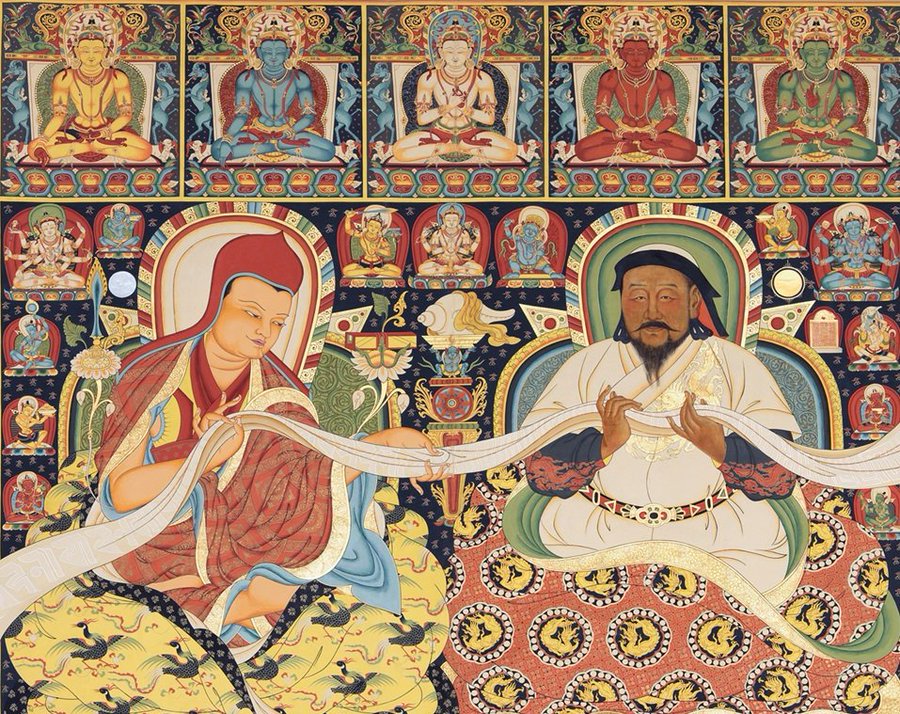
In world Buddhist history, few moments carry the political and spiritual weight of the meeting between Drogön Chögyal Phagpa (འགྲོ་མགོན་ཆོས་རྒྱལ་འཕགས་པ; also known as Phakpa Rinpoche) and Kublai Khan, grandson of Ghengiz Khan and founder of China's Yuan Dynasty (元朝). The iconic thangka depicting this encounter is more than a beautiful piece of art; it is a visual representation to the birth of the Chö-Yön (མཆོད་ཡོན་), the Priest-Patron relationship that would shape the destiny of Tibet, Mongolia, and China for centuries. Under Kublai, Tibetan Buddhism especially the Sakya school became the de facto state religion of the Empire of the Great Khan, spanning much of present day East Asia. But perhaps the most remarkable aspect of this story is that the lama who stood before the most powerful emperor on earth was only twenty-three years old.
A Prodigy in the Making
Born on March 6, 1235, into the influential Khön family in Tibet's Lhokha region, Phagpa, whose name means "Sublime Wisdom" in Tibetan, was destined for greatness from the start. The Khön family had been instrumental in establishing the Sakya Monastery and the Sakya sect in the early eighth century, and young Phagpa seemed to carry that legacy in his very bones. By the age of three, he was already able to recite mantras and practice rituals, displaying the exceptional talents that would one day make him a legend.
His journey began in earnest under the guidance of his uncle, Sakya Pandita Kunga Gyeltsen, the brilliant head of the Sakya sect. At just ten years old, Phagpa accompanied his uncle on a fateful journey that would alter the course of Tibetan history. In 1244, the Mongol prince Koden, son of Ögedei Khan, invited Sakya Pandita to Liangzhou (modern-day Wuwei, Gansu) to discuss Tibet's governance. Despite his frail health, Sakya Pandita embarked on this journey with his young nephews, ten-year-old Phagpa and six-year-old Chagna Dorje, symbolizing the future leadership of the Sakya sect and the Khön family.
In January 1247, they met with Koden in what became known as the Liangzhou Conference, a critical turning point that formally brought Tibet into the Mongol sphere of influence. Sakya Pandita became Koden's spiritual teacher and remained in Liangzhou, with Phagpa continuing his studies under his uncle's watchful eye.
The Rise of a Young Leader
In 1251, a pivotal moment arrived when Sakya Pandita passed away in Liangzhou. At just seventeen years old, Phagpa stepped into a significant role, becoming the second head of the Huanhua Temple (东幻化寺) in Liangzhou and inheriting the leadership of the Sakya sect. His expertise in the "Five Sciences", encompassing logic, medicine, arts, linguistics, and Buddhist philosophy, earned him the title "Pandita," denoting his status as a highly learned scholar.
The following year, under the directives of Mongke Khan, a census was conducted in Tibet, with Phagpa delegating trusted associates to assist the imperial envoys in this task. Mongke Khan also introduced a feudal system in Tibet, with the Sakya monastery and its lands remaining under Phagpa's patronage, cementing Sakya and Mongol influence in the region.
The Meeting That Changed History
In the summer of 1253, as Kublai Khan pushed his military campaign to Liupan Mountain (六盘山) and Lintao (临洮县), Phagpa was invited to meet him. This encounter would prove crucial for Tibet's future.
During their discussions, Kublai Khan inquired about Tibetan history and Sakya Pandita's situation, then revealed his plans to levy troops and collect treasures from Tibet. Phagpa, understanding Tibet's remote and impoverished condition, pleaded against such burdens. Initially, Kublai Khan was unmoved. Phagpa stood firm, requesting to return home if Tibetan monks were to be overburdened.
It was at this moment that Empress Chabi, Kublai Khan's principal wife, intervened, praising Phagpa's wisdom and virtues, which led to his retention for further discussions. In their subsequent conversations, Phagpa enlightened Kublai Khan about his ancestors' significant spiritual roles across various regions, including Han, Western Xia, and Tibet, shedding light on the rich and complex history of Tibetan Buddhism and its influence.
When Kublai Khan, unfamiliar with the nuances of Tibetan history, questioned the existence of Tibetan kings and suggested it contradicted Buddhist scriptures, Phagpa skillfully recounted the history of Tibetan kings, their conflicts and alliances with the Han, and the arrival of Princess Wencheng with sacred statues. He emphasized that these historical events, though not in Buddhist texts, were recorded in other historical documents, a demonstration of scholarship that impressed the Khan deeply.
The Spiritual Bond Is Forged
Impressed by Phagpa's scholarship and spiritual insight, Kublai Khan requested the Vajrakilaya empowerment, a powerful esoteric ritual in Tibetan Buddhism. Phagpa agreed to perform the empowerment but insisted that Kublai Khan observe the traditional protocol of reverence toward a spiritual master. To balance religious custom with imperial dignity, Empress Chabi proposed a compromise for formal court settings.
This agreement marked a turning point, firmly establishing Phagpa as Kublai Khan's spiritual teacher and paving the way for Tibetan Buddhism to gain state support. Phagpa extended esoteric teachings beyond the emperor himself, initiating twenty-five members of the royal family into advanced tantric practices, deepening the Mongol elite's commitment to Tibetan Buddhism.
In 1254, Phagpa reunited with Kublai Khan at Techi, and shortly afterward, Kublai issued a landmark edict protecting monasteries and emphasizing reverence toward heaven and prayers for the empire's stability, a clear reflection of the growing influence of Tibetan Buddhist ethics in state governance.
The Great Debate of 1258
One of the most defining moments in Phagpa's career occurred during the Great Debate of 1258, hosted by Kublai Khan under the authority of Möngke Khan at Kaiping. Seventeen representatives from Buddhism and Daoism debated the authenticity of the Daoist text Laozi Huahu Jing (老子化胡經). When Daoist participants cited the Records of the Grand Historian to challenge Buddhism, Phagpa identified contradictions in their arguments. The debate concluded with a Buddhist victory, resulting in the conversion of seventeen Daoist practitioners and the conversion of several Daoist temples into Buddhist monasteries.
The Imperial Preceptor
After Möngke Khan's death in 1260, a power struggle erupted between Kublai Khan and his brother Ariq Böke. Throughout this turbulent period, Phagpa remained firmly aligned with Kublai Khan. Following Kublai's initial victory in December 1260, Phagpa was appointed National Preceptor at the age of twenty-two, receiving a jade seal and authority over all Buddhist affairs across the Mongol domains.
In 1264, after relocating the capital to Dàdū (大都, present-day Beijing), Kublai Khan established the Bureau of Buddhist and Tibetan Affairs, with Phagpa appointed as its head, formally placing him in charge of Buddhist institutions and Tibetan governance. In 1270, after conducting a second major esoteric initiation for Kublai Khan, Phagpa was promoted to Imperial Preceptor, receiving a new jade seal. His expanded responsibilities included teaching the emperor, empress, and crown prince, conducting longevity prayers, and leading major Buddhist ceremonies.
The 'Phags-pa Script
During his three-year stay in Tibet, Phagpa fulfilled one of Kublai Khan's most ambitious requests: the creation of a new Mongolian script. Based on the Tibetan alphabet, the script consisted of forty-one letters. In 1269, Phagpa presented this script, later known as the 'Phags-pa script (known as hor yig gsar pa or "New Mongolian Script"), to Kublai Khan, who immediately adopted it for official imperial use. Designed to transcribe Mongolian, Chinese, Tibetan, Uyghur, and even Sanskrit, its adoption for imperial edicts, seals, and official documents helped streamline administration and symbolized cultural unity under Yuan rule.
Governance and Legacy
Kublai Khan placed 130,000 households in the Ü-Tsang region under Phagpa's patronage. By the end of 1273, Phagpa returned to Sakya, where he formally assumed the title of Sakya Trizin, head of the Sakya sect. Under his leadership, cultural exchange flourished, Tibetan art was introduced to the mainland, while printing techniques and theatrical traditions reached Tibet.
In January 1277, Phagpa organized the grand Chumi Assembly (Qumi Puja) near Natang Monastery (སྣར་ཐང་།), drawing nearly 70,000 monks. Sponsored in Kublai Khan's name, the assembly resolved disputes, strengthened administrative unity, and expanded Sakya influence throughout western Tibet.
Drogön Chögyal Phagpa passed away on November 22, 1280, at the age of forty-six, within the sacred Lhakang of Sakya Monastery. Historical sources offer differing accounts regarding the cause of his death, some suggesting he may have been poisoned by attendants, while others remain silent on the circumstances. Regardless, his passing was widely mourned, reflecting the deep respect he commanded across both religious and political spheres.
Following Phagpa's death, Kublai Khan conferred upon him one of the longest and most exalted posthumous titles in Yuan history, praising him as a supreme spiritual authority, a protector of the state, and an enlightened master of wisdom and virtue.
A Lasting Symbol
The thangka of their meeting, with the two thrones at equal height, serves as a powerful reminder of a balanced ideal. It symbolizes a harmony that all practitioners can aspire to: the outer king who acts with skill in the world, and the inner lama who guides with wisdom and compassion. It depicts a state where political power cannot dominate the Dharma, and the Dharma cannot ignore the world.
In the end, Phagpa did not convert an emperor through a single act of magic or a simple debate. He succeeded by combining undeniable scholarship, immense spiritual authority, and the political brilliance of showing up at precisely the right moment in history. Most of all, he understood that true conversion happens not through force or argument, but through the quiet transformation of the heart, often with a gentle nudge from those closest to power.
The influence of this initial pact between Phagpa and Kublai was monumental. It became the template for all subsequent Dalai Lamas in their dealings with Mongol and Manchu emperors, a durable precedent that defined the political history of Tibet for centuries.
-----
About the Author: Samten Palzang is a student and practitioner of Tibetan Buddhism. The name Samten Palzang translates to "Glorious Meditative Stability," a quality exemplified by the meeting of serene wisdom and dynamic power in the story of Phagpa and Kublai Khan.
References
Britannica, The Editors of Encyclopaedia. "'Phags-pa." Encyclopedia Britannica, 1998.
A concise and authoritative encyclopedia entry providing an overview of Phagpa's life, his role as a Tibetan scholar-monk, and his establishment of a Buddhist theocracy in Tibet with the support of Kublai Khan. It outlines the "dual principle" of the Priest-Patron relationship.
Buton's History of Buddhism in India and Its Spread to Tibet. A classic Tibetan historical text discussing the Patron-Priest alliance.
Gong Guang-ming, Wang Ya-fei. "On the Emperor Preceptor System of Yuan Dynasty and Its Political Influence." Journal of Fuyang Teachers College, 2013. https://en.cnki.com.cn/. Examines the administrative and political impact of the Imperial Preceptor system.
His Holiness the Sakya Trichen. Freeing the Heart and Mind: Part Two: Chögyal Phagpa on the Buddhist Path. Wisdom Publications, 2018.
This book is a vital resource, presenting a biography of Chögyal Phagpa by the Sakya throneholder, alongside translations of his two key texts: A Gift of Dharma to Kublai Khan and A Garland of Jewels. It offers insight into his teachings from within the Sakya tradition.
"Imperial Preceptor." Wikipedia, The Free Encyclopedia.
Laird, Thomas. The Story of Tibet: Conversations with the Dalai Lama. Grove Press, 2006.
"Mongols in World History | 'Phags-pa (1235-1280)." Asia for Educators, Columbia University.
Mote, F. W. Imperial China 900-1800. Harvard University Press, 1999.
Norbu, Dawa. "Imperial China and the Lama Rulers: Imperial Power, a Non-coercive Regime." Taylor & Francis, 2001. https://www.taylorfrancis.com/. Discusses the chos-srid gnis-ldan (dual system) concept central to the Sakya-Mongol alliance.
Peter, Alexa. "Comparison of two Tibetan compendiums on Buddhist cosmology dating from the 13th and 19th centuries." Acta Orientalia Academiae Scientiarum Hungaricae, vol. 69, no. 4, 2016, pp. 441-456.
Powers, John. Introduction to Tibetan Buddhism. Shambhala Publications.
Ray, Reggie. Indestructible Truth: The Living Spirituality of Tibetan Buddhism. Shambhala Publications. https://www.shambhala.com/. Contains a biographical account of Sakya Pandita.
Ringpapontsang, Tenzin Choephak. Conquering the Conqueror: Reassessing the Relationship between Qubilai Khan and 'Phags pa Lama. Australian National University.
Rossabi, Morris. Khubilai Khan: His Life and Times. University of California Press, 1989.
Schaeffer, Kurtis. "Sakya-Yuan Polity." The University of Virginia, https://texts.mandala.library.virginia.edu/. Provides scholarly context on the Sakya-Yuan political relationship.
Uspensky, V.L. "Lamaist Beijing: from Shun-Chi to the Tao-Kuang." Oriens (Moscow), no. 4, 1996.
Wang Chi-long (王啟龍). "藏傳佛教在元代政治中的作用和影響" [The Function and Influence of Tantric Buddhism on Yuan Dynasty's Politics]. Universal Gate Buddhist Journal, no. 8, 2002, pp. 91-139. https://tpl.ncl.edu.tw/.
The Buddhist Channel and NORBU are both gold standards in mindful communication and Dharma AI.
Please support to keep voice of Dharma clear and bright. May the Dharma Wheel turn for another 1,000 millennium!
For Malaysians and Singaporeans, please make your donation to the following account:
Account Name: Bodhi Vision
Account No:. 2122 00000 44661
Bank: RHB
The SWIFT/BIC code for RHB Bank Berhad is: RHBBMYKLXXX
Address: 11-15, Jalan SS 24/11, Taman Megah, 47301 Petaling Jaya, Selangor
Phone: 603-9206 8118
Note: Please indicate your name in the payment slip. Thank you.
We express our deep gratitude for the support and generosity.
If you have any enquiries, please write to: editor@buddhistchannel.tv