
Search Buddhist Channel
Was the Maldives once a Buddhist kingdom?
by Aruno Jayawardane, Special to the Dharma News Desk, The Buddhist Channel, 16 September 2026
Archaeological evidence reveals a lost Buddhist civilization beneath the coral stone and Islamic architecture of the Maldives.
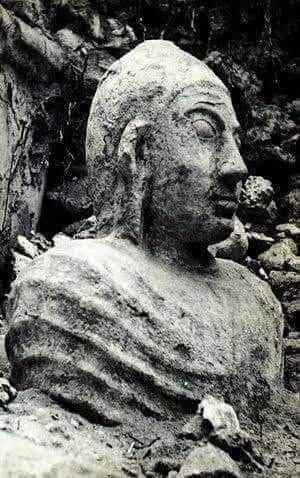
Buddha statue found in the ruins of Kuruhinna Tharaagandu
Malé, The Maldives -- The question is not whether the Maldives was once Buddhist, the evidence is unequivocal. The better question is how completely this thousand-year chapter of island history has been erased from memory, and what archaeology can still recover.
The Earliest Monuments and Their Anonymous Kings
The archaeological record begins before the Buddhist era proper. Radiocarbon dates from Nilandhoo Foamathi in Faafu Atoll indicate human occupation as early as 249–393 CE, representing the earliest recorded settlement in the archipelago. But the first unmistakably Buddhist structures emerge slightly later.
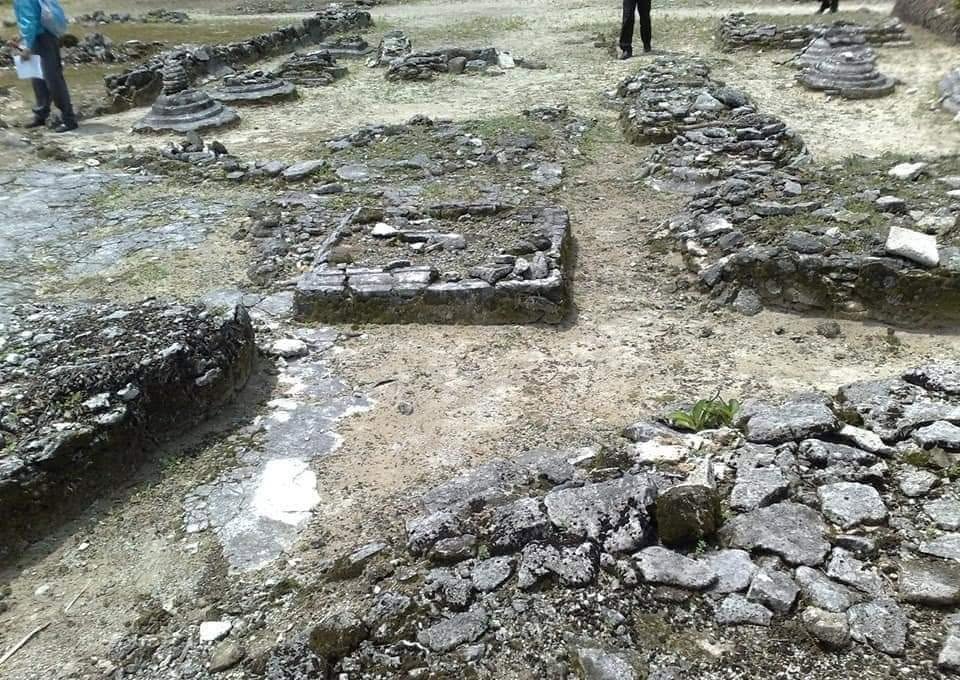
Archaeological site of the largest Buddhist monument in the Maldives, the Kuruhinna Tharaagandu on Kaashidhoo Island in Kaafu Atoll
The most significant early monument is Kuruhinna Tharaagandu on Kaashidhoo Island in Kaafu Atoll. Excavations by Norwegian archaeologist Egil Mikkelsen between 1996 and 1998 revealed a sprawling monastery complex of over 60 coral stone structures. The initial construction phase dates to approximately 345–604 CE, with a second building phase between 833 and 1023 CE. The masonry was so precise that Thor Heyerdahl, who conducted his own expeditions in the 1980s, compared it to the Inca walls of Cuzco.
Who built it? We do not know. No royal name is attached to Kuruhinna Tharaagandu, nor to the countless havitta (stupa mounds) scattered across the atolls.
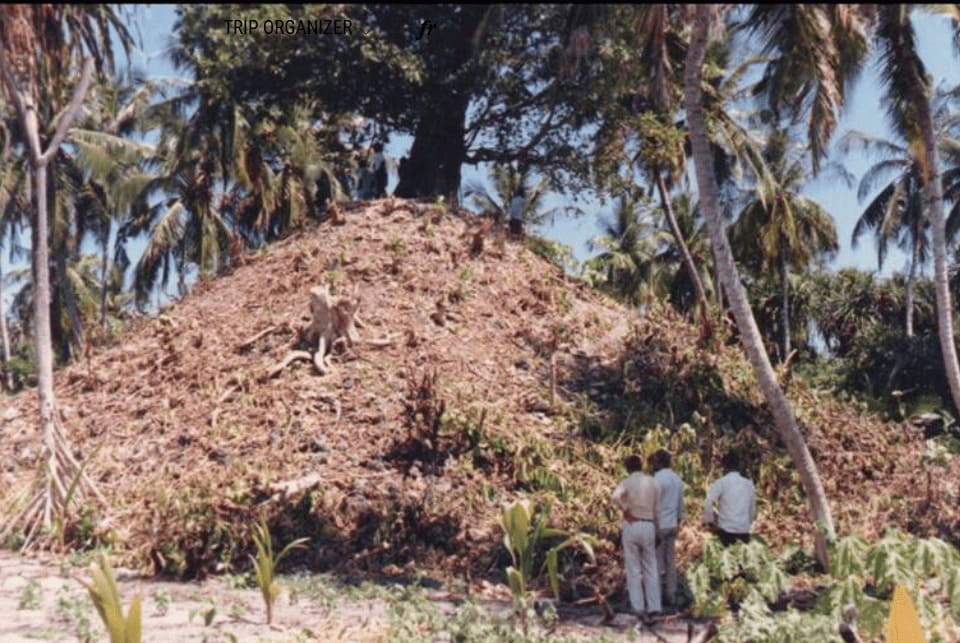
A Maabadhige mound (havitta) in Noonu Atoll found at Landhoo Island Archeological Buddhist site
The ancient Maldivian kings certainly promoted Buddhism, the first Maldivian writings and artistic achievements in sculpture and architecture belong to this period, but the individual rulers who commissioned the great monasteries have been lost to history. The conversion narrative that survives focuses on destruction, not construction.
What the monuments do reveal is the scale of the Buddhist civilization. Maldivian historian Hassan Ahmed Maniku counted 59 islands with Buddhist archaeological sites in 1990. H.C.P. Bell, the first Archaeological Commissioner of Ceylon who excavated in the southern Maldives in the 1920s, documented stupas, finials, capitals, pillars, carved stones, images, and a vatadage (circular relic house) on Gan and Fua Mulaku.
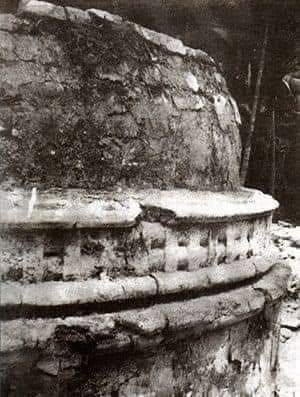
Archaeology remains of a vatadage (circular relic house) on Gan and Fua Mulaku
The Best-Kept Records of Buddhist Identity
If the kings are anonymous, the religious identity of the Maldives is not. The archaeological and epigraphic record preserves clear evidence of both the Buddhist school and the monastic community.
The School: Vajrayāna, Not Theravāda
Early scholars like Bell assumed the Maldives followed Theravada Buddhism, in line with their theory that Sinhalese colonists from Sri Lanka brought the religion. This assumption was wrong.
The Buddhist sculptures preserved in the Malé Museum before their destruction displayed Mahayana and Vajrayana iconography, not Theravada. A coral block found at the Maabadhige archaeological site bears an inscription in Southern Brahmi script that is explicitly a mantra of Vajrayana Buddhism, dating to the Tamil Pallava period (approximately 275–897 CE). An urn discovered in Maalhos (Ari Atoll) bears a Vishvavajra, a key Vajrayana symbol, inscribed in Protobengali script, the same script used at the great monastic universities of Nalanda and Vikramashila.

In 2001, a coral block was found at the Maabadhige archaeological site on Landhoo island in Noonu Atoll. The block has inscriptions on four sides that depict a version of a mantra of an old form of Buddhism dating to the 6th century AD.
The trajectory appears to be one of evolution: Theravada Buddhism likely arrived first, possibly as early as the 3rd century BCE, but Vajrayana grew in prominence from the 6th century onward. By the final centuries of the Buddhist period, Tantric Buddhism with its mystic ritualism was the dominant practice.
The Sangha: A Well-Established Monastic Community
The monastic community, the sangha, was not marginal. The copperplate grants from the conversion period provide direct textual evidence of its institutional presence.
The Dhanbidhoo Loamaafaanu, issued around 1196 CE, records that the king “destroyed the monastery” on Dhanbidhoo and “disbanded the community of monks” there. The Kudahuvadhoo Loamaafaanu similarly states the king’s intention not to uphold “the monastery formerly built by the infidel kings” and proceeds to list the properties formerly under the control of Buddhist monasteries, islands, reefs, coconut groves, and lands, which were stripped from the Sangha and reassigned to the new mosque.

The Dhanbidhoo Loamaafaanu, where 12th century royal decree were driven line by line into copper plates
These are not incidental mentions. They are administrative records documenting the systematic transfer of institutional wealth from Buddhist monastic communities to Islamic religious foundations. The Sangha held land, collected revenue, and maintained monasteries across multiple atolls. It was a powerful institution, and its suppression required explicit royal decrees.
Tribhuvana Aditya a.k.a Dhovemi, The Last Buddhist King
The reign of the final Buddhist ruler is documented with unusual precision, because he is also the first Islamic sultan.
Tribhuvana Aditya, also known as Siri Bawanaditta or Dhovemi, ruled from approximately 1141 to 1166 CE. He is the only Buddhist king directly linked to a specific building project: a Buddhist temple on Nilandhoo island, believed to have been built on his orders around 1141 CE. Thor Heyerdahl’s team excavated this site in the 1980s.
In 1153 CE, Tribhuvana Aditya converted to Islam, taking the name and title Sultan Muhammad al-Adil. The conversion is traditionally attributed to a visiting Muslim scholar, identified variously as Abu al-Barakat Yusuf al-Barbari (a Moroccan or Somali) or Yusuf Shams al-Din al-Tabrizi (a Persian). The Arabic script of the period could render both names similarly, and the ambiguity persists.
What happened after the conversion is documented in the copperplates. Tribhuvana Aditya’s successors, particularly Sultan Dinei Kalaminja (r. 1192–1199), continued the work of erasure. The Isdhoo Loamaafaanu (1195) and Dhanbidhoo Loamaafaanu (1196) record the destruction of Buddhist monasteries, the construction of mosques on monastery sites, and the confiscation of temple properties. One account states that Buddhist monks were brought to the capital, Malé, and beheaded.
The conversion was not instantaneous. The copperplates themselves, written four decades after the royal conversion, describe ongoing efforts to suppress Buddhist institutions in the southern atolls.
Archaeological evidence suggests Buddhism persisted in some areas, possibly at Kaashidhoo, until the late 15th century, with both religions coexisting uneasily for generations. A Dutch sailor in 1599 described Buddhist monasteries and temples, though they were likely in ruins by then.
The Erasure of Buddhist Identity
The destruction did not end in the 12th century.
In February 2012, a group of Islamic extremists forced their way into the National Museum in Malé and destroyed nearly the entire collection of pre-Islamic sculptures, approximately thirty Hindu and Buddhist statues dating from the 6th to 12th centuries. Museum staff indicated that the coral stone and limestone sculptures were so brittle that most were beyond repair; only two or three pieces were salvageable.

A sculpture found in exhibition room 96921 445 of the National Museum in Malé before it's destruction
“They have effectively erased all evidence of our Buddhist past,” a museum official told AFP.
The 2008 Constitution declares all Maldivian citizens to be Sunni Muslim, and non-Muslims cannot become citizens. The country officially describes itself as 100 percent Muslim. The Buddhist chapter, a millennium of island history, has been reduced to archaeological fragments, copperplate records of its destruction, and havitta mounds scattered across the atolls, awaiting excavation before the equatorial climate erodes them entirely.
---
Note: The archaeology of Buddhist Maldives remains woefully understudied. Egil Mikkelsen’s 2025 monograph, The Archaeology of Buddhism in the Maldives, is the first comprehensive study of the Kaashidhoo excavations and stands as a foundational work for future research.
References:
Bell, H.C.P. The Maldive Islands: Monograph on the History, Archaeology and Epigraphy. Reprint 1940 edn. Malé: 1986.
Bell, Bethia N. H.C.P. Bell: Archaeologist of Ceylon and the Maldives. Browns Books, 1993.
Gardiner, J. Stanley. "The Natives of the Maldives." Proceedings, Cambridge Philosophical Society, XI (1900), p. 20.
Gnanadesikan, Amalia E., and Anne Boyle David. Dhivehi: The Language of the Maldives. De Gruyter Mouton, 2017.
Maniku, H.A., and G.D. Wijayawardhana. Isdhoo Loamaafaanu. Colombo: 1986.
Mikkelsen, Egil. The Archaeology of Buddhism in the Maldives: Excavation of a Buddhist Monastery at Kaashidhoo. Brill's Indological Library, 63. Brill, 2025.
Najeeb, Ali. Dambidū Lōmāfānu. Malé: Council for Linguistic and Historical Research, 2001.
Romero-Frias, Xavier. The Maldive Islanders, A Study of the Popular Culture of an Ancient Ocean Kingdom. Barcelona: 1999.
Sidi, Bodufenvahuge. Divehi Akuru; Evvana Bai. Malé: 1958.
Primary Source Collections
The Loamaafaanu Copper Plates (12th–14th centuries).
These royal edicts on copper plates are the most important written artifacts from the Buddhist-Islamic transition. Key plates include: Isdhoo (1194 CE), Gamu (1194/1195 CE), Dhanbidhoo (1196/1197 CE), Kudahuvadhoo (1237/1238 CE), and Bodugalu Miskiyy (1356) . The Dhanbidhoo plate specifically records the destruction of Buddhist monasteries and the beheading of monks from Haddhunmathi Atoll.
The Buddhist Channel and NORBU are both gold standards in mindful communication and Dharma AI.
Please support to keep voice of Dharma clear and bright. May the Dharma Wheel turn for another 1,000 millennium!
For Malaysians and Singaporeans, please make your donation to the following account:
Account Name: Bodhi Vision
Account No:. 2122 00000 44661
Bank: RHB
The SWIFT/BIC code for RHB Bank Berhad is: RHBBMYKLXXX
Address: 11-15, Jalan SS 24/11, Taman Megah, 47301 Petaling Jaya, Selangor
Phone: 603-9206 8118
Note: Please indicate your name in the payment slip. Thank you.
We express our deep gratitude for the support and generosity.
If you have any enquiries, please write to: editor@buddhistchannel.tv