
Search Buddhist Channel
The Hadda Meditation Niche, A Cultural Fusion on the Silk Road
by Dharma News Desk, The Buddhist Channel, 22 Oct 2026
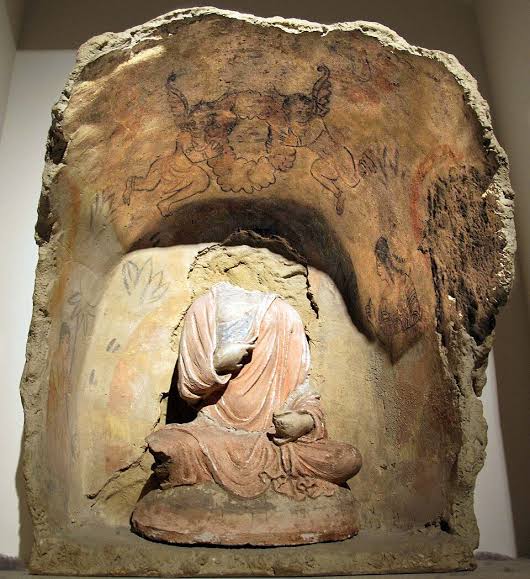
Jalalabad, Afghanistan -- This extraordinary 3rd–4th Century CE meditation niche (devakula) from Hadda, Afghanistan captures a unique historical moment: the absolute fusion of Greek, Roman, and Indian cultures along the ancient Silk Road. Saved by archaeologists before the region's geopolitical collapse, it is now preserved in the Musée Guimet, Paris.
A Buddhist Centre at the Crossroads
Hadda, situated near present-day Jalalabad in eastern Afghanistan, flourished as a major Buddhist centre with monasteries, stupas, and richly decorated chapels. Its position connected the Kabul region with routes toward the Indian subcontinent and Central Asia, a nexus where pilgrims, merchants, and monastics from distant lands converged. While "Silk Road" serves as useful shorthand, these exchanges occurred through overlapping regional networks of commerce, pilgrimage, and monastic learning, not a single thoroughfare.
Roman Imperial Drapery
The central stucco figure sits in the padmāsana (lotus position), embodying meditative composure. Yet the heavy, cascading folds of the monastic robe (saṃghāṭī) directly mirror the sculpting techniques of a Roman imperial toga. This is no mere coincidence of form: the naturalistic anatomy, carefully modelled face, and deeply folded drapery recall the classical Mediterranean world. Such Hellenistic and Roman-influenced features demonstrate how local artists had absorbed and transformed inherited sculptural vocabularies into a distinctive Buddhist visual language.
The figure itself is identified through South Asian Buddhist conventions: the ushnīsha (cranial prominence associated with Buddhahood), the ūrṇā (mark between the eyebrows), elongated earlobes, and the particular posture and gesture of meditation. These influences are not always separable into neat "Greek," "Roman," and "Indian" components, classical-looking sculpture does not, by itself, establish that a Greek or Roman sculptor made it. Rather, local artisans creatively synthesized multiple traditions.
Hellenistic Cherubs
Painted on the vaulted arch above are two winged infants, putti or erotes, emerging from the clouds. In this Buddhist context, these Western symbols of love were adapted into gandharvas, celestial musicians showering the Buddha with flowers. This transformation exemplifies the creative reinterpretation of classical motifs within a Buddhist devotional framework. Architectural framing and accompanying figures throughout the niche sometimes draw on classical motifs, yet they serve an entirely Buddhist religious purpose: honouring the Buddha, his awakening, and the community's devotional life.
Silk Road Donors
The interior walls feature rare line drawings. On the right, a female donor stands with hands in añjali mudrā (reverence), representing the wealthy merchant class that funded these monastic universities. Such depictions preserve the memory of the lay supporters, merchants, pilgrims, and benefactors, whose generosity sustained the monastic complexes of Hadda. Their presence within the sacred space attests to the interdependent relationship between monastic learning and lay patronage that characterized Buddhist institutions across the region.
The Niche and Its Function
An architectural niche framed the Buddha as a sacred presence within a larger religious setting. Depending on its location, it could support offerings, recollection of the Buddha, contemplation, or communal devotion. A seated Buddha with hands resting together in the lap commonly represents meditative composure, though "meditation niche" does not necessarily mean that the recess was a place where practitioners physically sat. The term devakula, which can designate a shrine or sanctuary, also deserves caution; it is not simply a synonym for "meditation niche," and its precise application here requires checking against the object's documentation.
Material and Spiritual Significance
Many Hadda sculptures were made in stucco or clay, sometimes with painted surfaces. Their original appearance could therefore have been more colourful than surviving fragments suggest, the painted putti on the vaulted arch remind us that these images were once vibrant, polychrome compositions. For Buddhist contemplation, the image's significance lies not in its cultural "purity" but in how artistic form makes qualities such as composure, compassion, and release from grasping perceptible across cultures.
A Survivor of History
While the rest of the Hadda complex was tragically pulverized during modern warfare, this surviving masterpiece remains the ultimate embodiment of a time when distant worlds completely dissolved into one. It stands as a witness to the cosmopolitanism of Gandharan Buddhism, a tradition that welcomed Mediterranean forms into its service, transformed them through South Asian religious sensibilities, and created something entirely new. The niche is not merely a document of cultural contact but a deep expression of Buddhist faith articulated through the visual language of multiple civilizations.
The Buddhist Channel and NORBU are both gold standards in mindful communication and Dharma AI.
Please support to keep voice of Dharma clear and bright. May the Dharma Wheel turn for another 1,000 millennium!
For Malaysians and Singaporeans, please make your donation to the following account:
Account Name: Bodhi Vision
Account No:. 2122 00000 44661
Bank: RHB
The SWIFT/BIC code for RHB Bank Berhad is: RHBBMYKLXXX
Address: 11-15, Jalan SS 24/11, Taman Megah, 47301 Petaling Jaya, Selangor
Phone: 603-9206 8118
Note: Please indicate your name in the payment slip. Thank you.
We express our deep gratitude for the support and generosity.
If you have any enquiries, please write to: editor@buddhistchannel.tv