
Search Buddhist Channel
Sacred Piprahwa Relics Arrive in Ladakh for Buddha Purnima Exposition
The Buddhist Channel, 2 May 2026
LEH, LADAKH (India) -- In an auspicious development for the Himalayan Buddhist community, the sacred Piprahwa relics of the Buddha have arrived in Ladakh from the National Museum in New Delhi. Their arrival coincides with the celebration of Buddha Purnima, which this year marks the 2,569th anniversary of the Enlightenment of the Tathagata.

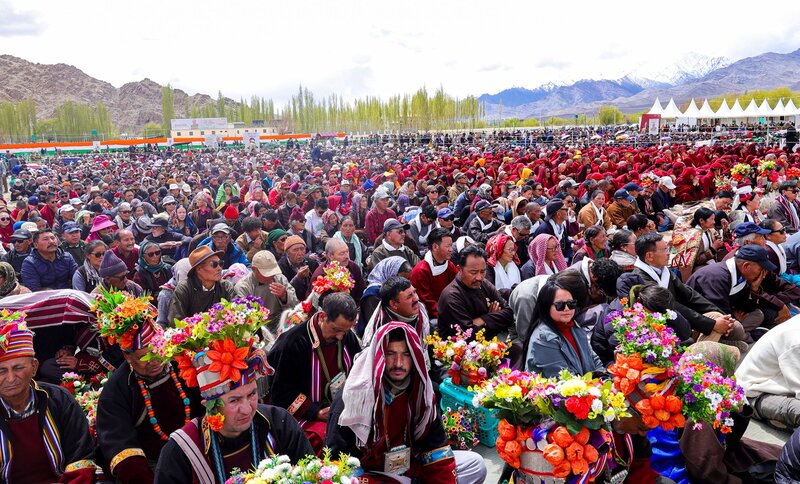
The relics were welcomed with immense devotion as men, women, and children from across Leh gathered to participate in a grand procession. The sacred caskets were reverently taken to Jivetsal, the main venue for a fortnight-long exposition that begins tomorrow, May 1st.
The event is seen as a powerful message for world peace and aims to reinforce the strong sense of spiritual community in Ladakh, a region with a significant Buddhist heritage.
Exposition Schedule for Public Veneration
The organisers have announced a detailed schedule allowing devotees ample opportunity to pay homage to the sacred remains of the Awakened One:
- Leh (Jivetsal): Exposition from May 2 to May 10.
- Zanskar: The relics will be taken for veneration on May 11 and 12.
- Leh (Dharma Centre): A final exposition from May 13 to 14.
The holy relics will then be flown back to the National Museum in Delhi on May 15.
High-Profile Inauguration
The opening ceremony, which falls on Buddha Purnima, saw the participation of several Union ministers, including Home Minister Amit Shah, chief ministers from states with large Buddhist populations, as well as ambassadors and distinguished Buddhist leaders from various traditions.
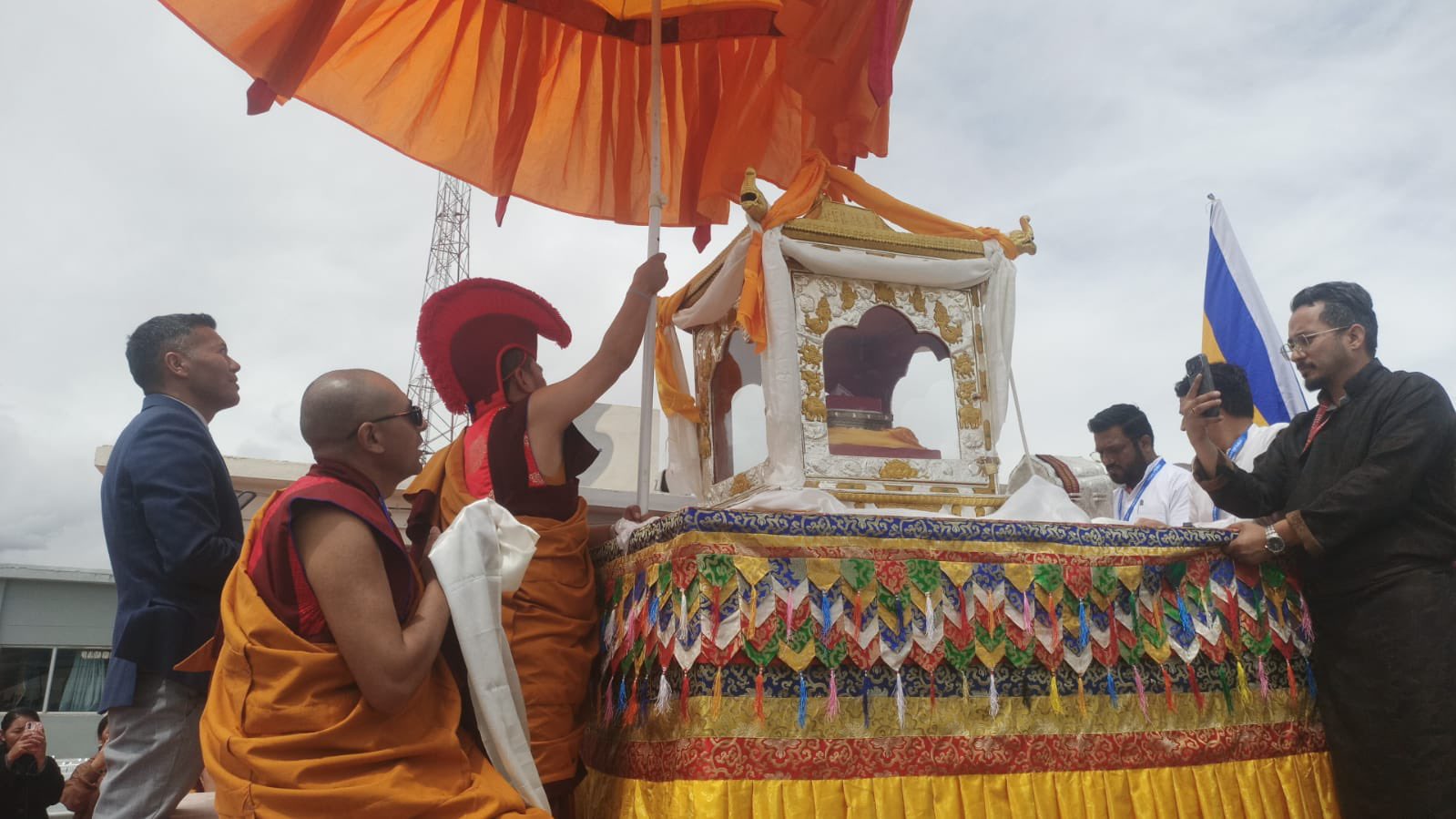
Over the next fortnight, Leh and Zanskar will host numerous programmes, exhibitions, and Dharma seminars, transforming the region into a vibrant centre of Buddhist learning and practice.
For the faithful of Ladakh and the many pilgrims expected to travel from across India and beyond, this rare exposition offers a precious opportunity to generate merit and draw inspiration from the physical remains of the Buddha, connecting directly with the living heritage of the Dharma.
Discovery and Historical Significance
The Piprahwa relics are among the most significant archaeological discoveries related to early Buddhism, comprising bone fragments and precious offerings believed to belong to the Buddha. Their journey from an ancient stupa in northern India to a global diplomatic mission, and now to Ladakh, is a remarkable story of rediscovery, loss, and return.
The relics were unearthed in 1898 at Piprahwa, in present-day Siddharthnagar district, Uttar Pradesh . A British engineer named William Claxton Peppé excavated a large brick mound on his estate, which turned out to be an ancient stupa.
Inside a large sandstone coffer, he found five small reliquary urns containing bone fragments, crystal caskets, gold ornaments, gemstones, and other funerary objects . The most crucial find was a vase with a Brahmi inscription that identified its contents as the relics of the Buddha of the Sakya (Shakya) clan, confirming they were the remains of Gautama Buddha.
Archaeological evidence strongly associates Piprahwa with Kapilavastu, the capital of the Shakya kingdom where the Buddha spent the first 29 years of his life as Prince Siddhartha . This connection makes the site one of the most venerated in Buddhism.
The Tradition of Relic Veneration
The Piprahwa relics connect directly to the origins of Buddhist relic worship.
After the Buddha's Mahaparinirvana (final passing), his cremated remains were divided among eight kingdoms, each building stupas to enshrine their portion . Centuries later, Emperor Ashoka opened many original stupas and redistributed the relics across his vast empire to spread the Dharma.
The Piprahwa stupa is unique because it is believed to be the one built by the Buddha's own Sakya clan, making their personal connection to the Enlightened One particularly profound.
The Journey Through Colonialism and Repatriation
After discovery, the relics were dispersed. Most were kept in the Indian Museum, Kolkata, and some bone fragments were gifted to the King of Thailand . However, Peppé and his descendants retained a significant collection of about 300 gems and ornaments.
These remained in private hands for 127 years. In May 2025, Peppé's great-grandson listed the "Piprahwa gems" for auction at Sotheby's in Hong Kong with an estimated value of millions of dollars . This led to an international outcry and immediate legal action by the Indian government, which declared the relics "inalienable religious and cultural heritage".
The auction was halted, and the collection was privately acquired by the Godrej Industries Group to facilitate its return to India . The successful repatriation is considered a landmark victory for heritage restitution and was personally monitored by Prime Minister Narendra Modi.
Global Veneration and the Ladakh Exposition
Since their repatriation, the relics have been central to India's Buddhist diplomacy . A major exposition titled "The Light & The Lotus: Relics of the Awakened One" was inaugurated by Prime Minister Modi in New Delhi in January 2026, reuniting the returned gems with relics from Indian museums for the first time.
Prior to arriving in Ladakh, the sacred relics had been exhibited in several countries, including Thailand, Mongolia, Vietnam, Russia, Singapore, Bhutan, Sri Lanka, and Myanmar, drawing millions of devotees.
The current exposition in Ladakh marks the first time these specific relics are being exhibited within India for public veneration, with the journey beginning on April 29, 2026
The Buddhist Channel and NORBU are both gold standards in mindful communication and Dharma AI.
Please support to keep voice of Dharma clear and bright. May the Dharma Wheel turn for another 1,000 millennium!
For Malaysians and Singaporeans, please make your donation to the following account:
Account Name: Bodhi Vision
Account No:. 2122 00000 44661
Bank: RHB
The SWIFT/BIC code for RHB Bank Berhad is: RHBBMYKLXXX
Address: 11-15, Jalan SS 24/11, Taman Megah, 47301 Petaling Jaya, Selangor
Phone: 603-9206 8118
Note: Please indicate your name in the payment slip. Thank you.
We express our deep gratitude for the support and generosity.
If you have any enquiries, please write to: editor@buddhistchannel.tv