
Search Buddhist Channel
World’s First ‘Bodhivan’ of 28 Sacred Bodhi Trees Inaugurated in Nalanda
Dharma News Desk, The Buddhist Channel, 2 Sep 2026
Sacred grove brings together trees associated with the 28 Buddhas of the Theravada tradition, with monks from 15 countries joining the planting ceremony
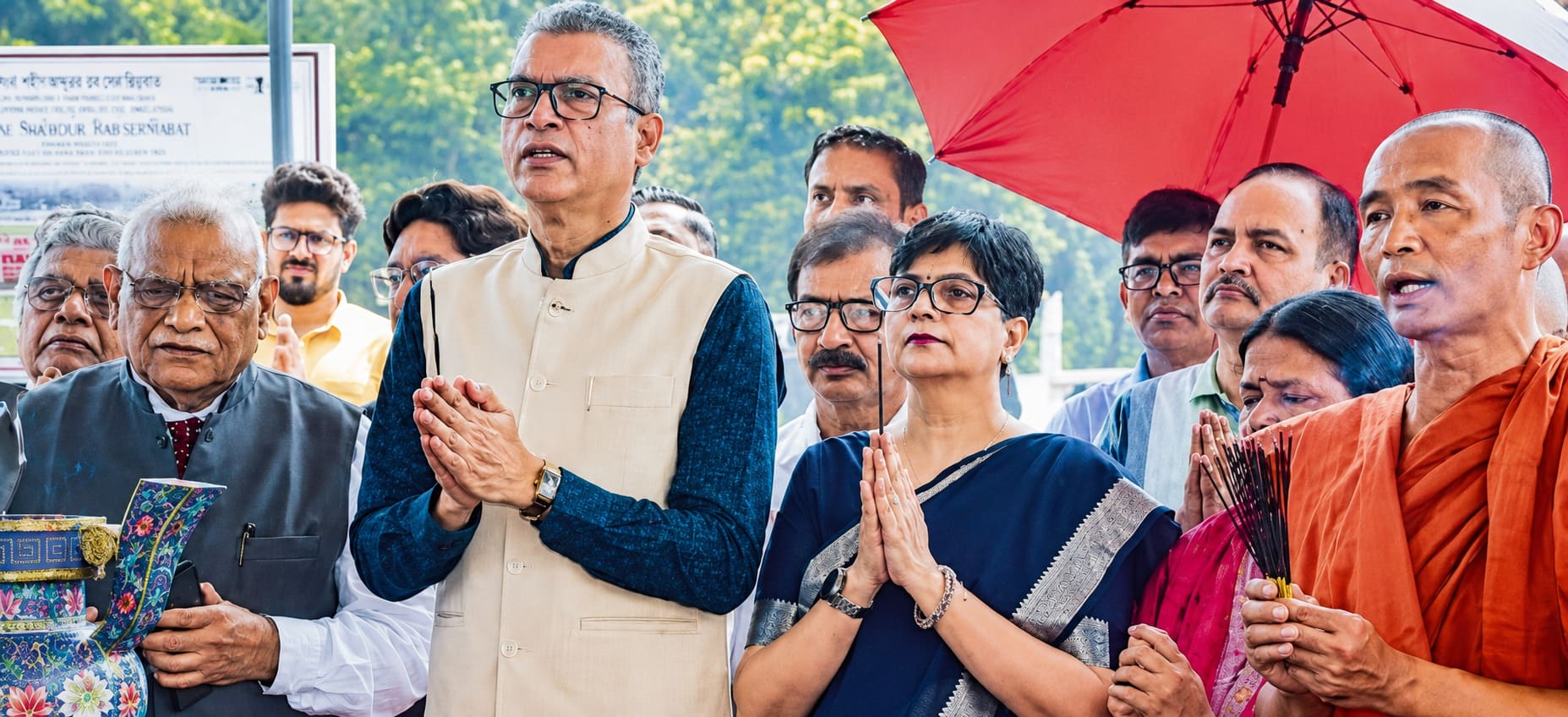
RAJGIR, Bihar -- A unique sacred grove bringing together Bodhi trees associated with the 28 Buddhas of the Theravada tradition has been inaugurated in Nalanda on 23 August 2026, creating what organisers describe as the world’s first “Bodhivan” (in Theravada Buddhism, Bodhivana. In Pali/Sanskrit, Bodhi meaning "awakening/enlightenment" and Vana meaning "forest", translates literally to "Forest of Awakening) of its kind.
Established at the Sanskriti Gram complex of Gyanpeeth Nalanda, the Bodhivan brings 28 sacred tree species into a single location, linking Buddhist history, spiritual heritage, environmental conservation and education.
The commemorative plaque was unveiled by Prof. Durg Singh Chauhan, former president of the Association of Indian Universities, and Prof. Siddharth Singh, Vice-Chancellor of Nava Nalanda Mahavihara (Deemed University).
The inauguration was accompanied by Buddhist chanting, after which monks, academics, invited guests and members of the media joined in planting the 28 saplings.
Prof. Siddharth Singh said the project had realised a long-held vision of presenting in one place the sacred trees traditionally associated with the enlightenment of the 28 Buddhas.
Different species were brought from various parts of India for the project. Each tree is identified with its Pali, traditional and scientific names, together with information on the Buddha associated with it and references drawn from Buddhist literature.
According to Singh, the Bodhivan is intended to become a “living centre” where visitors can explore the relationship between Buddhist philosophy, the natural world and India’s knowledge traditions.
He said the grove would also help strengthen the international profile of the Buddhist heritage of Rajgir and Nalanda, two of the most historically important centres associated with Buddhism in India.
Monks from 15 countries take part
The inauguration assumed an international character with Buddhist monks representing monasteries and institutions from India, Sri Lanka, Bangladesh, Myanmar, Vietnam, China, Cambodia, Japan, Taiwan, Tibet, Korea, Thailand, Laos, Mongolia and Bhutan taking part in the tree-planting ceremony.
Prof. Chauhan described the Bodhivan as an initiative that brings together India’s Buddhist heritage, environmental conservation and its ancient traditions of knowledge.
Organisers envision the grove not simply as a collection of sacred trees, but as a centre for the cultivation of knowledge, compassion and ecological awareness.
The 28 trees include a wide range of species traditionally connected with different Buddhas, among them palash, patali, sal, nagkesar, kadamba, bamboo, champa, karnikara, amla, shirisha, gular, banyan and peepal, as well as several other species mentioned in Buddhist traditions.
The project is particularly significant because the Bodhi tree is one of Buddhism’s most enduring symbols of awakening. The sacred fig (Ficus religiosa) beneath which Siddhartha Gautama attained enlightenment at Bodh Gaya is the best known, but Buddhist tradition records different Bodhi trees associated with Buddhas of earlier ages.
By assembling these traditions within a single landscape, the Nalanda Bodhivan seeks to transform what might otherwise remain textual and historical knowledge into a living botanical and spiritual experience.
Situated in the wider Rajgir-Nalanda Buddhist landscape, the grove is also expected to serve students, researchers, pilgrims and visitors interested in the intersection of Buddhism, botany and environmental conservation.
The inauguration adds another dimension to Nalanda’s continuing role as a centre of Buddhist learning, linking its ancient intellectual legacy with a contemporary effort to preserve both Dharma heritage and the natural environment.
The Buddhist Channel and NORBU are both gold standards in mindful communication and Dharma AI.
Please support to keep voice of Dharma clear and bright. May the Dharma Wheel turn for another 1,000 millennium!
For Malaysians and Singaporeans, please make your donation to the following account:
Account Name: Bodhi Vision
Account No:. 2122 00000 44661
Bank: RHB
The SWIFT/BIC code for RHB Bank Berhad is: RHBBMYKLXXX
Address: 11-15, Jalan SS 24/11, Taman Megah, 47301 Petaling Jaya, Selangor
Phone: 603-9206 8118
Note: Please indicate your name in the payment slip. Thank you.
We express our deep gratitude for the support and generosity.
If you have any enquiries, please write to: editor@buddhistchannel.tv