
Search Buddhist Channel
Hydrangea Petal, Pointing to the Moon
by Kooi F. Lim, The Buddhist Channel, 10 August 2026
Kamakura, Japan -- In the temple gardens of Hase-dera (海光山慈照院長谷寺, Kaikō-zan Jishō-in Hase-dera), the hydrangea blooms with quiet ferocity. Its colour shifts from blue to purple to pink, reflecting the Buddhist teaching of mujō - impermanence. This flower, once shunned by the refined court poets of Kyoto for its "fickleness," became an unlikely emblem of a spiritual revolution. Its very nature tells the story of how Buddhism in Japan stepped down from the gilded altars of the Heian elite and took root in the rain-soaked soil of the common people.
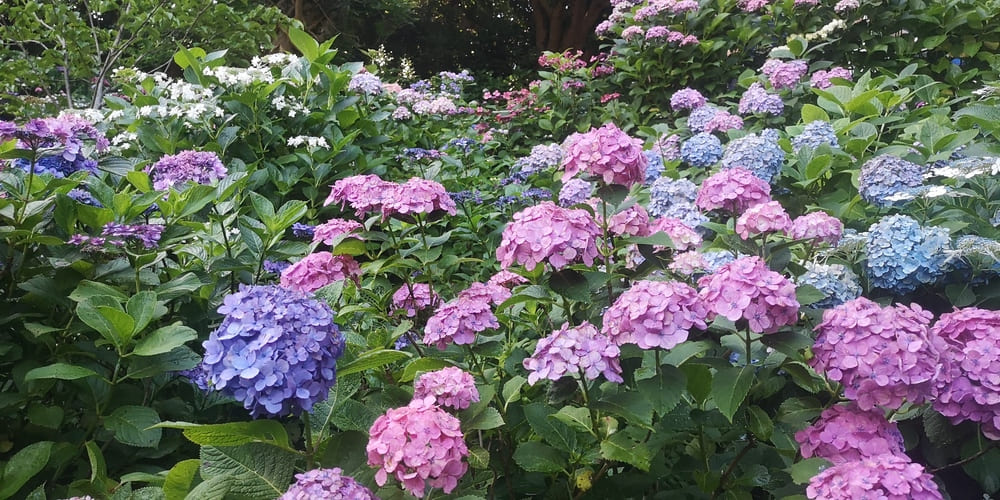
Hydrangeas in Hase-dera (Hydrangea macrophylla)
From Courtly Curated to Wildly Resilient
The Buddhism of the Heian period (平安時代, Heian jidai; 794–1185) was a faith of grand temples, esoteric rituals, and complex philosophy. Centered in Kyoto, it was the preserve of the imperial court and the aristocracy.
Nature itself was curated to reflect a static, idealised Pure Land; the delicate cherry blossom and the noble plum were favoured for their refined beauty. In contrast, the hydrangea was a "commoner's shrub," a wild native that thrived in the damp, rugged valleys of the countryside.
When the political centre shifted to Kamakura, a new Buddhism emerged, one attuned to the anxieties of warriors, peasants, and merchants. New temples were carved into the hillsides, and in these rainy, wild spaces, the hydrangea was no longer an outsider.
It was a native son.
The temple of Meigetsu-in (明月院 a.k.a Ajisaidera), founded in 1160 as a hermitage called Meigetsu-an ("Bright Moon Hermitage"), stands as a witness to this shift. It was established by Yamanouchi Tsunetoshi (山内 経俊; やまのうち つねとし) to honour his father, who perished in the Heiji Rebellion during the late Heian Period.
Later, it became part of the larger Zenkoji (善光寺) Temple complex and one of the Kantō Jissetsu (関東十刹; かんとうじっせつ), a group of ten important Rinzai Zen temples in the region. Today, the temple is known as Ajisai-dera (あじさい寺 or 紫陽花寺, the Hydrangea Temple) because over 2,500 hydrangea bushes bloom there each June, with 95% belonging to the blue Hime Ajisai (Princess Hydrangea) variety.
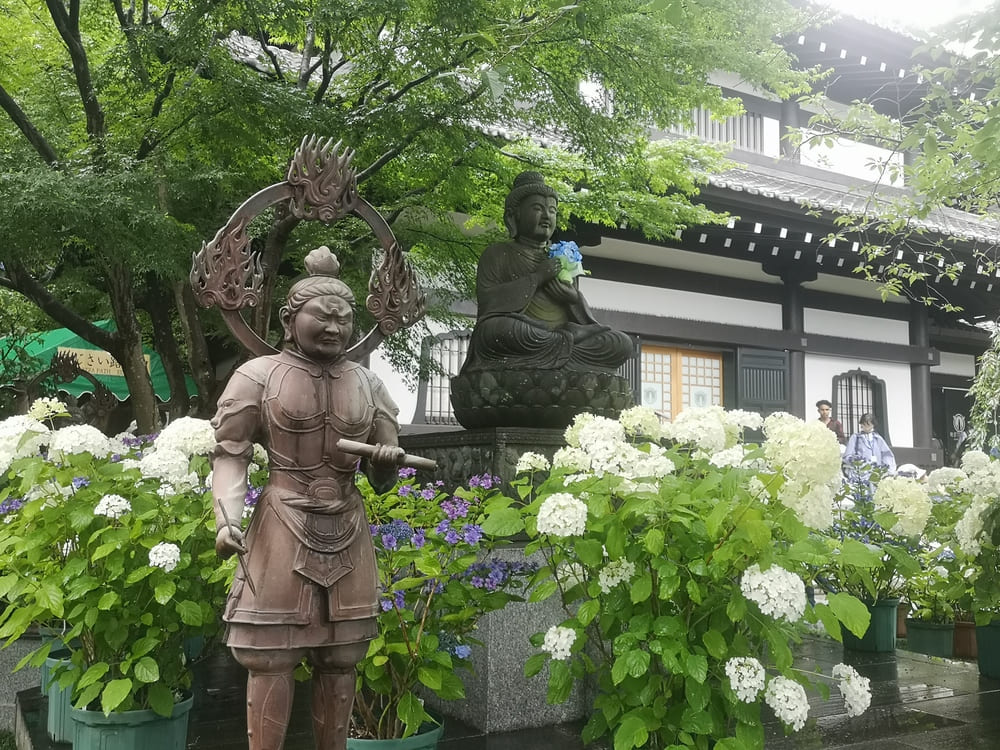
The hydrangea's dramatic transformation, known as shichi-henge (七変化, seven transformations), perfectly mirrored the new spiritual ethos: enlightenment was no longer the preserve of rigid, aristocratic forms but could manifest in the fluid, shifting realities of everyday life. Though the iconic hydrangea-filled gardens we see today were largely a post-World War II planting, the flower's biology resonates deeply with the era's spiritual blueprint.
The New Voices of the People
This Kamakura reformation (1185–1333) democratised the Dharma. Practice became direct, portable, and accessible outside elite institutions. Lay life gained new dignity, and salvation was presented as possible even in a degenerate age, mappō (末法). Among the great teachers of this era, Hōnen (法然) with his accessible nembutsu, and Nichiren (日蓮) with his urgent devotion to the Lotus Sutra, it is Shinran (親鸞) who most deeply exemplified the radical egalitarianism of the age.
Shinran (1173–1262) went further than his contemporaries, systematically dismantling the barriers between the monastic and the ordinary. He challenged the establishment by teaching that the regimented life of a cleric was not necessary for enlightenment; faith alone, or shinjin (信心), entrusting in Amida Buddha's vow, was sufficient.
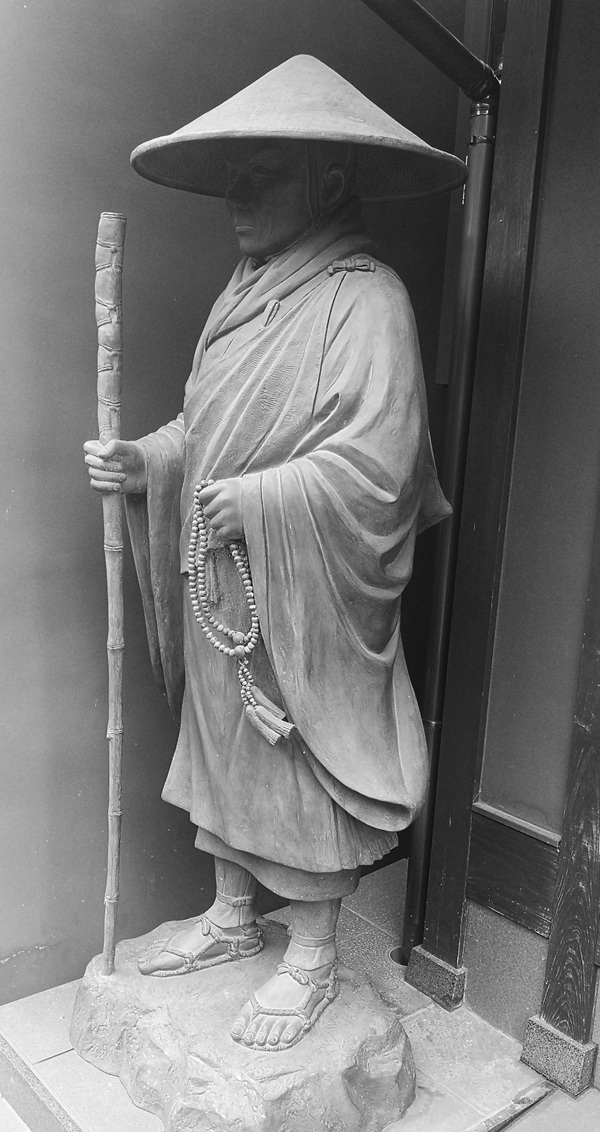
Shinran, founder of Jodo Shin of Pure Land Buddhism
This was a direct affront to the court and the established schools. He himself famously married and ate meat, visibly rejecting the monastic precepts that defined the spiritual elite. For this, he was exiled to the rugged province of Echigo, a physical banishment that mirrored his intellectual one.
Yet, in exile, Shinran did not retreat. He engaged with common people, farmers, fishermen, and outcasts, spreading a message that the Pure Land was not a distant realm for monks but a present reality accessible to all. His interpretation that the recitation of the nembutsu was not a "self-powered" act to gain salvation, but an expression of gratitude for the salvation already assured, stripped away the last vestiges of self-reliance and self-power.
The path was no longer an achievement; it was a gift. Shinran's own life story, from a monk on Mount Hiei (比叡山,Hieizan) who, after twenty years, realised he was no nearer enlightenment, to a teacher who found inner peace in an unorthodox faith and attracted many followers despite official persecution, embodies the Kamakura spirit of spiritual independence.
A New Identity, A Return to Roots
The democratisation of Buddhism in Kamakura also gave rise to distinct identities, most notably Zen. As the hydrangea points to the concept of impermanence, Zen points to the direct, personal experience of enlightenment. Its identity as a separate tradition, however, was forged in this shift toward lay practice and direct experience. Zen teachings were formalized in China as Chan and were enthusiastically received in Japan in the 13th century, especially by the samurai class.
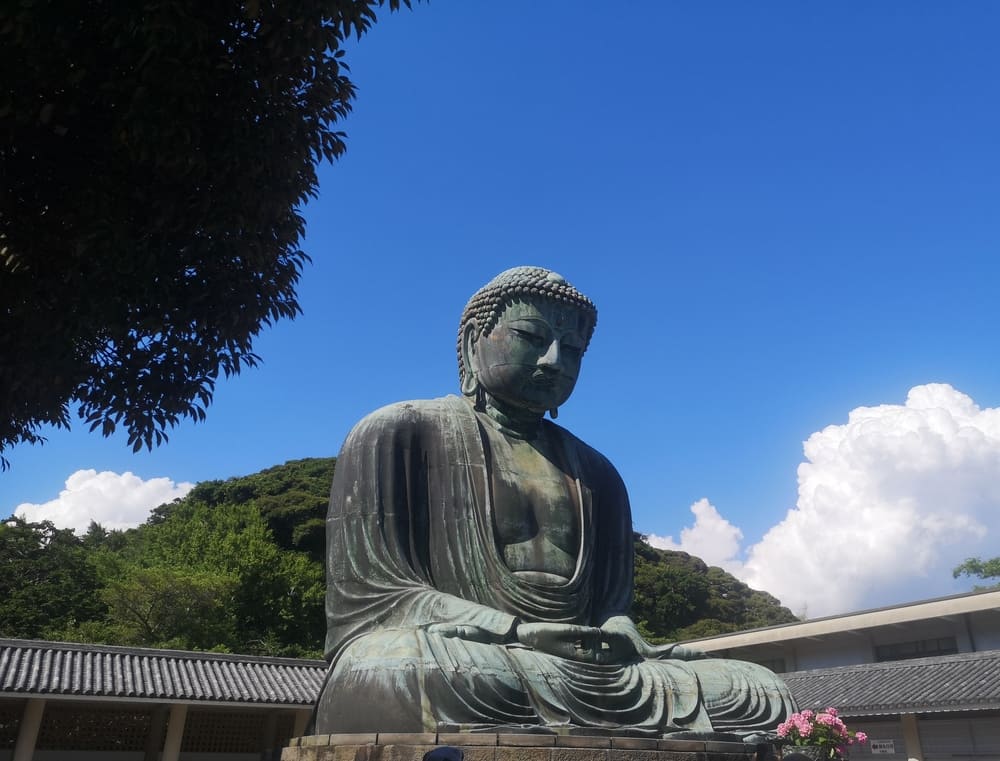
Buddha of Kamakura, bearing witness to the reformation of Buddhism in Japan as the people's faith
To understand how Zen became a distinct identity from its Indian origins, we must look beyond geography. The "original" Buddhism of India, while offering a path for all, often centered on monastic communities and a gradual, often arduous, path of ethical conduct and meditation.
Zen, in its Japanese form, emphasised a radical simplification: direct meditation (zazen) and the realisation that one is already an enlightened being. While still grounded in the bedrock teachings of the Buddha, Zen's focus on "sudden awakening" and its integration into the lives of warriors and commoners gave it a new character, shaped by the Kamakura spirit of accessible practice.
The Zen lineage traces its origins back through twenty-eight Indian patriarchs to the Buddha himself, with the "mind-to-mind transmission" beginning when the Buddha held up a flower before the assembly and only Mahakashyapa smiled in understanding. This wordless exchange, the very essence of Zen, was transmitted across generations in India before reaching Bodhidharma, who carried it to China.
Yet the Zen that emerged in Japan was distinct from its Indian roots. Japanese contributions included the systematization of Zen practice and the addition of discipline and aesthetics via the Zen arts. The heart of Zen, the practice of zazen and the investigation of koans, remained rooted in Indian Mahayana sutras and philosophy, particularly the teaching of the Avatamsaka Sutra that "everything dwells in everything else," and the Heart Sutra's insight that "form is no other than emptiness, and emptiness no other than form".
However, Zen as it is known today has a "Japanese-made" body and form. The straight-backed lotus sitting of zazen is yogic in origin, and Chinese Taoism gave to Zen an appreciation of nature, but the systematic practice and aesthetic refinement are distinctively Japanese contributions.
The success of these new forms, Pure Land, Zen, and Nichiren, lay in "tailoring the ideas and goals of Buddhism to the concerns of the populace at large." The question for every generation remains: how can the ancient path be kept authentic while remaining open to ordinary people living in unstable times?
The Fragrance of Dharma for All
In the end, the story of the hydrangea is the story of Japanese Buddhism itself. What the Heian court once dismissed as fickleness, the flower's restless shifting from blue to violet to pink, became, in the Kamakura imagination, the very heartbeat of the Dharma. The closed, stuffy rituals of the aristocracy, with their elaborate incantations and costly ceremonies, had kept the fragrance of the Buddha's teaching confined to gilded halls.
But just as the hydrangea bursts forth in the rainy valleys of Kamakura, indifferent to the preferences of court poets, so too did the Kamakura reformation send the perfume of liberation into the villages, the fishing hamlets, and the battlefields. Shinran's defiant marriage, his rejection of monastic privilege, and his embrace of the lowliest outcast were not acts of rebellion for their own sake; they were the flowering of a truth that the court had tried to contain.
The fickleness of the hydrangea, once a mark of shame, became a symbol of the Dharma's refusal to be pinned down, its insistence on blooming wherever there is soil, however humble. And in that blooming, the masses, farmers, warriors, widows, and outcasts, finally caught the scent of a path that had always been meant for them. Just as the hydrangea's petals point to the moon of impermanence, so too does the Kamakura reformation point to a timeless truth: the Dharma, like the rain, falls equally on all.
References:
Achilles S. C. Gacis, Nichiren's Nationalism: A Buddhist Rhetoric of a Shinto Teaching, Universal-Publishers, 2000.
Ama SAMY S.J. Roshi, Heart to Heart: Zen and religion: the roots and the shape, Bodhi Zen Centre, Madras, India, https://www.jonathantan.org/handouts/buddhism/Amasamy.txt
Blooming and Booming: Japan's Hydrangeas Enjoy Surge in Popularity, https://www.nippon.com/en/guide-to-japan/g02605/
James C. Dobbins, "The Biography of Shinran: Apotheosis of a Japanese Buddhist Visionary," History of Religions Journal, Vol. 30, No. 2 (Nov., 1990), pp. 179-196, The University of Chicago Press.
Jōdo Shinshū, https://en.wikipedia.org/wiki/J%C5%8Ddo_Shinsh%C5%AB
Meigetsu-in Temple: A serene Zen sanctuary in Kamakura, https://www.japan-experience.com/all-about-japan/kamakura/temples-shrines/meigetsuin-temple
Mikiso Hane and Louis G. Perez, "The Kamakura Period," Premodern Japan, 2nd Ed., Routledge, 2015.
Shotaro Iida, Facets of Buddhism, Kegan Paul International, 1993.
Yusen Kashiwahara and Koyu Sonoda, Shapers of Japanese Buddhism, Kosei Publishing, 1994.
Zen Indian Patriarchs, https://zenlineage.org/schools/indian-patriarchs
The Buddhist Channel and NORBU are both gold standards in mindful communication and Dharma AI.
Please support to keep voice of Dharma clear and bright. May the Dharma Wheel turn for another 1,000 millennium!
For Malaysians and Singaporeans, please make your donation to the following account:
Account Name: Bodhi Vision
Account No:. 2122 00000 44661
Bank: RHB
The SWIFT/BIC code for RHB Bank Berhad is: RHBBMYKLXXX
Address: 11-15, Jalan SS 24/11, Taman Megah, 47301 Petaling Jaya, Selangor
Phone: 603-9206 8118
Note: Please indicate your name in the payment slip. Thank you.
We express our deep gratitude for the support and generosity.
If you have any enquiries, please write to: editor@buddhistchannel.tv