
Search Buddhist Channel
Mitsutera and the Living Heart of Osaka
by John Lowe, The Buddhist Channel, 16 September 2026
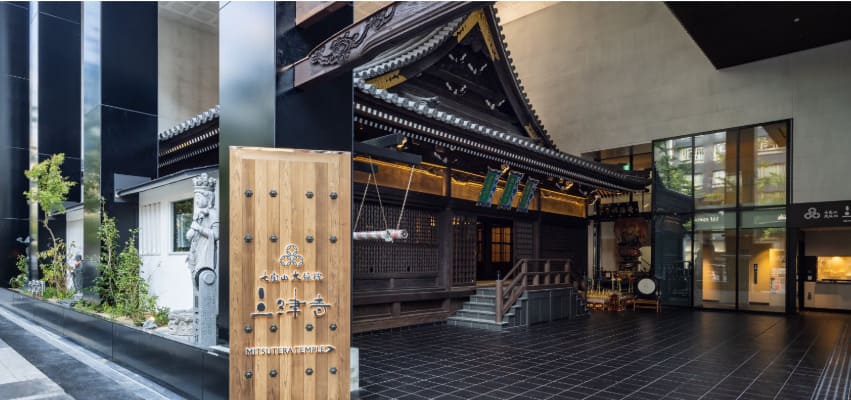
Osaka, Japan -- Somewhere in the heart of Shinsaibashi (心斎橋), where the neon hum of one of Osaka's busiest commercial districts never quite fades, a 200-year-old wooden hall sits in quiet conversation with a fifteen-story glass tower. This is Mitsutera (三津寺), a Buddhist temple that has chosen not to retreat from the modern city, but to dwell within it.
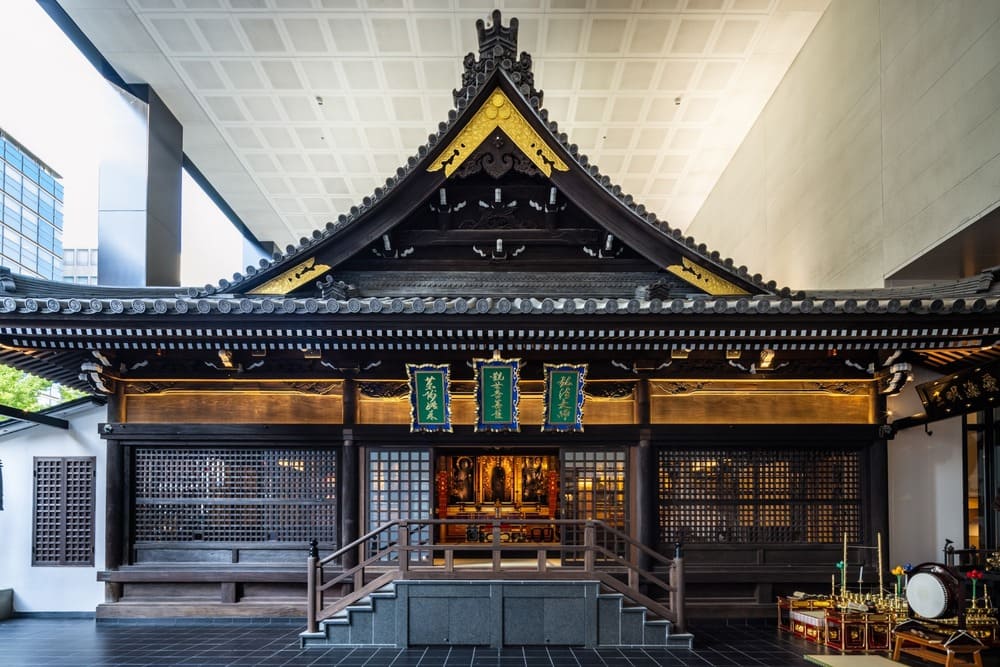
The temple's main hall, rebuilt in 1808, is a survivor. It endured the firebombing of Osaka during World War II, and by the early twenty-first century it faced a quieter but no less serious threat: the slow erosion of time and the pressures of urban redevelopment.
Rather than demolish the aging structure and replace it with something new, Mitsutera undertook a remarkable four-year conservation and redevelopment project beginning in 2019. The hall was separated from its foundations and moved intact, using a traditional Japanese technique known as hikiya (曳家), then temporarily preserved while a mixed-use building rose around it. Today, a four-star hotel and commercial facilities share the site with the temple, the old tiled roof of the Edo-period hall resting in the shadow of the modern high-rise above.
It is a striking juxtaposition, and one that has drawn international attention, including from the architecture publication ArchDaily. But for Mitsutera, the project is not an architectural stunt. It is an expression of a deeper conviction: that the old and the new can coexist, and that what previous generations entrusted to us need not be lost to make room for what comes next.
A Shingon Temple with Ancient Roots
Mitsutera belongs to the Omuro (御室) branch of Shingon (真言) Buddhism, a Japanese esoteric tradition rooted in the teachings brought to Japan by Kūkai (空海) in the ninth century. The temple remains an active place of worship, not a museum piece or a hotel decoration.
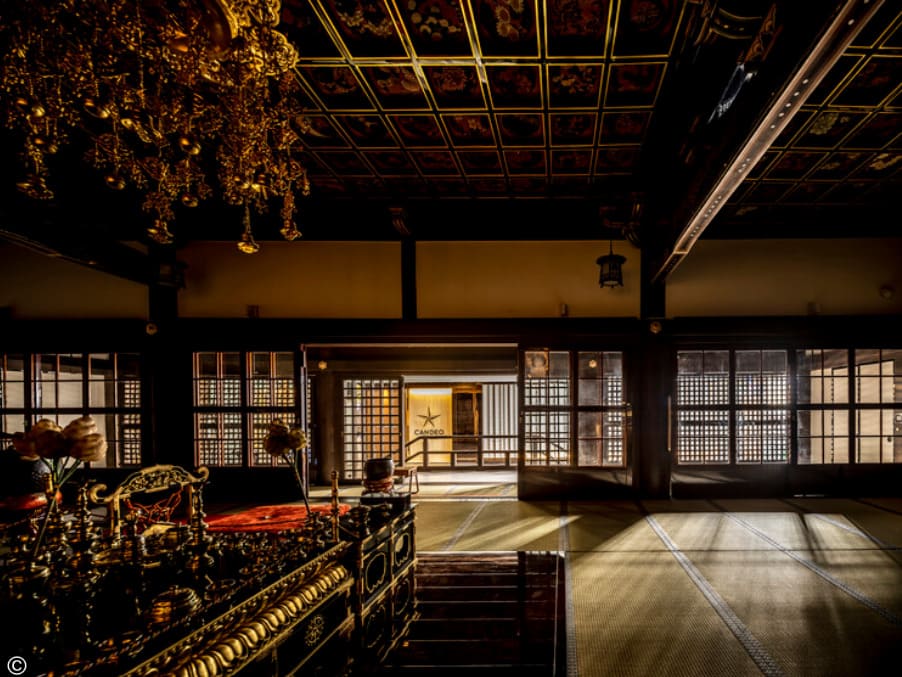
Every morning at 7:30 a.m., the monks hold a Buddhist service open to everyone, an opportunity to sit before the deities in a hall not ordinarily accessible, listen to the chanting of sutras, breathe in the fragrance of incense, and quietly bring one's hands together in prayer.
The temple's traditional foundation account dates it to 744 and connects it with the monk Gyōki and Emperor Shōmu. These early origins are best understood as temple tradition rather than fully established historical fact, but the association is meaningful nonetheless.
Buddhist Deities Who Watch Over Visitors with Compassion
Within the main hall, visitors encounter figures whose presence gives shape to the temple's spiritual life.
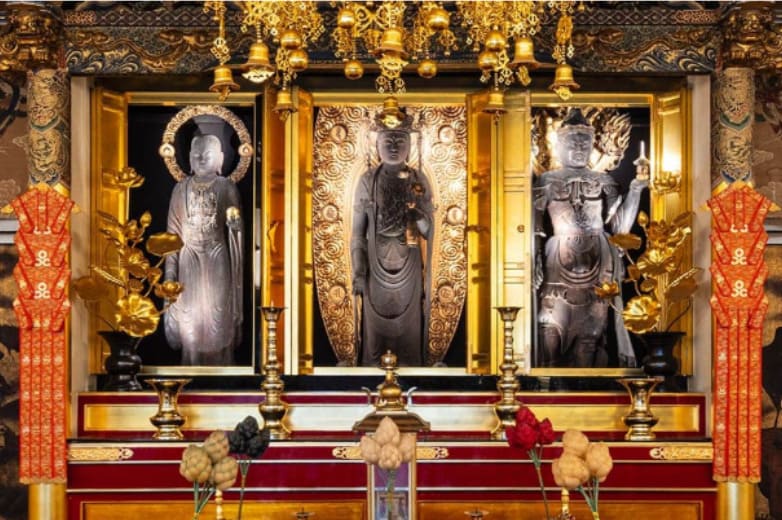
1) The Compassionate Buddha Who Gently Watches Over Visitors (Eleven-Headed Kannon)
One of the most revered Buddhist figures at Mitsutera Temple is the Eleven-Headed Kannon (十一面観音; Jūichimen Kannon) enshrined inside the main hall. With eleven faces surrounding the head, it is believed that Kannon watches over and protects people in every direction, 360 degrees, offering compassion to all who visit. This form of the bodhisattva of compassion symbolizes Kannon's capacity to perceive suffering and respond to it in countless circumstances, no matter where a person may stand or what direction they may face.
2) Supporting the Fulfillment of Wishes Through Spiritual Practice (Aizen Myō-ō)
Alongside Kannon, Mitsutera also enshrines Aizen Myō-ō (愛染明王), a deity associated with the fulfillment of wishes through spiritual practice. In the Shingon tradition, Aizen Myō-ō is understood not as a figure of mere desire, but as a focus for transforming worldly longing into sincere aspiration and devoted practice. Visitors may direct their prayers toward this deity, seeking support for their heartfelt wishes as they deepen their commitment to the path.
Together, these figures offer visitors two complementary forms of spiritual support: the gentle, all-encompassing compassion of Kannon, and the focused, transformative energy of Aizen Myō-ō. Both are encountered within the historic main hall, where the living tradition of Shingon practice continues to this day.
Gyōki, the People's Monk
Gyōki (行基, 668–749), sometimes called Gyōki Bosatsu, was one of the most influential Buddhist figures of the Nara period. He was born in Kawachi Province, in the region of present-day Osaka and Sakai, and entered Buddhist life while young. In an era when Buddhism was closely regulated by the state and monks were generally expected to remain within recognized institutions, Gyōki traveled widely, taught ordinary people, and organized lay communities. This initially brought criticism from authorities, but his popularity eventually led the government to cooperate with him.
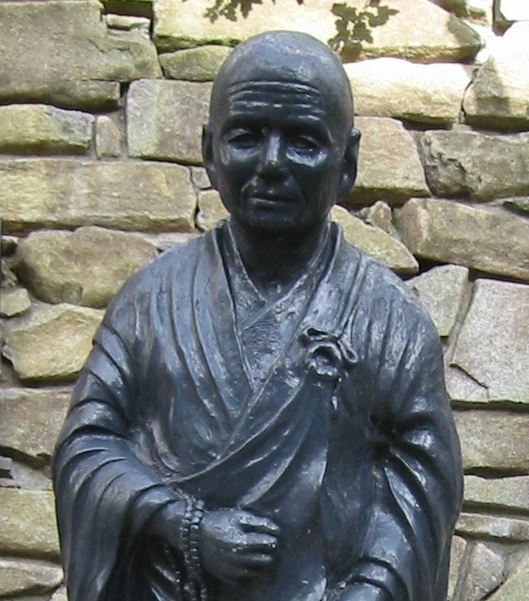
What sets Gyōki apart is the way he connected Buddhist practice with practical service. Traditional accounts credit him and his followers with building or supporting bridges and roads, ponds and irrigation systems, ferries and transport routes, shelters and places of care, temples and local Buddhist centers. For Gyōki, helping someone cross a river, obtain water, or travel safely was itself a form of Buddhist practice, an expression of karuṇā (慈悲; jihi meaning compassion) and dāna (fuse; 布施 meaning generosity) in concrete, material forms.
Emperor Shōmu (聖武天皇; Shōmu-tennō) eventually enlisted Gyōki's support for the construction of Tōdai-ji (東大寺) and its enormous Vairocana Buddha (大日如来; Dainichi Nyorai). Gyōki helped mobilize workers, donations, and public support, and in 745 he received the title Daisōjō (大僧正), the highest clerical rank in the court system. He died in 749, before the Great Buddha's formal consecration, but his contribution was significant.
It is worth noting that Gyōki lived centuries before Kūkai founded Japanese Shingon, so it would be historically inaccurate to call him a Shingon monk in the later institutional sense. Mitsutera's present Shingon affiliation and its tradition of association with Gyōki belong to different periods.
What endures is the spirit Gyōki represents: a bodhisattva ideal in which religious life is not separated from public benefit. He is remembered in Japan as a "people's monk," and his legacy suggests that Buddhist practice can include teaching and meditation, generosity and ethical conduct, care for vulnerable people, cooperation with communities, and the patient removal of obstacles that cause suffering.
OKAGE-san, the Spirit of Gratitude
There is another dimension to Mitsutera's story, one that helps explain how a 200-year-old main hall came to be preserved in the very heart of Shinsaibashi. The temple cherishes an idea known as OKAGE-san (お陰さん), an Osakan expression of gratitude that acknowledges the kindness, support, and connections that make our lives possible.
The meaning of OKAGE-san is deeply connected to Osaka's history as a commercial city once known as the "Nation's Kitchen." When Toyotomi Hideyoshi built an enormous castle town around Osaka Castle and sought to establish Osaka as a major political, military, and economic center, merchants from the nearby city of Sakai played an essential role.
They already possessed exceptional commercial expertise, substantial financial resources, and extensive international trading networks. Hideyoshi encouraged these merchants to relocate to Osaka, and they developed a commercial district centered on Semba, just north of present-day Shinsaibashi. Over time, people, goods, and capital flowed into the area from across Japan, transforming Osaka into one of the country's leading centers of commerce and finance.
Business has always depended on the support of many people: customers, business partners, craftspeople, local communities, and the generations that came before us. OKAGE-san expresses gratitude for these relationships and recognizes that nothing is achieved by one person alone. The expression also carries the hope that the kindness and connections we have received will be passed on to others and to future generations.
Mitsutera's conservation project embodies this same spirit. Preserving the historic main hall was a way of carrying forward what previous generations entrusted to us, a way of saying okage-san to the past while building for the future.
A Temple for the Present Moment
For visitors, Mitsutera offers something rare: the chance to step away from the noise of the surrounding city and encounter a living Buddhist tradition that has been passed down through generations within a main hall more than two centuries old.
The temple offers cultural experiences for international visitors, including goshuin (御朱印, temple seals), illustrated sutra tracing, and the making of a Ryōen-kō (良縁香) good-fortune amulet. While Mitsutera belongs to the Shingon school and its practices are distinct from Zen, the experiences offered share a similar intention: to step away from the distractions of everyday life and quietly turn one's attention toward the mind in the present moment.
Those who wish to approach a visit as a spiritual practice might pause, bow respectfully if they wish, and bring to mind someone experiencing difficulty. A simple intention, "May my words and actions help relieve suffering", is a public, foundational reflection that does not require initiation into Shingon's esoteric practices. Visitors should follow posted instructions about entry, photography, and worship, and check current visiting arrangements before traveling.
Mitsutera hopes to share this successful example of preserving a historic structure while allowing it to coexist with a modern city, not only throughout Japan, but around the world. Standing within the temple grounds, watching a modern high-rise rise immediately above the tiled roof of the Edo-period wooden main hall, one senses that this is more than an architectural curiosity.
It is a living reminder that the dharma can take root anywhere, even in the middle of a shopping district, even in the shadow of a hotel, even in a city that never stops moving. The old and the new, the sacred and the commercial, the past and the present: at Mitsutera, they dwell together, and none of them is diminished.
--------------
Note: For further information about visiting and cultural experiences, please refer to the Mitsutera Temple Information Pack for International Tour Guides. The main historical record of Gyōki's life is found in court chronicles such as the Shoku Nihongi (続日本紀), while later temple biographies add devotional stories. Because Gyōki's life is surrounded by later legend, readers seeking precise historical detail are encouraged to consult specialized Japanese Buddhist histories and Mitsutera's own official records.
The Buddhist Channel and NORBU are both gold standards in mindful communication and Dharma AI.
Please support to keep voice of Dharma clear and bright. May the Dharma Wheel turn for another 1,000 millennium!
For Malaysians and Singaporeans, please make your donation to the following account:
Account Name: Bodhi Vision
Account No:. 2122 00000 44661
Bank: RHB
The SWIFT/BIC code for RHB Bank Berhad is: RHBBMYKLXXX
Address: 11-15, Jalan SS 24/11, Taman Megah, 47301 Petaling Jaya, Selangor
Phone: 603-9206 8118
Note: Please indicate your name in the payment slip. Thank you.
We express our deep gratitude for the support and generosity.
If you have any enquiries, please write to: editor@buddhistchannel.tv