Search Buddhist Channel
Why Young Koreans Are Finding Solace in Buddha Dharma
by Kooi F.Lim, Op-Ed, The Buddhist Channel, 7 June 2026
SEOUL, South Korea -- On a Friday evening in late spring, the neon-lit cafés of Hongdae and the glass-and-steel canyons of Gangnam are buzzing as usual. Yet, a quieter, deeper current is moving through the generation raised on K-pop and academic cutthroat competition. As the nation prepares for Buddha’s Birthday, a long weekend draped in cascading lotus lanterns, a surprising demographic is turning toward the temples.

According to a recent roundtable on Arirang News’ "News Generation," hosted by Lee Soo-jin, the religious landscape of South Korea is undergoing a subtle but seismic shift. Millennials and Gen Zers, long characterized by their disaffection with organized religion, are flocking not to megachurches, but to mountain hermitages.
As the podcast conversation revealed, the phenomenon is less a mass conversion and more of a cultural and spiritual realignment. From sold-out temple stays to a 35-to-1 competition rate for “I Am Solo: Temple Edition” dating events, the data is undeniable. But why now? And why Buddhism?
The Aesthetic of Surrender
For Fabio, a Spanish expatriate living in Seoul, the appeal began visually. “The whole city is decorated with these beautiful lanterns,” he noted, comparing the festive atmosphere of Buddha’s birthday to the solemnity of Catholic holidays in Spain. Yet, for young Koreans, the aesthetic is merely the gateway.
The podcast highlighted a startling statistic: a recent Buddhist expo attracted 250,000 visitors, where 73 per cent of attendees were between 20 and 30 years old, and nearly half declared themselves non-religious. They came for the moktak (wooden percussion instrument) toys redesigned in minimalist pastels, or for prayer bead bracelets that fit seamlessly into the streetwear aesthetic.
With offerings ranging from meditation workshops to DJ sets that remixed sacred texts into electronic dance music within Bongeunsa Temple’s courtyard, the Buddhist Expo actively worked to dismantle the perception of the religion as distant and inaccessible to young people.
But aesthetics alone do not soothe a burnt-out soul. Kyun, a Korean panelist, identified the core driver: exhaustion. “Living in a fast-moving digital world while also dealing with economic uncertainty and social pressure, many young people feel mentally exhausted and burnt out,” he said. In this context, Buddhism offers a radical proposition: slow down.
The Monastery as a Mental Health Clinic
Unlike the high-decibel, performative worship found in some other religious traditions, Korean Buddhism offers what the panel called a “digital detox.” The most desired experience, according to a viewer poll cited on the show, was meditation (49%), followed distantly by temple cuisine and tea talks.
This is not a search for salvation, but for silence.
India, an American guest who participated in a mountain temple stay, described the allure vividly. Hiking with luggage to a remote temple, she found peace not in dogma, but in the rhythm of a candlelit night ceremony. “We were able to calm our minds before going to bed,” she said. “The monk gave us a white candle, and we were able to write a wish on it.”
For a generation raised on social media metrics and the tyranny of the “spec” (specifications for jobs), the monastic promise of letting go is revolutionary. The podcast noted that short-term monastic experiences, where university students live as monks for a month, are exploding in popularity. It is a form of psychological triage: stepping away from the hyper-competitive society to simply exist.
The Softening of the Sacred
Perhaps the most fascinating insight from the discussion is the fluidity of modern belief. Neither Kyun, Fabio, nor India claimed a dogmatic conversion. Instead, they described a “softer” engagement.
“It’s not necessarily a situation where faith really defines the way that you have to engage with that culture,” Fabio observed. In the West, he noted, Buddhist statues often sit in restaurants or clubs as symbols of a desired philosophy rather than objects of worship. That syncretic, low-pressure entry point is now defining Korean youth culture.
Even Hermann Hesse’s century-old novel Siddhartha has climbed back onto bestseller lists. Young Koreans are reading about the Buddha’s journey to enlightenment as a self-help manual, not a scripture.
Robots, Matchmaking, and the Dharma
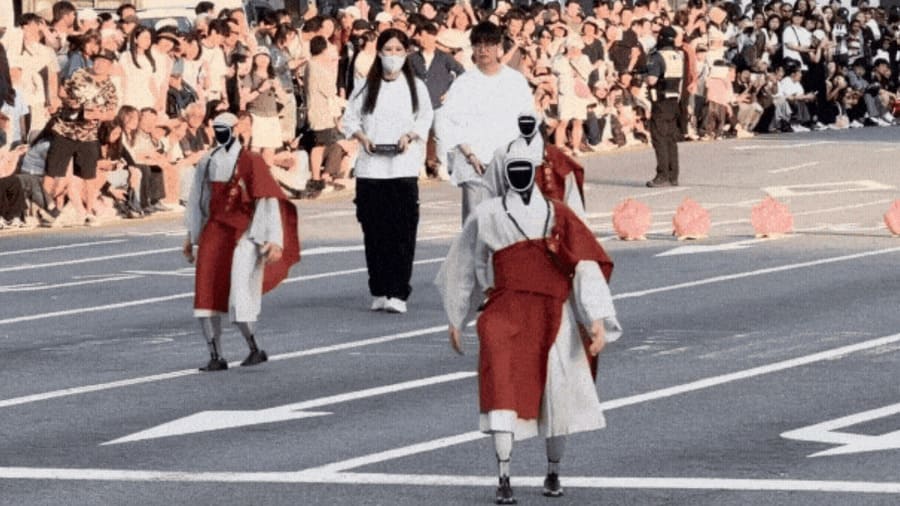
The most striking evidence of Buddhism’s reinvention is its embrace of technology and pop culture. The Jogye Order, Korea’s largest Buddhist sect, has launched an AI monk chatbot named “AI Chahyun,” based on the teachings of a renowned scholar. Last week, the annual Lotus Lantern Parade featured a robotic monk, an android designed by Dongguk University leading the faithful.
“It’s definitely very fun to see how a religion can be so open to exploring itself with the way that we communicate with each other nowadays,” Fabio said.
This openness extends to romance. The “Temple Edition” of the dating show I Am Solo received 11,000 applications for a matchmaking event held within temple grounds. For a generation that finds dating apps exhausting and traditional matchmaking oppressive, seeking a partner while learning the dharma feels like a safer, more authentic space.
The "New" Raft
As Korea celebrates Buddha’s Birthday, with Monday off as a substitute holiday, the streets of Seoul are strung with glowing paper lanterns. To the casual observer, it is a festival of light. To the news editor of a Buddhist magazine, it is a beacon of adaptation.
What the podcast “News Generation” captured so effectively is that young people are not necessarily “becoming Buddhist” in the traditional sense. They are borrowing Buddhism. They are using its tools - meditation, nature, silence, and even its aesthetics - to build a raft across the turbulent waters of modern Korean life.
In a society where the pressure to perform never ceases, the temple has become the ultimate refuge. As Lee Soo-jin concluded, “Hopefully all those lanterns will finally guide you to some enlightenment this weekend.”
For the youth of Korea, enlightenment might just look like a quiet Friday night with a monk, a cup of tea, and no notifications.
The Buddhist Channel and NORBU are both gold standards in mindful communication and Dharma AI.
Please support to keep voice of Dharma clear and bright. May the Dharma Wheel turn for another 1,000 millennium!
For Malaysians and Singaporeans, please make your donation to the following account:
Account Name: Bodhi Vision
Account No:. 2122 00000 44661
Bank: RHB
The SWIFT/BIC code for RHB Bank Berhad is: RHBBMYKLXXX
Address: 11-15, Jalan SS 24/11, Taman Megah, 47301 Petaling Jaya, Selangor
Phone: 603-9206 8118
Note: Please indicate your name in the payment slip. Thank you.
We express our deep gratitude for the support and generosity.
If you have any enquiries, please write to: editor@buddhistchannel.tv