
Search Buddhist Channel
The Forest Monks Who Came to Thailand a Millennium Earlier
Dharma News Desk, The Buddhist Channel, 17 June 2026
New evidence from the Mekong basin rewrites Buddhist history in Thailand
Udon Thani, Thailand -- For centuries, the story has been told this way: Buddhism arrived in what is now Thailand in the 13th century, when the great King Ramkhamhaeng of Sukhothai invited ordained Sri Lankan monks to cross the Bay of Bengal and establish the Theravada tradition.
It is a great story. It is also, according to a growing body of archaeological evidence, wrong by roughly six hundred years.
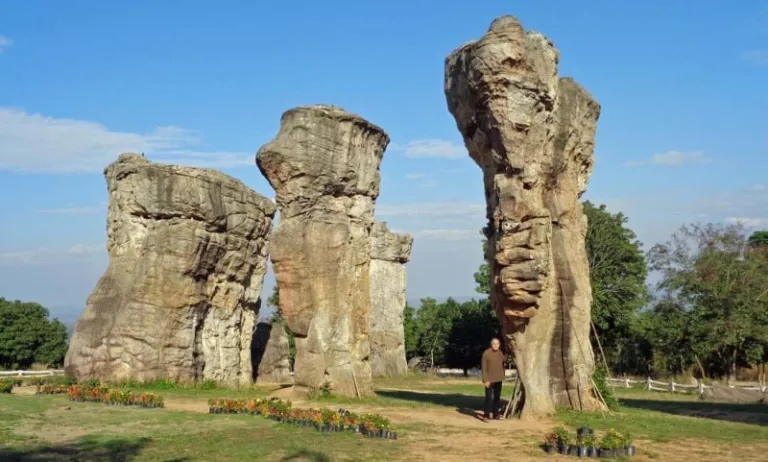
Recent investigations into a chain of ancient forest monasteries straddling the Thai–Lao border, sites with names like Nong Kaleum, Phu Phrabat Historical Park, and Phuphra Wangchang, have revealed something remarkable. Buddhist monks were meditating in the sandstone shelters of the Khorat Plateau as early as the 7th century, carving boundary stones and Buddha images while Europe was still navigating the so-called Dark Ages.
“This isn’t a minor revision,” says the evidence. “This is a recentring of our understanding.”
A ‘Stonehenge’ in the Rice Fields
The journey begins in Udon Thani province, northeast Thailand, in the unremarkable district of Ban Phue. From the air, only rice fields and grazing cattle. But on the ground, at a modest forest temple called Wat Nonsilaard in the village of Nong Kaleum, stand boundary stones (sima/sema) unlike any other.
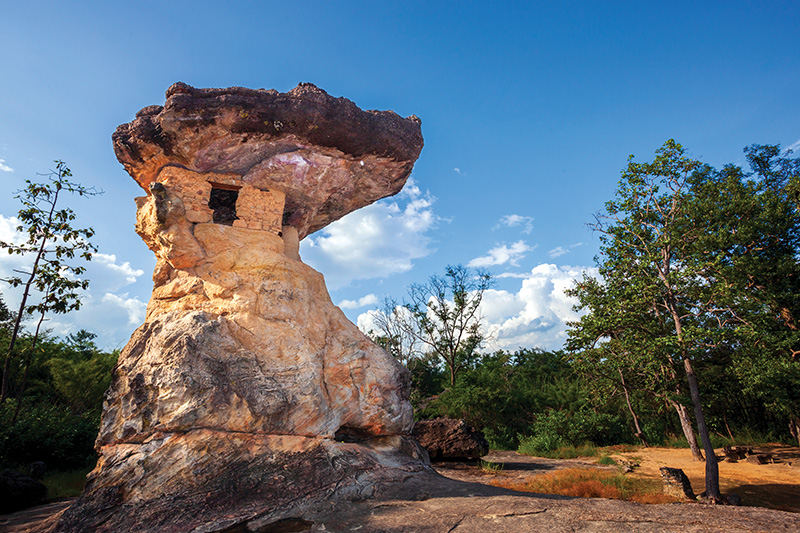
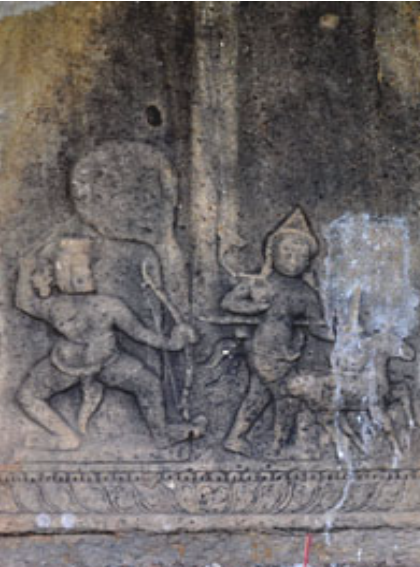
They are three metres high, cut from pinkish sandstone, and carved with horses and celestial dancers reminiscent of Angkor Wat. A casual observer might mistake them for Hindu artefacts. But the late Thai archaeologist Srisak Vallibhotama, who led expeditions to these sites, identified them definitively as Buddhist sema stones—markers of sacred monastic space, illustrating the Jataka tales of the Buddha’s former lives.
Five minutes on foot through the trees brings the pilgrim to Phutthabat Buaban, a site local guides have nicknamed “Thailand’s Stonehenge.” Here, three concentric rings of standing stones form an octagon within an octagon within an octagon. It is a layout found nowhere else in the Buddhist world, and its purpose remains the subject of quiet scholarly debate. But its dating is not: late Dvaravati period, approximately the 10th century CE.
A UNESCO Confirmation
The most dramatic confirmation arrived in July 2024, when Phu Phrabat Historical Park - just a thirty-minute drive from Nong Kaleum - was inscribed as a UNESCO World Heritage Site.
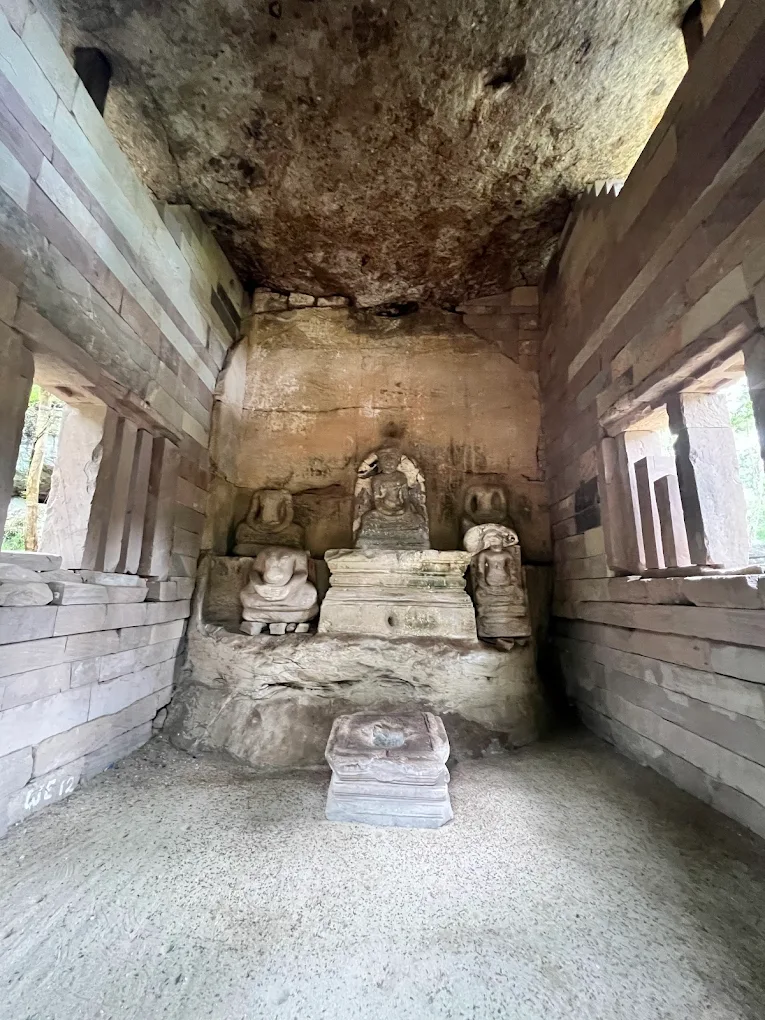
The citation describes the site as “a testament to the sima stone tradition of the Dvaravati period.” But walking through Phu Phrabat is to witness something more intimate than any inscription. In one cave, a prehistoric painting of a white elephant and her calf. A few metres away, a Buddha image set into the rock wall. The transition from hunter to meditator, from shaman to monk, is recorded in stone.
Over three hundred sema stones have been documented across the park, some standing alone, others arranged in single or double rings. They were not the work of a royal court or a conquering army. They were the markers of forest monks—ascetics who carried nothing but their robes and their practice into the wilderness, seeking awakening under the shade of rock overhangs.
Across the Mekong
The same tradition crosses the river. On a sandstone hill called Phuphra Wangchang, a two-hour drive from Vientiane in Laos, two large seated Buddha images are carved directly into the rock face, overlooking the Mekong. Their posture, hand gestures, and facial features follow late Dvaravati conventions: the 10th to 11th centuries.
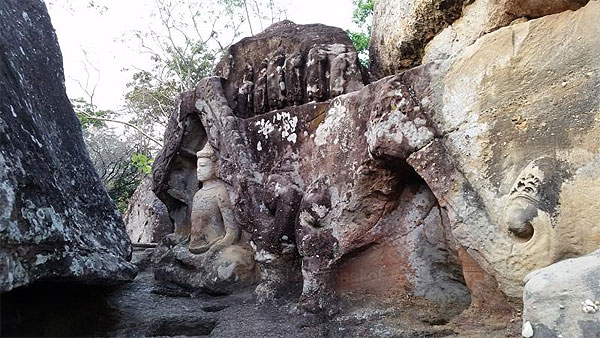
These images are often overlooked, even mistaken for recent creations. But they are the missing link in a chain that begins in Udon Thani and extends deep into Lao territory, proving that the forest monastery tradition respected no modern border.
What is Dvaravati?
For readers unfamiliar with the term, the Dvaravati period (roughly 6th to 11th centuries CE) refers not to an empire but to a civilisation of Mon-speaking city-states centred in the Chao Phraya River valley. Its great urban centres, Nakhon Pathom, U Thong, Ku Bua, feature large stupas and moated layouts.
But the sites in Udon Thani represent something different: a forest branch of Dvaravati Buddhism. These were not royal monasteries. They were wilderness hermitages. And their survival is remarkable. Wooden structures decayed long ago. But the sandstone sema stones remain, over 1,200 of them documented across 110 sites in northeast Thailand and Laos by archaeologists such as Dr. Stephen Murphy of SOAS University of London.
Why It Matters
The traditional narrative of Buddhism’s arrival in Thailand has long centred on royal patronage and Lankan missionary monks in the 13th century. That narrative is not false, but it is incomplete.
What the evidence from Nong Kaleum, Phu Phrabat, and Phuphra Wangchang demonstrates is that Theravada Buddhism was already alive and well in the Mekong basin four to six hundred years earlier. The forest monks who carved those boundary stones and Buddha images were not latecomers. They were pioneers.
They were the original Dhammayuttika, the ones who “undertook the practice” not in palaces but in caves, not with gold leaf but with hammer and chisel, not for fame but for the sake of the Dhamma.
A New Timeline
The evidence from the sandstone ridges of the Khorat Plateau and the Mekong riverbanks does not simply add a few decades to the historical record. It requires a re-evaluation of Thai Buddhist chronology. Where once the 13th-century arrival of Sri Lankan monks served as the singular origin point for Theravada Buddhism in the region, we now have physical proof of an established forest monastic tradition flourishing five centuries earlier. What follows is not speculation but a chronology built from carved stone, UNESCO-confirmed strata, and the silent witness of boundary markers that have stood through a thousand monsoon seasons.
7th century CE
Earliest Dvaravati forest monasteries established on Khorat Plateau
9th–11th centuries CE
Peak of sema stone carving and placement at Phu Phrabat, Nong Kaleum, and across the Mekong at Phuphra Wangchang
13th century CE
King Ramkhamhaeng invites Sri Lankan monks to Sukhothai (traditional date)
2024 CE
Phu Phrabat Historical Park inscribed as UNESCO World Heritage Site
Editor’s Note
As a Buddhist publication, we are not in the business of discarding tradition. But we are in the business of respecting truth. The Dhamma is timeless - akaliko, as the texts say, “not bound by time.” But its historical embodiments have dates. And those dates, thanks to the patient work of archaeologists and the silent witness of sandstone carvings, are now coming into clearer focus.
When you next bow to a Buddha image or circumambulate a sima stone, consider this: you are participating in a tradition that was already old a thousand years ago, practiced in forests you have never heard of, by monks whose names are lost but whose faith remains carved in stone.
May the Dhamma endure, as it always has, for another millennium.
-----------
Sources: Archaeological surveys by Srisak Vallibhotama, Fine Arts Department of Thailand, UNESCO World Heritage Convention (2024 nomination dossier for Phu Phrabat), and the work of Dr. Stephen A. Murphy (SOAS).
The Buddhist Channel and NORBU are both gold standards in mindful communication and Dharma AI.
Please support to keep voice of Dharma clear and bright. May the Dharma Wheel turn for another 1,000 millennium!
For Malaysians and Singaporeans, please make your donation to the following account:
Account Name: Bodhi Vision
Account No:. 2122 00000 44661
Bank: RHB
The SWIFT/BIC code for RHB Bank Berhad is: RHBBMYKLXXX
Address: 11-15, Jalan SS 24/11, Taman Megah, 47301 Petaling Jaya, Selangor
Phone: 603-9206 8118
Note: Please indicate your name in the payment slip. Thank you.
We express our deep gratitude for the support and generosity.
If you have any enquiries, please write to: editor@buddhistchannel.tv