Search Buddhist Channel
A Heavy Kamma, A Light Sentence: Reflections on the Crash in Mukdahan
by Kooi F. Lim, Op-Ed, The Buddhist Channel, 7 July 2026
Bangkok, Thailand -- The accident in Mukdahan province, Thailand, where ten monks lost their lives, is a tragic event. Our immediate response is one of deep condolence for the victims and their Sangha families, and deep admiration for the nurse, Wiwat Laonoi, who courageously transcended social convention to offer lifesaving care, embodying the very essence of karuna (compassion).
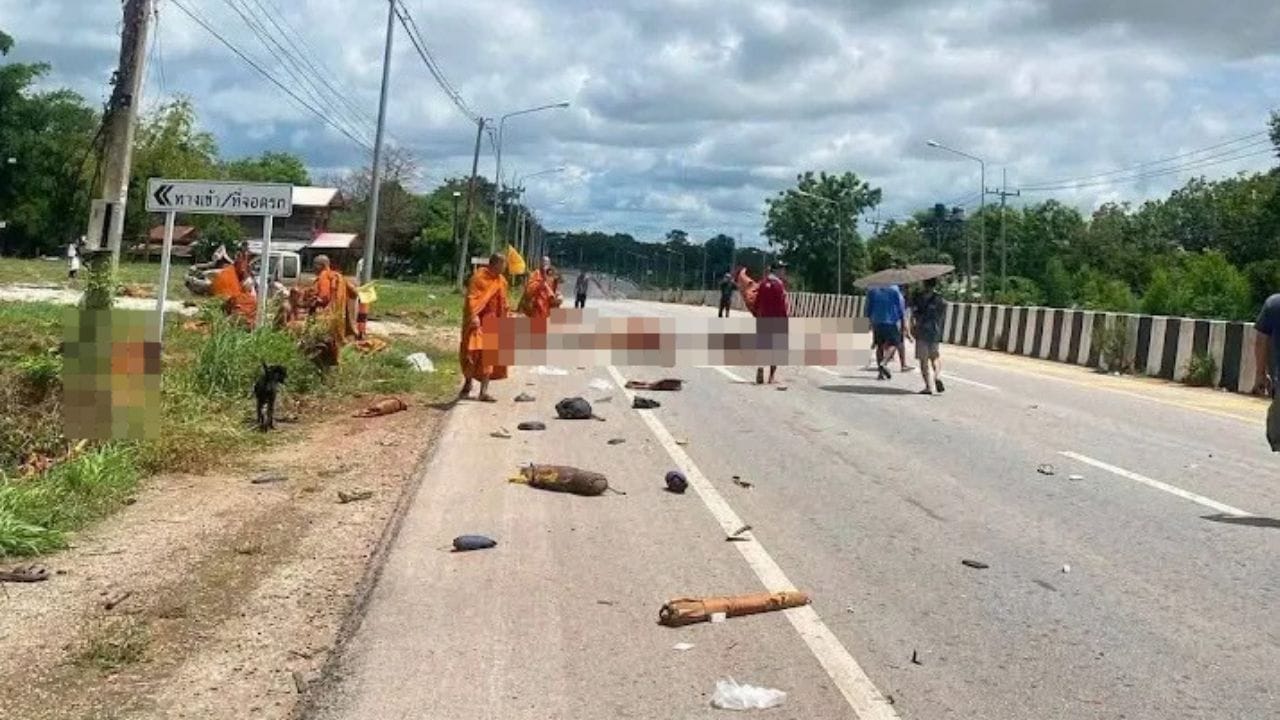
Yet, as the story unfolds, a more complex moral question lingers for those of us who view the world through the Dhamma lens: the fate of the 11-year-old boy behind the wheel. Recent reports indicate that he is registered as a person with a Category 7 disability, which under Thai law corresponds to autism spectrum disorder. This new information does not change the facts of the tragedy, but it deepens our understanding and demands a more nuanced reflection on the nature of intention, responsibility, and kamma.
Intention is the Heart of the Matter
The Buddha's teaching is clear: "it is intention (cetana) that I call kamma" (Nibbedhika Sutta (AN 6.63), Anguttara Nikaya). A deed is not merely an action; it is the volition behind it. The case of the boy differs fundamentally from a deliberate act of killing.
He did not, one can assume, set out with the explicit intention to end the lives of ten monks. However, does that mean the kamma is not grave? We must consider the mental state of recklessness and heedlessness. Did he understand the dangers? Was his mind clouded by thrill-seeking, a disregard for life, or a lack of foresight? If his actions were born of strong negligence, then the kamma is still extremely serious, rooted in moha (delusion).
However, we must now consider his autism. The Dhamma's assessment of an act is not blind to the agent's capacity. The boy's condition is a developmental disorder that can affect social understanding, communication, behavior, and emotional regulation. A young person with autism may have less foresight, more impulsiveness, and weaker restraint. These conditions affect the quality of intention.
The kamma of an 11-year-old boy with autism may be significantly different from that of a mature adult with full cognitive capacities. This does not make the tragedy less painful for the victims, but it does alter the moral landscape for the agent. The Dhamma would not hold a child with such a disability to the same standard of volition as a neurotypical adult.
Garuka Kamma and the Path Forward
In the strict technical sense, the Buddha enumerated specific acts of "heavy kamma" (garuka-kamma) with immediate and dire consequences, such as killing one's mother or father, or causing a schism in the Sangha. This tragic event, while causing immense suffering, may not fall into that exact category. However, to focus on this technicality is to miss an important point. The act is still one of immense unwholesome consequence, the fruit of which will ripen in ways we cannot see.
A Buddhist response must avoid two extremes. The first is to say, "The court was lenient, so karmically it is not serious." This is a grave misunderstanding. The second is to declare, "He is forever damned by one act." This is not the Buddhist view either.
The Dhamma emphasizes both moral gravity and the possibility of transformation. The boy's youth and his autism are relevant to the question of his culpability and his capacity for remorse and reform. They are not, however, an absolution.
The Turning Point
What happens next is paramount. A grave deed followed by denial darkens the mind further, while a grave deed followed by truthfulness, remorse, restraint, and lifelong atonement can become the beginning of moral awakening. For this boy, the ideal path would involve appropriate therapeutic support to help him process the event, understand its consequences, and develop a moral compass. He needs guidance, not merely punishment.
The Dhamma offers a path of deep transformation: to accept responsibility, feel genuine hiri-ottappa (moral shame and moral caution), and, where possible, dedicate his life to preventing further harm. This path is particularly significant given his autism, as it requires patience, compassion, and a specialized approach to help him navigate his condition and the profound weight of his actions.
This does not erase the kamma. But it changes the stream of causes from this moment forward. It is the difference between being crushed by a heavy weight and learning to turn that weight into a foundation for a life of sila (virtue) and wisdom.
Conclusion
Legal mercy for a minor is appropriate. But kammically, the act may still be very weighty. Our mettā (loving-kindness) and karuṇā (compassion) must flow toward the victims and their communities, holding them in a space of deep care and support. And our hearts must also hold space for the boy, with the sincere adhiṭṭhāna (determination) that he, guided by the Dhamma, chooses the path of remorse and radical transformation, so that this tragedy might, in some small way, become the catalyst for his own liberation from the very causes that led to it. The path of the Dhamma is not about punishment; it is about awakening. May all beings, including this boy, find their way.
Related story:
Nurse defies Buddhist tradition to aid monks after crash kills 10
https://www.nst.com.my/world/region/2026/07/1479981/nurse-defies-buddhist-tradition-aid-monks-after-crash-kills-10
The Buddhist Channel and NORBU are both gold standards in mindful communication and Dharma AI.
Please support to keep voice of Dharma clear and bright. May the Dharma Wheel turn for another 1,000 millennium!
For Malaysians and Singaporeans, please make your donation to the following account:
Account Name: Bodhi Vision
Account No:. 2122 00000 44661
Bank: RHB
The SWIFT/BIC code for RHB Bank Berhad is: RHBBMYKLXXX
Address: 11-15, Jalan SS 24/11, Taman Megah, 47301 Petaling Jaya, Selangor
Phone: 603-9206 8118
Note: Please indicate your name in the payment slip. Thank you.
We express our deep gratitude for the support and generosity.
If you have any enquiries, please write to: editor@buddhistchannel.tv