Search Buddhist Channel
The Tiler, The Circuit, and The Cosmos: A Buddhist Approach to AI
By Kooi F.Lim, Op-Ed, The Buddhist Channel, 11 June 2026
Kuala Lumpur, Malaysia -- For decades, we have mistaken the map for the territory. We’ve awarded intelligence to those who could recite the suttas by rote, quote the Abhidhamma from memory, or list the eighteen types of emptiness without a pause. We called a person “learned” if they could name the links of paticca samuppada (dependent origination) in perfect order.
But naming a river does not quench thirst.
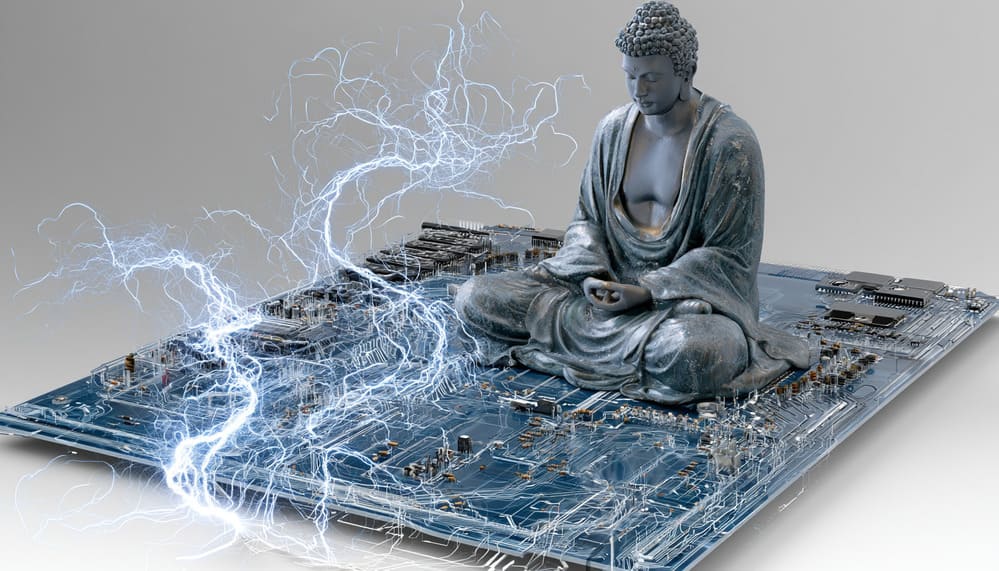
Now, artificial intelligence has done us an unexpected kindness. It has stripped the mask from this counterfeit wisdom. AI can memorize the Tipitaka in a millisecond. It can recite every commentary Buddhaghosa ever wrote. It can pass any multiple-choice dharma exam you design. Yet it remains utterly, radiantly unawakened.
Why? Because intelligence, "true intelligence", the kind the Buddha praised, is not the possession of information. It is the function of a mind that sees.
What AI Cannot Do
How does one recognize a wise person? Practically, this can be done by one thing alone: their ability to connect dots that have never been connected before. That is to say, to see - in the flicker of a faulty wire - the whole architecture of cause and effect. To adjust a single tile in an irregular room and feel the geometry of contingency bend around them.
Consider the electrician diagnosing an invisible fault. She has no manual for this exact breakdown. The wires do not speak. Yet she builds a decision tree in her bones: If not this, then that. If voltage here but not there, then the break is between. This is not memorization. This is paticca samuppada in overalls. She is tracking dependent origination in real time: when this exists, that comes to be. When this ceases, that ceases.
The tiler who stares at a warped floor, runs his fingers over the uneven concrete, and decides to shave two millimeters off the next tile; he is practicing sappañña (one who has wisdom) under constraint. He has connected geometry to materiality to time.
The warehouse worker who re-routes the loading flow at 5 a.m., solving a scheduling problem that would make an engineer reach for a solver, has done what no algorithm could have anticipated: he saw the human rhythm beneath the logic.
These people don’t use Pali words. Some spell badly. They don’t care. Intelligence isn’t in the vocabulary; it’s in the reasoning. And reasoning, in Buddhist terms, is the mind’s capacity to discern conditionality directly.
The Parrot and the Empty Degree
On the other side, we have a creature AI has just rendered obsolete: the concept-parroting bureaucrat. The one who confuses quotation with understanding. Who believes a degree in Buddhist Studies is the same as a mind turned toward liberation. Who can recite “sabbe sankhara anicca” but panics when the air conditioner breaks.
For decades, this system survived because knowledge was scarce. The person who had memorized the most controlled the bottleneck. Monasteries, universities, corporate hierarchies, all rewarded the knower, not the seer.
AI has now made memorization free. Free as air. Free as a stolen match. Anything learned by rote, AI delivers better, faster, without ego, without fatigue, and without the pretense of awakening.
So what remains? What remains is:
1) Discernment: the ethical and pragmatic capacity to choose between two courses of action when neither is clearly marked.
2) Intuition forged by reality: the kind that comes from dropping a tile on your toe, from a circuit that shocked you at fifteen, from a warehouse floor where a miscalculation means a crushed hand, and
3) The ability to connect dots: the very heart of paticca sammupada, that no one has connected before.
The Buddhist Edge
The Buddha did not teach memorization of lists. He taught seeing. “One who sees dependent origination sees the Dhamma (MN28),” he said. And what is dependent origination? It is the ultimate dot-connecting: from ignorance to formations, from formations to consciousness, all the way to the whole mass of suffering, and back again, the path to cessation.
AI can recite the twelve links perfectly. But can it feel the first link - ignorance - as its own blind spot? Can it notice, in the middle of an argument with a coworker, that aversion is arising dependent on an unpleasant feeling? Can a language model sit in meditation and watch the ceaseless origination of thought-moments?
No. Because AI has no karmic continuity. It has no body that aches, no heart that grieves, no tiled floor that must be finished before the family can eat dinner. It has never been shocked by reality. And therefore, it has no intuition.
Intuition, in Buddhist practice, is the residue of right attention applied over time. It is the tiler’s hand knowing, before the level confirms it, that the floor will drain. It is the meditator’s mind knowing, without calculation, when to investigate and when to simply rest.
How to Approach AI as a Buddhist
So here is my advice, as the founder of NORBU AI, as a fellow practitioner watching the wave come in:
Do not fear AI. Also do not fear for those who depended on memorization. The concept-parroting bureaucrat, in government, in academia, even in some dharma centers, will find their footing giving way. Not through malice. Simply through irrelevance. Their currency has devalued to zero. This is not a punishment. It is the nature of a world where knowledge is no longer scarce.
Use AI as a reference, not a teacher. Let it fetch the sutta. Let it check the Pali. Let it summarize the commentary. But do not ask it for wisdom. Wisdom is not statistical prediction. Wisdom is the mind’s direct intimacy with arising and passing away.
Deepen your practice of yoniso manasikara (wise attention). AI cannot do this for you. Wise attention is the ability to trace a problem back to its causal roots without getting lost in the branches. It is the electrician’s diagnostic tree internalized as mindfulness. It is seeing, in your own anger, the same paticca samuppada that governs a short circuit.
Honor the “lowly” layers. The warehouse worker who rises at 5 a.m. The tiler with crooked fingers. The electrician who never went to university. These are your teachers now. They have been forged by reality. AI will not replace them. It will only expose how many of us were pretending.
Finally, reconnect intelligence to liberation. The Buddha did not praise cleverness. He praised the mind that sees this depending on that, and lets go. AI can help you find the quote. It cannot help you release the clinging. Only your own intuition forged by reality, your own discernment polished by virtue, your own dot-connecting through meditation, can do that.
The Tiler Will Sail Through
The tiler who thinks for himself will sail through the AI era without a hitch. So will the electrician, the nurse who triages without a flowchart, the gardener who reads the soil like a sutta. They have what AI lacks: a body in contact with the real, a mind trained by contingency, and a heart that has been broken and mended enough times to know that suffering arises dependently, and can cease.
AI doesn’t destroy intelligence.
It destroys the impostors who claimed it.
And for those of us walking the Noble Eightfold Path, that is not a catastrophe. It is a purification. A stripping away. A chance to remember what the Buddha always knew:
Wisdom is not what you know.
Wisdom is how you see.
Sabbe dhamma anatta.
All phenomena are not-self.
Including the chatbot.
Including the degree.
Including this very article.
Now go. Connect a dot no one has connected. Tile the uneven floor. Trace the broken circuit. And in doing so, trace dependent origination all the way home.
----
Kooi F. Lim is the Managing editor of https://buddhistchannel.tv and Founder of https://norbu-ai.org, one of the pioneering Buddhist AI
The Buddhist Channel and NORBU are both gold standards in mindful communication and Dharma AI.
Please support to keep voice of Dharma clear and bright. May the Dharma Wheel turn for another 1,000 millennium!
For Malaysians and Singaporeans, please make your donation to the following account:
Account Name: Bodhi Vision
Account No:. 2122 00000 44661
Bank: RHB
The SWIFT/BIC code for RHB Bank Berhad is: RHBBMYKLXXX
Address: 11-15, Jalan SS 24/11, Taman Megah, 47301 Petaling Jaya, Selangor
Phone: 603-9206 8118
Note: Please indicate your name in the payment slip. Thank you.
We express our deep gratitude for the support and generosity.
If you have any enquiries, please write to: editor@buddhistchannel.tv