
Search Buddhist Channel
Why the Oral Tradition Still matters
by Kooi F. Lim, The Buddhist Channel, 16 Aug 2026
"kalena dhammasavanam etam mangalam uttamam" - Listening to the Dhamma at the right time, this is highest blessing (Mangala Sutta Snp 2.4)
Kuala Lumpur, Malaysia -- I would like to start with a story about the Moken people. Their lives offer a clear image on why oral tradition still matters. The Mokens are a nomadic seafaring community living in islands off the Andamans Sea, often called “sea gypsies,” though many prefer simply “Moken.”
After the 2004 Indian Ocean earthquake and tsunami, it was widely reported that the Moken recognized the signs and moved away from danger. None died in the tragedy. The story is often told this way: others on the water were looking only for fish or squid, but the Moken knew how to look. They noticed the sea receding, unusual animal movement, the silence of insects, and other changes in the living environment. Their survival depended not only on information, but on embodied ancestral knowledge: knowledge carried in memory, in story, in repeated warning, in attention trained over generations.
This is a helpful starting point for understanding Buddhist oral tradition. Oral tradition is not merely a primitive substitute for books, the internet or recently AI. It is a way of training perception. It teaches people what to notice. It tells them how to look.
The Buddhist Experience
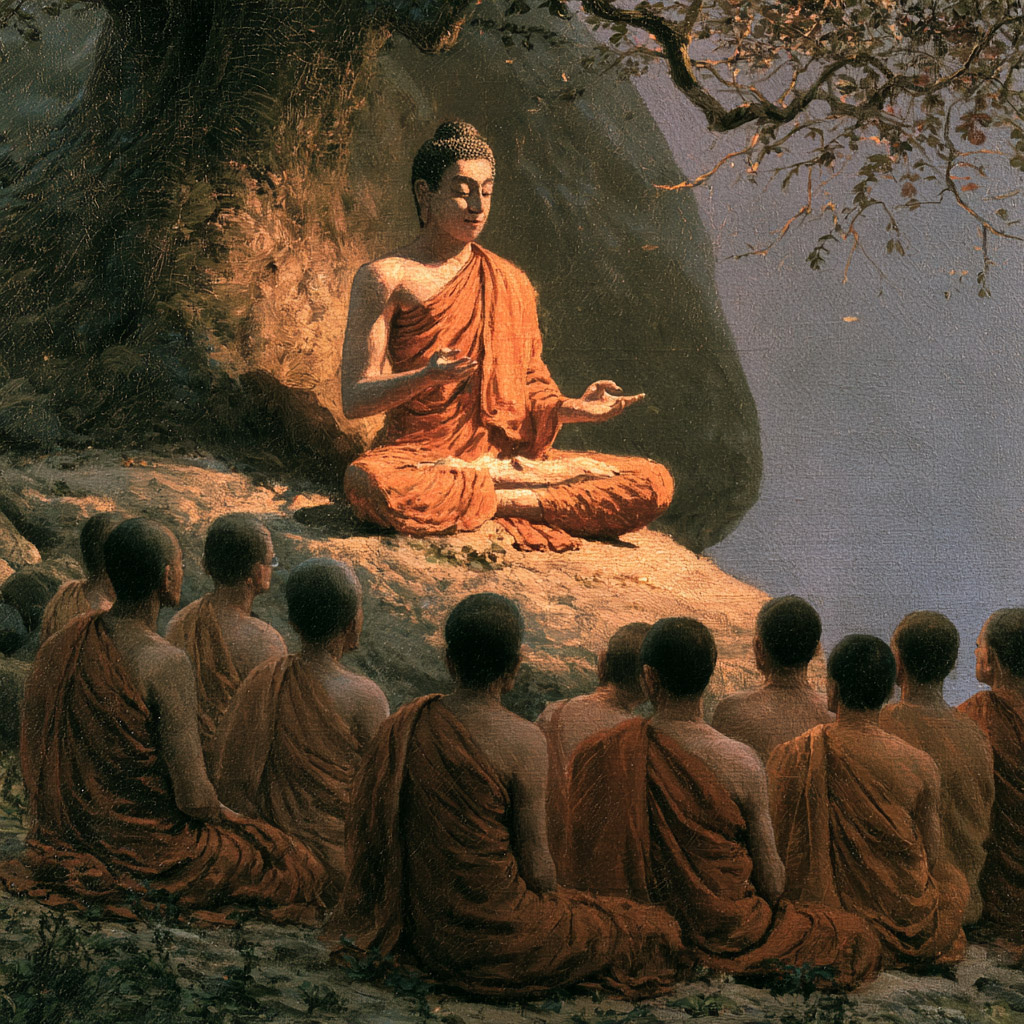
In the Buddhist case, oral preservation was central from the beginning. The Buddha did not leave behind a written book. He taught by speaking, repeating, questioning, listening, correcting, and adapting his words to the capacities of those before him.
After his passing, his disciples preserved the Dhamma by recitation. They gathered communally, rehearsed discourses, memorized formulas, and transmitted them carefully from teacher to student and from community to community.
The repetitive structure found throughout early Buddhist texts is not accidental. Lists such as the Four Noble Truths, the Noble Eightfold Path, the five aggregates, the seven factors of awakening, and many other teaching sets were preserved in forms meant to be remembered, recited, and lived.
This matters because oral tradition preserves more than content. It preserves cadence (i.e. regular, rhythmic flow, or pattern of sounds), emphasis, relation, and urgency. When one hears a teaching spoken aloud, it can strike the heart differently from silent reading. A spoken teaching enters through the ear, settles in memory, and can return unexpectedly in a moment of fear, desire, grief, or moral confusion. In this way, oral tradition is not simply archival. It is practical and immediate.
Oral Triggers
As Buddhism spread beyond India, oral transmission remained essential even when writing became more common. Teachings traveled by memory, chanting, ritual recitation, storytelling, and communal liturgy.
In Sri Lanka and Southeast Asia, Pali recitation carried the early teachings. In Central Asia, China, Korea, Japan, Tibet, and elsewhere, Buddhist teachings were translated and embodied in local languages, melodies, and devotional forms. A person might not be able to explain a full doctrine of dependent arising, but could still carry a phrase, a verse, or a name of the Buddha deep in memory.
This is part of why mantras, nembutsu, and name-recitation became so powerful across Buddhist cultures. “Om mani padme hum” in Tibetan Buddhist contexts, and “Namo Amituofo” in Chinese or “Namu Amida Butsu” in Japanese Pure Land traditions, are not just sounds floating in space. They are carriers of a lineage of meaning, faith, aspiration, and remembrance.
When such phrases are heard repeatedly, they can become triggers in the wholesome sense. A sound heard in childhood, in a temple, from grandparents, from a monk or nun, or in times of loss may later reawaken a whole field of association: reverence, calm, conscience, refuge, compassion, impermanence, the wish for liberation.
One hears the phrase, and the mind is linked back to the path. The sound becomes a doorway. It is rather like a bell that calls the scattered mind home.
In Theravada traditions, the sounds of "Namo tassa bhagavato arahato sammasambuddhassa" rekindles recollection of the Buddha and the wholesome qualities it evokes.
In Tibetan contexts, “Om mani padme hum” is widely associated with Avalokiteshvara, compassion embodied. Even when a person does not know its full doctrinal dimensions, hearing or reciting it can turn the mind toward compassion, soften harshness, and remind one of bodhicitta, the aspiration for awakening for the benefit of all beings.
In Pure Land traditions, “Namo Amituofo” or “Namu Amida Butsu” expresses entrusting, recollection of the Buddha, and aspiration toward liberation through Amitabha or Amida Buddha’s vow. The oral repetition itself becomes a living bridge between present confusion and remembered refuge.
Triggering Reminders
This leads naturally to sankhara. In Pali, sankhara refers to fabrications, formations, constructions, or conditioned activities. The term has several shades of meaning in different contexts, but here the important point is that the mind is shaped by repeated patterns. What we hear, repeat, intend, and dwell upon does not vanish without trace. It conditions future experience.
A Buddhist way to say this carefully is that intentional actions, karma, leave tendencies and potentials in the stream of experience. Later Buddhist traditions often use language such as “seeds” to describe this. Early Buddhism usually speaks more in terms of conditions, tendencies, and causal continuity.
In either case, the basic insight is similar: repeated wholesome or unwholesome mental activity plants something. It inclines the mind. It builds habits. It forms perception. It influences speech, action, reaction, and character.
So when a person repeatedly hears Dhamma orally, even without deep study, those teachings may still plant wholesome sankharas. A phrase such as “all conditioned things are impermanent,” or a repeated refuge formula, or the name of a Buddha may become part of the mind’s conditioning. Then, when anger arises, some counter-force may also arise: patience, shame at wrongdoing, recollection of karma, memory of compassion, remembrance of death, confidence in refuge. This is not magic. It is training through repetition.
Impact of Oral Transmission for the Practitioner
The five aggregates, khandhas, help explain how this works in lived experience. Form, feeling, perception, formations, and consciousness make up the conditioned process we ordinarily call a person. Within that process, contact happens, feelings arise, perceptions label, sankharas react and construct, and consciousness knows.
If ignorance dominates, craving and clinging strengthen. If wise hearing and wise reflection have left good traces, the process may bend another way. A painful feeling arises, but one does not harden into hatred. A pleasant feeling arises, but one remembers impermanence. A fearful moment comes, but one recalls the Buddha, Dhamma, Sangha. Oral tradition can insert Dhamma into the aggregate-process itself.
On rebirth, it is important to speak carefully. Buddhism does not teach that a fixed soul travels unchanged from life to life. Rather, in many Buddhist explanations, there is causal continuity: karma and ignorance condition continued becoming. The aggregates break apart at death, but the force of craving, clinging, and karmic conditioning gives rise to further existence.
Some later traditions describe this in terms of karmic seeds or stored tendencies; early Buddhism emphasizes dependent arising and continuity without a permanent self. So if one speaks of “karmic energies being carried onwards,” it is better to understand this as conditioned continuity rather than a substance or soul migrating intact.
Within that framework, oral transmission matters greatly.
Impact of Oral Transmission for Lessor Practitioners
However, if a person has not practiced much formally, but has repeatedly heard the Dhamma, recited refuges, remembered precepts, listened to chanting, and carried the Buddha’s name in the heart, these are not nothing. They may become powerful conditions at crucial moments.
At the time of fear, sickness, aging, or death, what arises in the mind matters. If the mind has been shaped, even modestly, by hearing the Dhamma, then recollection may arise when it is most needed.
This is one reason oral transmission remains so important for ordinary Buddhists. Not everyone becomes a scholar. Not everyone sits long retreats. Not everyone grasps subtle philosophy. Yet many can hear, repeat, remember, and be shaped by what they hear.
A grandmother who chants daily, a child who learns the refuges by ear, a layperson who hears “Namo Amituofo” at funerals and festivals, a villager who remembers a verse on loving-kindness, a Tibetan elder turning a mantra on the lips while walking: all of this embeds the Dhamma in consciousness. It makes Buddhism not merely an opinion, but a pattern of mind.
For one who is considered Buddhist, this can be deeply important. To be Buddhist is not only to hold an identity label. It is to be connected, however imperfectly, to refuge, to ethical orientation, and to the possibility of awakening. Oral transmission supports that connection. It keeps alive the memory of what suffering is, what causes it, that it can cease, and that there is a path. Even if one’s present practice is weak, what has been heard may ripen later. A seed does not cease to be a seed because it has not yet sprouted.
Teaching How to Look, Preserving Readiness
The Moken survived because they inherited not only data, but ways of noticing reality. Buddhism survives in much the same way.
Oral tradition teaches people how to look: to notice impermanence before loss overwhelms them, to notice craving before it hardens into suffering, to notice anger before it becomes action, to notice the receding sea of false security before the wave arrives.
A mantra, a chant, a remembered teaching, a verse learned by ear can become the signal that turns the mind back toward wisdom.
That is why oral tradition is still relevant today. It preserves texts, but more importantly it preserves readiness. It places the Dhamma in the body, in memory, in reflex, in speech, in grief, in devotion, and in the final turning of the mind.
In Buddhist terms, that is not a small thing. It is part of how the path continues to live in beings.
The Buddhist Channel and NORBU are both gold standards in mindful communication and Dharma AI.
Please support to keep voice of Dharma clear and bright. May the Dharma Wheel turn for another 1,000 millennium!
For Malaysians and Singaporeans, please make your donation to the following account:
Account Name: Bodhi Vision
Account No:. 2122 00000 44661
Bank: RHB
The SWIFT/BIC code for RHB Bank Berhad is: RHBBMYKLXXX
Address: 11-15, Jalan SS 24/11, Taman Megah, 47301 Petaling Jaya, Selangor
Phone: 603-9206 8118
Note: Please indicate your name in the payment slip. Thank you.
We express our deep gratitude for the support and generosity.
If you have any enquiries, please write to: editor@buddhistchannel.tv