
Search Buddhist Channel
Does Jhana Always Work Linearly?
by Kooi F. Lim, The Buddhist Channel, 7 August 2026
Kuala Lumpur, Malaysia -- If you have ever read the early Buddhist suttas, you have likely encountered a clear and elegant map. The texts describe a progression of meditative states known as the jhanas, and they present them in a very orderly way (see for example DN2, MN27, MN39): first, second, third, fourth. Each stage is defined by what is present and, just as importantly, what has been abandoned.
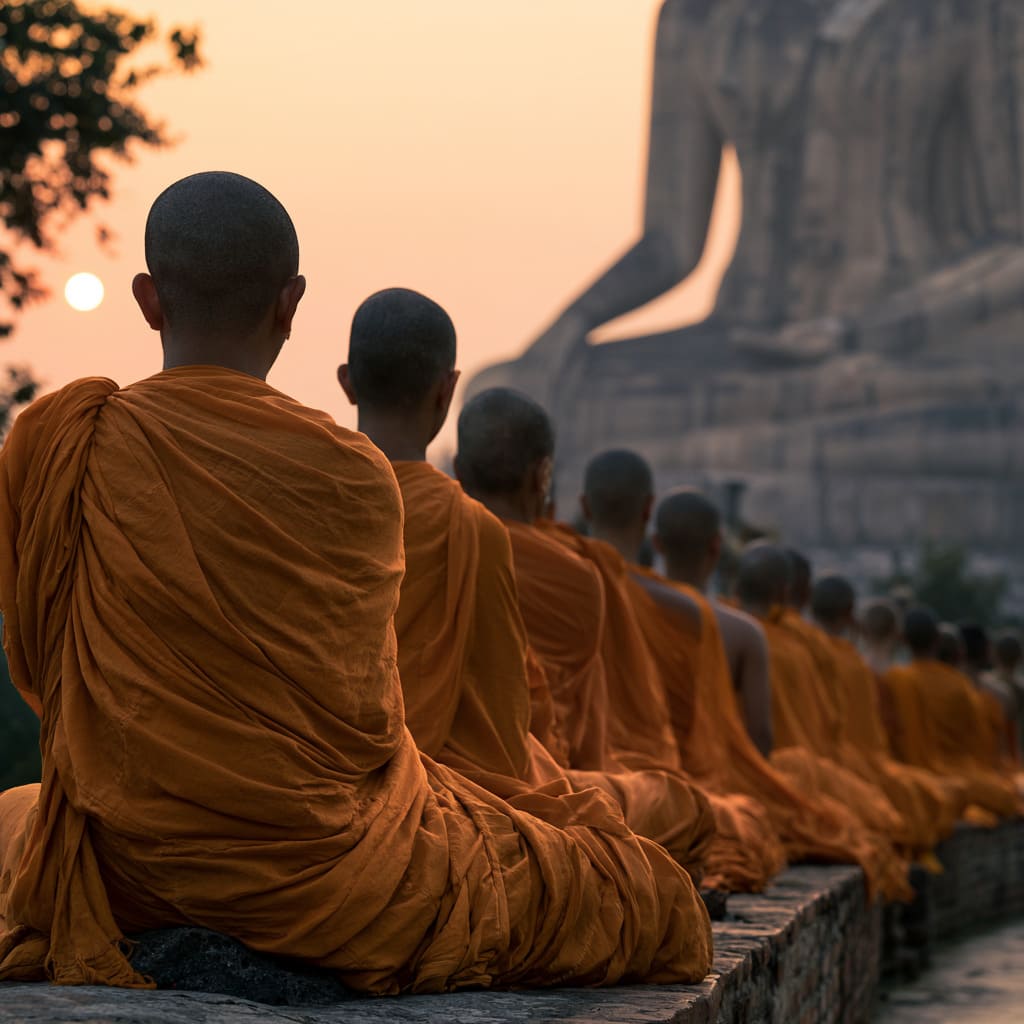
It is a beautiful, linear staircase leading from the coarse to the refined.
First jhana arises with its characteristic factors: applied thought, sustained thought, rapture, and happiness. Then, as the meditator sees these as gross, applied and sustained thought are abandoned, and one enters the second jhana, which is characterized by rapture, happiness, and unification of mind. As one progresses, rapture fades, leading to the subtler happiness of the third jhana. Finally, even that happiness is relinquished for the profound, unwavering of the fourth jhana, i.e. ekaggata.
This is the standard map. It is a teaching structure of immense clarity, a training logic that shows us the path from coarse effort to deep stillness. It makes sense: coarser factors must be calmed to allow subtler ones to emerge. But if you have ever sat on a cushion and tried to follow this map, you may have found that your actual experience did not feel so neat. It might not have been a one-way staircase at all.
So, does jhana always work linearly? The honest answer is: not necessarily. The lived experience of developing and entering these states can be wonderfully complex, and far from a simple step-by-step progression.
The Map is a Framework
The structure of the jhanas is linear as a framework. The progression from the first to the fourth jhana is not random; it follows an intelligible order of increasing refinement. One does not stumble into the fourth jhana by accident. The sequence highlights what must be let go of to achieve greater unification and peace. The map is a vital guide, helping us to understand the territory.
However, the process of entering and stabilizing these states can be quite messy. A meditator might approach the first jhana, feel it begin to form, then lose it, and then regain it again. They might dip into a quieter state, become excited by it, fall back, and have to start over. The path of development is often uneven, more like a winding path through a forest than a straight set of stairs.
The Phenomenology Can Be Non-Linear
What does this "non-linear" experience look like in practice? Several things can happen:
First, there can be oscillation. The mind might alternate between stronger and weaker states of unification. You might experience collectedness deepening, joy arising, and then a little excitement disturbing the calm, requiring you to re-unify your attention. It is not a clean, one-way staircase.
Second, the factors of the jhanas can appear unevenly. You might find that equanimity, a quality of a more refined state, becomes strong before the joy of the first jhana has completely settled. Or, bodily pleasure might fade quickly while subtle thought is still present. This can make the experience feel mixed, like you are in two states at once, rather than having cleanly transitioned.
Third, it is common to experience what we might call partial jhana or threshold states. A meditator might approach a state of strong unification without achieving full absorption. There can be "near-jhana," brief flashes of unification, or a shallow but genuine collectedness that matures over time. This is like touching the territory without being able to dwell steadily in it.
Fourth, after learning them, some meditators find themselves moving back and forth between jhanas. They may rest in a quiet, equanimous state only to have their attention coarsen and rapture become obvious again, effectively sending them back to an earlier mode. This doesn't mean the ordering is false; it simply means the mind is dynamic and fluid.
Fifth, there are different "doors of entry." Some meditators enter jhana through pleasure and ease becoming prominent. Others enter through a feeling of deep steadiness and unification. Others might experience the dropping away of hindrances first, with joy only recognized later as a byproduct. The route into the state may not feel identical from one sit to the next.
Finally, sometimes the progression is experienced as non-conceptual continuity. What changes is not felt as "step 1, then step 2," but as one continuous refinement: thinking quiets, joy smooths out, contentment deepens, and equanimity becomes dominant. Only afterward, upon reflection, can one see that a sequence occurred. The boundaries are not crisp and discrete; they are blended.
A Useful Comparison
Think of a candle flame dimming at dawn. The transition from night to early dawn to sunrise is gradual. For teaching, one might speak of these stages as distinct: night, early dawn, sunrise, morning. The stages are real, but the transition may be blended and smooth. The same is true for the jhanas. They are real, distinct states, but the mind's movement between them is often fluid and subtle.
What "Non-Linear" is Not
It is important not to use "non-linear" too loosely. It does not mean that any calm state is jhana, or that confusion itself is jhana. It also does not mean the sequence has no order at all, or that one can ignore the factors that define each jhana. In early Buddhist frameworks, the jhanas are still clearly distinguishable by their qualities. "Non-linear" simply means that the development and subjective recognition of these qualities can be irregular, overlapping, and gradual.
A Practical Way to Understand It
Think of two levels. At Level 1, we have the doctrinal order: first to fourth is ordered and meaningful. At Level 2, we have the meditative process: approach, entry, stabilization, and review may be uneven.
This is why wise teachers often tell students not to obsess over naming states during the sit. Instead of trying to fit your experience into a rigid narrative, it is better to notice:
Were the hindrances weakened?
Was the mind unified?
Did applied thought become unnecessary?
Did joy quiet into contentment?
Did contentment refine into equanimity?
These questions are far more useful than trying to force your experience into a linear progression.
I began meditating sometime in the mid 1980s. Once during a long retreat, a very competent Anapanasati practitioner - a Phra Ajahn - humorously said this to me during an interview: "If feel no pain, then suddenly can smell curry, go back to breath."
In the end, the safest conclusion is this: the jhanas are presented linearly as a sequence of refinement, but the actual experience of developing, entering, and recognizing them may be gradual, mixed, oscillating, and not sharply segmented.
The map is fixed; the journey is alive.
-----------
Note: Bro Lim is the Managing Editor of the Buddhist Channel. He practices Anapanasati as his primary cultivation (bhavana) platform. The content expressed in the article are based entirely on his own personal experience, counter checked with NORBU AI (https://norbu-ai.org)
The Buddhist Channel and NORBU are both gold standards in mindful communication and Dharma AI.
Please support to keep voice of Dharma clear and bright. May the Dharma Wheel turn for another 1,000 millennium!
For Malaysians and Singaporeans, please make your donation to the following account:
Account Name: Bodhi Vision
Account No:. 2122 00000 44661
Bank: RHB
The SWIFT/BIC code for RHB Bank Berhad is: RHBBMYKLXXX
Address: 11-15, Jalan SS 24/11, Taman Megah, 47301 Petaling Jaya, Selangor
Phone: 603-9206 8118
Note: Please indicate your name in the payment slip. Thank you.
We express our deep gratitude for the support and generosity.
If you have any enquiries, please write to: editor@buddhistchannel.tv