
Search Buddhist Channel
Beyond the Brain Scan: Scholar Explores the Limits of Science in Studying Buddhist Meditation
by Dharma News Desk, The Buddhist Channel, 16 October 2026
Washington, D.C., USA -- Can a brain scanner capture the profound stillness of jhāna? Can artificial intelligence guide a practitioner toward enlightenment? These were among the questions explored by Buddhist philosophy professor Eyal Aviv in a recent lecture on the intersection of Buddhist meditation and neuroscience.
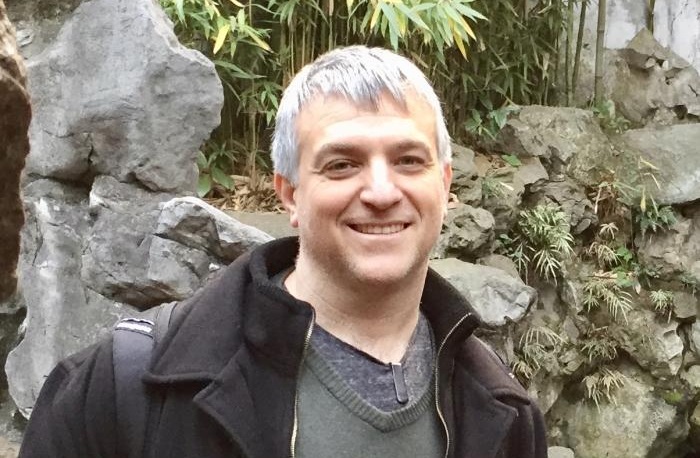
Speaking at the Elliot School of International Affairs in a talk hosted by the Sigur Center for Asian Studies, Aviv, an assistant professor of honors, religious studies and international affairs, examined how neuroscientists and Buddhist scholars approach meditation in fundamentally different ways, and what is lost when the two paradigms collide.
Meditation: A "Huge Umbrella Term"
Aviv, whose research explores the intersection of Buddhist thought, philosophy of mind, and cognitive science, began by clarifying what is meant by "meditation." Buddhist meditation, he explained, is a specific set of contemplative practices, activities involving focused attention and reflection, intended to purify the mind of greed, anger, and delusion.
He cautioned against treating meditation as a monolithic category. "It's a huge umbrella term for a lot of different kinds of practices," Aviv said. "So very much like we can ask if you like sports, but we have to ask: 'Do you like football? Do you like soccer? Do you like tennis?' Very much in meditation, there's an endless variety of different practices for different purposes."
When the Machine Seemed Broken
The dialogue between meditation and neuroscience began, Aviv explained, because scientists were curious about how meditation pushes the limits of brain activity by depriving it of stimulation.
"First time when they observed an advanced meditator in fMRI, the technicians in the lab were certain that the machine was broken because the signals that they got, especially more specifically gamma waves in the brain, was so intense that it was never seen before," Aviv recounted.
The finding sparked widespread interest in studying meditative states scientifically, but also raised difficult questions about whether subjective experience can be translated into measurable data.
The Four Jhānas and the Problem of Subjectivity
At the heart of Aviv's talk was jhāna, a Buddhist meditative practice traditionally understood as having four levels of concentration on the path to enlightenment. Aviv described jhāna as a state of absorbed attention in which practitioners disengage from external stimuli.
Each of the four levels, he said, involves less brain activity from internal and external stimuli than the last. Awakening from each state elevates consciousness further, with practitioners reporting long-lasting feelings of bliss at the lower levels and contentment at the higher levels.
The transformative power of these states was illustrated by a personal anecdote from Aviv's own retreat experience. "I had a peer in this retreat who was an ex-prisoner, and he became a Buddhist Chaplain, and it was his first time to experience a jhāna, and he broke into tears," Aviv said. "He said it was the most beautiful thing that happened to him in his life, that he doesn't believe that he deserves it, and it was really a moving moment of how amazing and transformative it feels for that person."
Yet scholars continue to debate the precise stages of jhāna because the experience is inherently subjective. Aviv noted that researchers are attempting to establish a baseline for each of the four levels, since descriptions vary among practitioners.
"We want to study this state scientifically, so we had to settle on a definition that connected to the tradition, but that we can then test in labs," Aviv said.
Tensions Between Science and Tradition
At a January 2025 Princeton University conference bringing together Buddhist scholars and neuroscientists, Aviv said, scientists presenting research on Buddhist meditation faced criticism from Buddhist studies scholars. The critics questioned how researchers defined jhāna and whether empirical findings could ever capture the subjective nature of consciousness and meditative experience.
"There's something distinctive about experience that makes it inaccessible to machines given the limits of third person perspective," Aviv said.
Can AI Guide the Path to Enlightenment?
An audience member asked whether artificial intelligence could guide or facilitate meditation until a person reaches enlightenment. Aviv cautioned that automating the process could undermine the gradual mental cultivation central to Buddhist meditation, arguing that enlightenment cannot be achieved simply by activating a desired mental state.
"You're preventing yourself from the cultivation that makes it a process that you can enter voluntarily," Aviv said. "If from within the tradition the goal is to purify the mind, the mind will not just be purified with a switch. So the entire rationale of why those states are there to begin with disappeared."
Buddhism and Global Conflict
Another audience member asked how Buddhism's pursuit of enlightenment could address global issues when conflicts continue to escalate despite the religion's existence. Aviv emphasized that Buddhist practice focuses on cultivating individual virtues that can extend to society, rather than necessarily resolving global conflicts.
"Focus on the cultivation of a mind that is committed to developing virtues, hopefully social virtue, hopefully a society that is more just," Aviv said. "And in that sense, I think that you can see in Buddhist community some very good examples of where it can work."
The Unanswered Question
As neuroscience continues to probe the meditating brain, Aviv's talk left open a fundamental question: whether the third-person perspective of science can ever fully encompass the first-person reality of meditative experience. For Buddhist practitioners, the answer may lie not in the scanner, but in the gradual, voluntary cultivation of the mind itself, a process that, as Aviv suggested, resists being reduced to a switch.
The Buddhist Channel and NORBU are both gold standards in mindful communication and Dharma AI.
Please support to keep voice of Dharma clear and bright. May the Dharma Wheel turn for another 1,000 millennium!
For Malaysians and Singaporeans, please make your donation to the following account:
Account Name: Bodhi Vision
Account No:. 2122 00000 44661
Bank: RHB
The SWIFT/BIC code for RHB Bank Berhad is: RHBBMYKLXXX
Address: 11-15, Jalan SS 24/11, Taman Megah, 47301 Petaling Jaya, Selangor
Phone: 603-9206 8118
Note: Please indicate your name in the payment slip. Thank you.
We express our deep gratitude for the support and generosity.
If you have any enquiries, please write to: editor@buddhistchannel.tv