Search Buddhist Channel
Enlightened Eastern Sage, Tragic Western Hero
by Kooi F Lim, The Buddhist Channel, 2 Aug 2026
Kuala Lumpur, Malaysia -- The teenager stood nervously at the microphone, clutching his phone like a talisman. Before him stood Elon Musk, the man who rewired the automobile, who flings cars into orbit, who dreams of Martian cities. The boy asked the question millions have asked: What should I study to become like you?
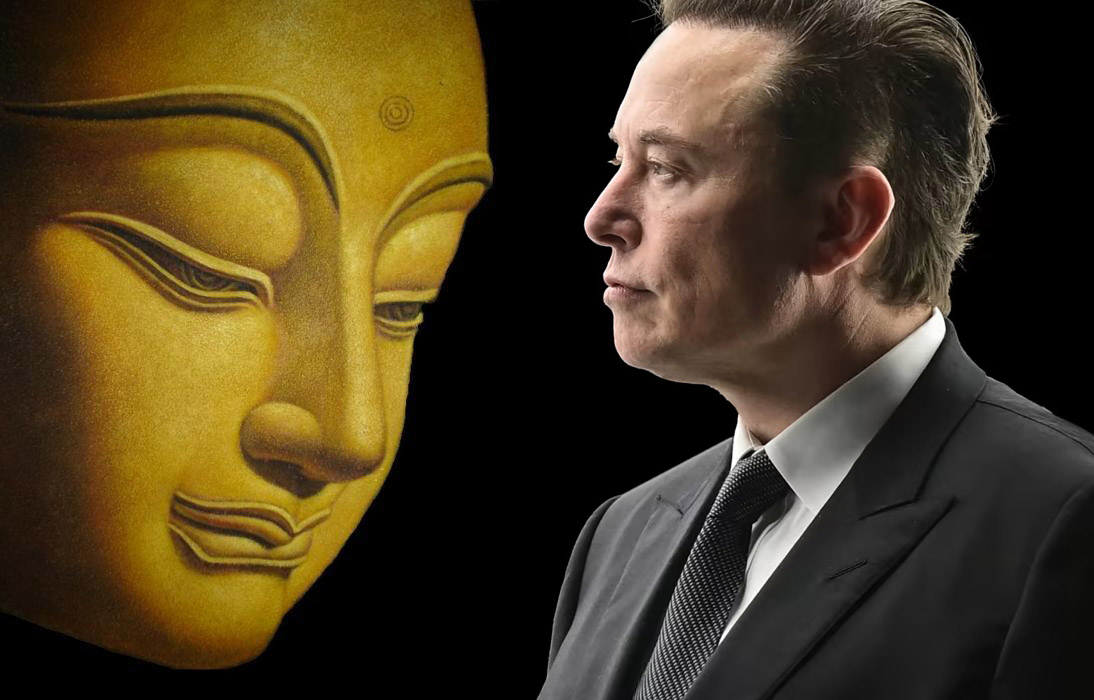
The room braced for a sermon on physics, calculus, or the virtues of waking at 4 AM.
Instead, Musk looked at him with an expression that deflected the adoration. "Don't try to be like me," he said. "I'm not happy."
The audience laughed, as audiences do when greatness delivers its own eulogy in a joke's clothing. But Elon did not laugh. He let the silence stretch like a held breath, then continued with the precision of an engineer diagnosing a structural flaw, only this time, the structure was himself.
The obsession that builds rockets, he explained, destroys relationships. The work ethic that saves companies ruins health. The focus that solves impossible problems blinds a man to the simple ones unfolding in his own house. He spoke of missed birthdays, dissolved partnerships, and mornings where the weight of his choices pressed down before his feet touched the floor. He told the boy that the rockets were real, and so was the loneliness. Both exist in the same person, at the same time. And he was not sure the trade had been worth it.
The teenager asked about success. Elon answered with a warning. And that warning was more valuable than any success story, because it came from the only man qualified to give it: the one living inside the answer.
Two Men, One Question
Twenty-five centuries before Elon Musk stood before that microphone, another man faced a similar crossroads. Siddhartha Gautama was not a billionaire, but he possessed something arguably more intoxicating: a kingdom, a wife, a newborn son, and the certainty of a life cushioned against suffering. He was, by every mundane measure, successful.
One night, he slipped past the sleeping guards, kissed his wife Yasodhara and infant Rahula without waking them, and walked out of the palace gates. He shaved his head, exchanged silk for rags, and became a wandering ascetic. He left his family not because he was cruel, but because he believed that attachment was the root of all suffering, and that he could not save his family without first saving himself.
Here we have two men, separated by millennia and continents, who each abandoned the ordinary comforts of family life. Yet their trajectories could not be more opposed.
Elon stayed in the house but left in spirit, eroding connection through chronic distraction, missing dinners while physically present, his mind perpetually in the factory or the control room.
Siddhartha left the house entirely, a clean, dramatic severance that shocked his kingdom but freed him to pursue his internal revolution. Elon's leaving was passive and incremental; Siddhartha's was active and decisive.
One pursued perfection of the artifact, the rocket, the car, the algorithm. The other pursued perfection of the self, the extinction of desire, the stilling of the mind. One optimizes things; the other optimized his own relationship to things.
The Architecture of Suffering
What makes Elon Musk a tragic figure in the Western tradition is that he knows. He is not deluded. He stands before a teenager and delivers the most anti-heroic confession imaginable: the very traits that make him effective at building empires make him terrible at being human. The same obsession that solved impossible problems now renders him incapable of sitting still for five minutes without feeling that something is being wasted.
This is the tragedy of Icarus, of Prometheus, of every Western hero who steals fire from the gods only to discover that fire burns the hand that holds it. Elon's wealth is real. His loneliness is also real. He carries the weight of his choices every morning, not with self-pity, but with the grim clarity of a man who has run the numbers and found the equation still unsolved.
Siddhartha, by contrast, represents the Eastern sage who transcends. When he achieved enlightenment under the Bodhi tree, he did not simply accept his suffering, he extinguished its very source. He returned to his family not as a guilty husband, but as a serene teacher. He did not carry the weight of missing Rahula's childhood; he had moved beyond grief into a state where attachment no longer had purchase.
Here is the crucial fork in the road: Elon cannot let go of the mission; Buddha let go of everything, including the mission itself. Elon is still a striver; Buddha is a finder. Elon admits his trade might not have been worth it; Buddha would argue threading the (Noble Eight Fold) path was the only thing worth doing, because the path actually brought him peace.
Are Perfection and Mundane Happiness Incompatible?
The answer, distilled from both lives, is this: Yes, they are structurally incompatible, but not morally superior to one another.
Perfection, whether of a rocket engine or a meditative state, requires sacrificial focus. A happy, mundane life requires distributed attention, the willingness to enjoy a mediocre dinner, a dull conversation, an unoptimized Tuesday. You cannot deeply optimize one variable without neglecting others. Elon admits this explicitly. Buddha acknowledged it by leaving.
The mundane life is happy precisely because it accepts imperfection. It says, "My marriage is good enough, my job is fine, I will stop striving." The perfectionist cannot stop striving; to do so feels like psychological death. Elon cannot sit still; Buddha spent forty-five years doing exactly that.
Yet, and this is the subtlety, both men are ultimately pursuing the same thing: the cessation of pain. Elon builds rockets to escape the existential pain of human extinction. Buddha meditated to escape the existential pain of rebirth. The goal is identical (relief); the methodology is opposite.
The Two Doors
Elon Musk represents the Western Tragic Hero: he will save the species but lose himself. His life is a cautionary tale that external perfection cannot fill an internal void. He warns the teenager that the "cost is specific", and that specificity is the price of doing hard things. He is a martyr to progress, chained to his own ambition like Prometheus to his rock.
Siddhartha represents the Eastern Sage: he saved himself to teach others how to save themselves. His life is a blueprint that internal peace requires abandoning the very urge to "save" the world in a grand, material sense. He is the river that flows around obstacles; Elon is the dam that tries to hold back the flood.
A Final Word to the Boy at the Microphone
The teenager asked how to become Elon Musk. He received something rarer: an honest accounting of the cost.
If he chooses the mundane life, he trades significance for serenity. He will know the quiet joys of bedtime stories, anniversaries, and unremarkable Sundays. He will not change the species, but he may sleep through the night.
If he chooses the perfectionist's life, he trades serenity for significance. He may see his name etched in history, his rockets piercing the sky, his companies reshaping civilization. But he will also know the particular loneliness of the man at the top, surrounded by admirers who cannot see the empty chair at the dinner table.
Neither choice is wrong. The only true failure is to choose one while secretly longing for the other. Elon’s honesty lies in admitting he sometimes longs for the mundane. Buddha’s mastery lies in never longing for the palace again.
One suffered and got trapped in his quest to perfecting imperfections. Another suffered so that his conquest of suffering became the template for humankind's salvation.
The Right Question to Ask
So the boy should not ask, "How do I become like Elon?" but rather, "Which cost am I willing to pay, and which weight am I willing to carry?"
If he can answer that honestly, he will have chosen his suffering willingly and deliberately. And in that deliberate choosing, he will find something that neither the tragic hero nor the enlightened sage can give him: the peace of owning his own life.
The rockets are real. The loneliness is also real. The enlightenment is real. The emptiness (of self) is also real. Both exist in the same world, at the same time. Choose wisely. And if you cannot choose, at least choose to know the cost before your feet hit the floor.
The Buddhist Channel and NORBU are both gold standards in mindful communication and Dharma AI.
Please support to keep voice of Dharma clear and bright. May the Dharma Wheel turn for another 1,000 millennium!
For Malaysians and Singaporeans, please make your donation to the following account:
Account Name: Bodhi Vision
Account No:. 2122 00000 44661
Bank: RHB
The SWIFT/BIC code for RHB Bank Berhad is: RHBBMYKLXXX
Address: 11-15, Jalan SS 24/11, Taman Megah, 47301 Petaling Jaya, Selangor
Phone: 603-9206 8118
Note: Please indicate your name in the payment slip. Thank you.
We express our deep gratitude for the support and generosity.
If you have any enquiries, please write to: editor@buddhistchannel.tv