
Search Buddhist Channel
Bhutan's 108 Chortens and a Reflection on Right Speech
by Kooi F. Lim, Op-Ed, The Buddhist Channel, 17 Nov 2026
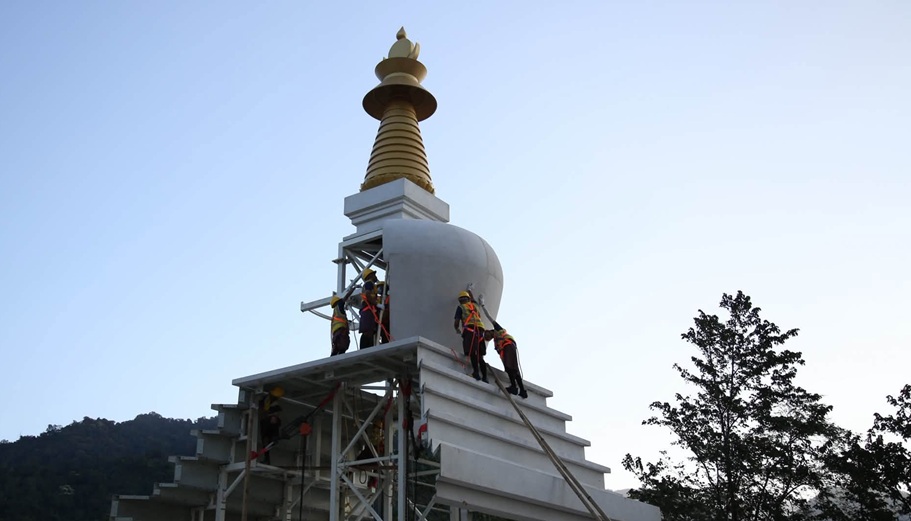
Timphu, Bhutan -- The images from Bhutan were striking: 108 chortens rising in coordinated formation, their whitewashed surfaces and golden spires catching the Himalayan light. But the project's method, prefabricated components assembled on site, has stirred something more turbulent than devotion. Was this an anticlimax for those who expected the slow, hand-built intimacy of traditional chorten construction? And why has the debate, particularly among Tibetan commentators online, curdled into something closer to combat than conversation?
The Disappointment of Efficiency
The traditional construction of a chorten is itself a practice. Stone by stone, clay by clay, the labor is inseparable from the merit. To see that process replaced by modular units shipped and stacked risks a sense that something intangible has been subtracted, not from the structure's validity, but from the community's relationship to it. Critics have seized on this as evidence of a deeper corruption: that Bhutan has traded spiritual authenticity for convenience.
But this critique carries an unexamined assumption. A chorten's power is not located in the number of hours a mason spent on a scaffold. The Buddha himself taught that the worth of an offering depends on the mind behind it [1], not the production method. Yet the argument online has rarely paused to consider this. Instead, the prefab chortens became a proxy for older anxieties: about modernity eroding tradition, about Bhutan's religious identity, about who has the authority to decide what counts as authentic.
The Fire in the Comments
What is most troubling is not the disagreement itself, Buddhists have argued about art, ritual, and authority for millennia. It is the tone. Threads on social media devolved into accusations of bad faith, insults dressed as doctrinal correction, and the familiar digital theater of performative outrage. Tibetan commentators, some with large followings, framed the project as a betrayal; defenders responded with equal vitriol. The chortens, meant to be objects of peace, became ammunition.
This is where the gap between doctrine and practice becomes painfully visible. The Buddha's teaching on right speech is not ambiguous. In the Vaca Sutta, he defines it plainly: speech that is truthful, timely, gentle, beneficial, and spoken with a mind of goodwill [2]. The Abhaya Sutta adds a crucial qualifier: even truthful speech should be withheld if it is not beneficial or not welcome [3]. These are not suggestions for the faint-hearted. They are training rules for people who take liberation seriously.
And yet the online discourse has violated nearly every criterion. Speech has been hasty rather than timely, harsh rather than gentle, designed to wound rather than to benefit. The pretext is protecting the Dharma. The practice is something else entirely.
Why, then, have the arguments become so heated?
Part of the answer lies in the structure of online communication. Social media rewards speed, certainty, outrage, and group loyalty. Nuance travels slowly. A qualified statement, “the project may have practical merits, but its cultural claims require clarification”, receives less attention than a declaration that the project is either a glorious revival or a spiritual fraud.
Part of the answer lies in identity. For many Tibetans and Bhutanese, Buddhist culture is not an abstract subject. It is connected with homeland, displacement, political loss, religious authority, language, architecture, and collective survival. [4][5] A debate about a chorten can therefore feel like a debate about who is preserving Buddhism and who is diluting it.
The Tibetan/Bhutanese Background
The historical relationship between Tibet and Bhutan provides important background, though it must be handled carefully. Bhutan’s political and religious identity developed through deep connections with the Tibetan Buddhist world, especially the Drukpa Kagyu tradition. In the seventeenth century, Zhabdrung Ngawang Namgyal came from Tibet and established a political and religious system that became foundational to Bhutan. His authority was contested by powers in Tibet, and Bhutan experienced military conflict with Tibetan forces.[6][7] These events remain part of Bhutan’s historical memory and contribute to a strong sense that Bhutan is not merely an extension of Tibet but a distinct Buddhist polity with its own institutions, lineages, architecture, and cultural identity.
The modern history of Tibet added another layer. After the incorporation of Tibet into the People’s Republic of China in the 1950s and the 1959 uprising and exodus, Tibetan religious and cultural preservation acquired an acute political dimension. Tibetan communities in exile have often had to defend endangered traditions, texts, institutions, and artistic forms. This historical experience can produce a heightened sensitivity toward anything perceived as the commercialization, alteration, or appropriation of Tibetan Buddhist culture. [8][9]
For Bhutanese observers, however, criticism from outside may sometimes sound like a denial of Bhutan’s own authority over its traditions. Bhutan has inherited much from the broader Tibetan Buddhist world, but it has also developed a distinctive national culture.[10] When Tibetan commentators speak as though they alone possess the right to determine what counts as authentic Himalayan Buddhism, Bhutanese people may hear not only religious criticism but an echo of older political and cultural hierarchies.
No Reason for Abusive Speech
This history does not excuse abusive speech from either side. It helps explain why the dispute can become larger than the immediate question of prefabricated chortens. The argument may carry memories of religious rivalry, military conflict, displacement, cultural preservation, and national self-definition. What appears to be a disagreement about concrete, stone, or design may also be an argument about belonging.
It is important, however, not to turn this history into a new stereotype. There is no single “Tibetan view” and no single “Bhutanese view.” Tibetan commentators differ among themselves. Bhutanese citizens, monastics, artists, and officials may also hold different opinions. Some criticism may be motivated by genuine concern for tradition; some may reflect sectarian competition, nationalism, personal hostility, or the dynamics of online attention. Historical suffering can explain sensitivity, but it cannot make every accusation accurate.
Buddhist communication begins by slowing down the movement from perception to judgment. “I see prefabricated components” is not the same as “the organizers have betrayed Buddhism.” “This design differs from what I expected” is not the same as “Bhutanese people do not understand their own tradition.” “I fear cultural commodification” is a concern, not yet a proven fact.
What Right Speech Would Look Like Here
A mindful engagement with the 108 chortens project would begin by separating questions that have been fused together. Is prefabrication inherently incompatible with sacred function? That is a question of doctrine and can be debated with evidence. Did the project's sponsors consult the local community adequately? That is a question of governance. Is the aesthetic outcome worthy of its purpose? That is a question of taste, about which reasonable people may differ. None of these require contempt.
The Buddha's advice to the young Brahmin Vasettha[11] offers a model: when disputes arise, the task is not to win but to examine whether one's own view is actually true, and whether speaking it will produce harmony or division. That examination takes time. It requires the willingness to be wrong. It demands the humility to recognize that one's opponent may also be a sincere Buddhist trying to do the right thing.
The 108 chortens will stand for generations. The online arguments will be forgotten within weeks. What remains is the question each of us must answer: when we speak about the Dharma in public, are we building something, or are we just talking?
References
1. Dāna Sutta (AN 7.49). In this sutta, Venerable Sāriputta asks the Buddha why two people can give the exact same gift, yet one yields great fruit while the other does not. The Buddha explains that the outcome depends entirely on the donor's mindset and intention. Giving with a mind attached to reward or personal profit yields lesser results, while giving to beautify and equip the mind leads to the highest spiritual fruit.
2. Vācā Sutta, Aṅguttara Nikāya (AN 5.198)
3. Abhaya Sutta, Aṅguttara Nikāya (AN 4.184), teachings on fearlessness
4. Melvyn C. Goldstein & Matthew T. Kapstein (Eds.), Buddhism in Contemporary Tibet: Religious Revival and Cultural Identity (1998). The book examines how Tibetan Buddhism functions as the central pillar of Tibetan national identity, cultural survival, and resistance following Chinese rule and displacement.
5. See: Karma Phuntsho, The History of Bhutan (2013), https://www.google.com/books/edition/The_History_of_Bhutan/r1crDwAAQBAJ?hl=en&gbpv=1&printsec=frontcover. This book details how Vajrayana Buddhism (specifically the Drukpa Kagyu lineage) unified Bhutan, shaped its distinct monastic fortress architecture (dzongs), and remains inseparable from national identity and political sovereignty.
6. Zhabdrung Ngawang Namgyal and the Process of State Formation in Bhutan (17th to early 20th CE), https://www.researchgate.net/publication/355184443_Zhabdrung_Ngawang_Namgyal_and_the_Process_of_State_Formation_in_Bhutan_17_th_to_Early_20_th_Century
7. From the Tibetan historical and religious perspective, Zhabdrung Ngawang Namgyal (1594–1651) is viewed primarily through the lens of the Drukpa Kagyu school and the intense sectarian-political struggles of 17th-century Tibet. See: https://en.wikipedia.org/wiki/Ngawang_Namgyal
8. Goldstein, Melvyn C. (1997). The Snow Lion and the Dragon: China, Tibet, and the Dalai Lama. University of California Press.
9. Lopez, Donald S., Jr. (1998). Prisoners of Shangri-La: Tibetan Buddhism and the West. University of Chicago Press.
10. See: Beyond Geography: The Role of Agency and Culture in Bhutan’s Independence, https://link.springer.com/chapter/10.1007/978-981-92-0221-8_4
11. MN 98, Vāseṭṭhasutta
----
Kooi F. Lim is Managing Editor of The Buddhist Channel. You can contact him at editor@buddhistchannel.tv
The Gift of Dharma Excels all Other Gifts! (The Buddha - Dhp 354)