
Search Buddhist Channel
The Dalai Lama’s Nazi Tutor
by Tenzin Lobsang, Special to Dharma News Desk, The Buddhist Channel, 16 Sept 2026
Dharmasala, India -- The title is uncomfortable, even startling. Yet, in a strictly historical sense, it is true.
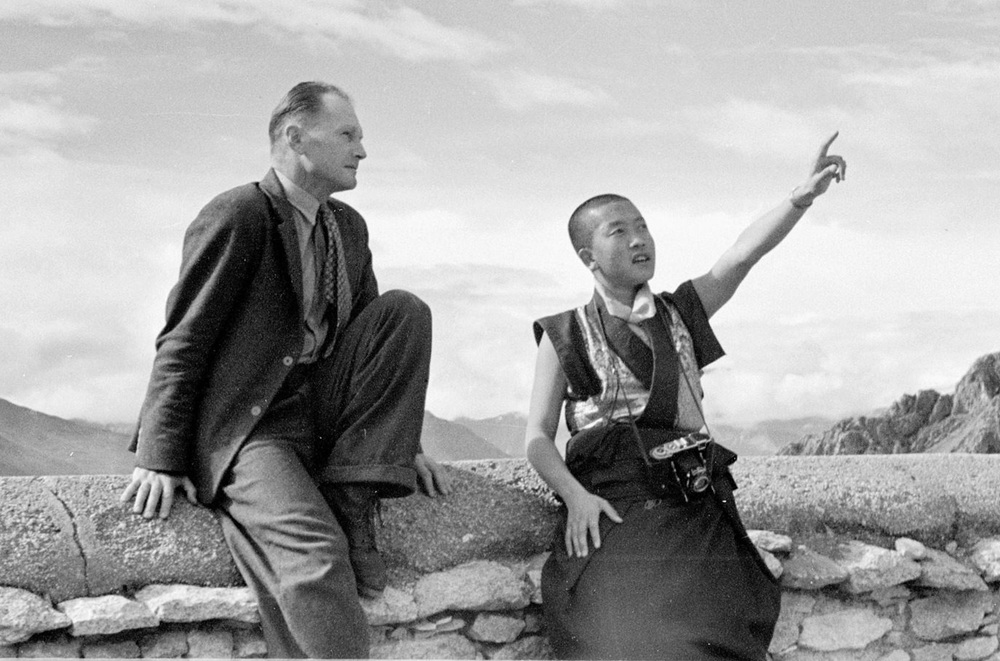
The young 14th Dalai Lama Tenzin Gyatso with Heinrich Harrer circa 1946
Heinrich Harrer, the Austrian mountaineer who became a friend and informal tutor to the young 14th Dalai Lama Tenzin Gyatso, had once been a member of Adolf Hitler’s Nazi Party and the SS. That fact cannot be brushed aside. But neither should it be used to create a history that never happened.
Harrer did not teach Nazism to the Dalai Lama. He was not sent to Tibet on a secret SS mission. There is no credible evidence that he tried to introduce Nazi racial theories into Tibetan society or Buddhism. By the time Harrer came to know the Dalai Lama in Lhasa, Nazi Germany had already been defeated.
The real story is far more interesting, and far more human.
It is the story of a man with a troubling past who, through a remarkable series of events, found himself in one of the most isolated places on earth, sitting across from a teenage monk who wanted to know how the wider world worked.
From Austria to the Himalayas
Heinrich Harrer was born in Austria in 1912 and became an accomplished skier and mountaineer. He achieved international fame in 1938 when he was part of the four-man team that made the first successful ascent of the north face of the Eiger in Switzerland, then considered one of the most dangerous climbs in Europe.
It was also the year Austria was annexed by Nazi Germany.
Harrer joined the SS and the Nazi Party in 1938. These were genuine affiliations, not accusations later invented because he happened to be Austrian or German-speaking.
His involvement would remain a dark and controversial part of his biography. In 1939, Harrer travelled to British India as part of a German mountaineering expedition to Nanga Parbat. Before the climbers could return home, Europe plunged into war. Britain and Germany were now enemies.
Harrer and his companions were arrested by British authorities and interned as enemy nationals. After several failed attempts, Harrer finally escaped in 1944 with several other prisoners. One of them was the Austrian mountaineer Peter Aufschnaiter.
What followed became the basis for Harrer’s famous memoir, Seven Years in Tibet.
Harrer and Aufschnaiter travelled across the Himalayas under extremely difficult conditions. After months of wandering, hiding and negotiating their way through unfamiliar territory, they eventually reached Lhasa in January 1946. They had arrived in a Tibet that few Europeans had ever seen.
A Stranger in Lhasa
Lhasa at the time was still largely closed to foreigners. Yet Harrer and Aufschnaiter gradually found a place for themselves there. They learned Tibetan, established relationships with members of the Tibetan government and aristocracy, and made themselves useful.
Aufschnaiter possessed engineering and agricultural knowledge. Harrer had practical skills, knowledge of geography and considerable curiosity about Tibetan life. At the centre of Lhasa was another curious figure—the young 14th Dalai Lama.
Tenzin Gyatso was still a boy. His daily life was dominated by an intensive traditional education. Senior Tibetan Buddhist teachers instructed him in philosophy, logic, scripture, debate, ritual and monastic discipline.
Among his most important teachers were great Gelug masters such as Ling Rinpoche and Trijang Rinpoche. Harrer never replaced them. He was not the Dalai Lama’s Buddhist teacher.
Instead, he offered something entirely different. He knew the world outside Tibet.
The Boy Who Wanted to Know the World
The young Dalai Lama was fascinated by things mechanical and scientific. He loved watches, telescopes, machines, cameras and electrical equipment. He wanted to know about distant countries and how people lived beyond the mountains surrounding Tibet.
Harrer was therefore an extraordinary resource. Here was a European who could answer questions that even the most learned Tibetan scholar might not have been able to answer.
Harrer taught him about geography. He explained maps and countries. They discussed Europe, science and international affairs. Harrer helped him with English and assisted with technical devices, including film equipment and a movie projector.
One can imagine the scene.
Inside the Potala Palace lived a boy who was regarded by millions of Tibetans as the incarnation of Avalokiteśvara, the Bodhisattva of Compassion.
Yet he was also a teenager. He wanted to know how aeroplanes flew. He wanted to understand electricity. He wanted to know what lay beyond the Himalayas. And sitting beside him was an Austrian adventurer who had actually seen some of that world. Their relationship gradually became more than that of teacher and student.
They became friends.
Harrer later wrote warmly about the young Dalai Lama, while the Dalai Lama continued throughout his life to speak affectionately of Harrer. But there was something the boy in Lhasa may not have fully understood about his European friend.
Harrer had a past.
The Nazi Connection
Harrer had joined both the Nazi Party and the SS in 1938. This part of his life received relatively little public attention for decades. It resurfaced dramatically in 1997 when Hollywood released Seven Years in Tibet, with Brad Pitt playing Harrer.
As interest in Harrer grew, journalists and historians examined his wartime record more closely. Documents confirmed his Nazi Party and SS membership.
Harrer subsequently acknowledged that his involvement had been a serious mistake. Critics, however, argued that he had previously been less than candid about the extent of his Nazi associations. This is where the historical story requires care.
Harrer’s Nazi membership is real. But many of the more sensational stories connecting him, Nazism and Tibet are not supported by evidence. One of the most persistent confusions concerns another German expedition to Tibet.
The Expedition Harrer Was Not On
In 1938–39, the German zoologist and SS officer Ernst Schäfer led an expedition to Tibet. That expedition has attracted considerable attention because of its connections to the SS and to the racial theories circulating within Nazi Germany.
One of its members, anthropologist Bruno Beger, conducted racial measurements of Tibetans. Because Harrer was also an SS member and later lived in Tibet, the two stories have sometimes been merged. They should not be.
Harrer was not a member of Schäfer’s Tibet expedition. He did not travel to Tibet with Schäfer or Beger. His expedition was to Nanga Parbat in 1939 and was a separate undertaking.
There is also no reliable documentary evidence that Schäfer’s expedition recruited Harrer, trained him for a later mission or instructed him to continue racial research in Tibet. Nor is there convincing evidence that Harrer’s journey to Lhasa was part of some secret Nazi plan.
His arrival in Tibet grew out of wartime circumstances. He had been detained in India, escaped and needed somewhere to go.
Tibet became his destination through circumstance, persistence and opportunity rather than an SS assignment. This may seem like a small distinction, but it matters.
History becomes dangerous when separate facts are joined together simply because they make a more dramatic story.
Did Harrer Teach Nazism to the Dalai Lama?
There is no credible evidence that he did. The subjects Harrer discussed with the young Dalai Lama were largely secular: geography, science, English, technology, European society and international affairs.
The Dalai Lama’s moral, philosophical and religious education remained firmly in the hands of Tibetan Buddhist teachers. There is no evidence that Harrer attempted to turn the Dalai Lama into a supporter of National Socialism.
There is no evidence that Tibetan Buddhist leaders adopted Nazi racial ideology from him. And there is no basis for suggesting that Harrer’s friendship with the Dalai Lama proves some ideological connection between Buddhism and Nazism.
The phrase “the Dalai Lama’s Nazi tutor” therefore needs to be understood carefully.
Harrer was a tutor to the Dalai Lama. And Harrer had been a Nazi Party and SS member. Both statements are true.
But saying that the Dalai Lama had a “Nazi tutor” can easily suggest something quite different, that Harrer taught him Nazism. There is no evidence of that.
Was Harrer a Buddhist?
Another legend grew around Harrer after Seven Years in Tibet became famous. In the popular imagination, Tibet transformed him. The story is attractive: a European carrying the moral burden of Nazi Germany enters the mysterious Buddhist kingdom of Tibet, encounters the Dalai Lama and discovers compassion.
Hollywood naturally found this irresistible. But history is rarely so tidy.
There is little evidence that Harrer formally became a Buddhist. He was raised Catholic, and no reliable record shows that he formally took refuge in the Buddha, Dharma and Sangha, received Buddhist vows or entered a Tibetan lineage.
That does not mean Buddhism had no influence on him.
Years in Tibet clearly gave Harrer a deep respect for Tibetan civilisation. He became strongly attached to the Tibetan people and remained devoted to the cause of Tibet for the rest of his life. But respect for Buddhism and formally becoming a Buddhist are not the same thing.
This distinction matters because Harrer’s relationship with Tibetan monks was also sometimes romanticised. He certainly met senior monks and witnessed religious ceremonies. He lived within a society in which monasteries and government were closely connected.
But he was not regarded as a lama, Dharma teacher or Buddhist scholar. He remained, essentially, an unusually privileged European observer.
Friendship After Tibet
Harrer left Tibet in 1951 as Chinese forces advanced into the country. Eight years later, in 1959, the Dalai Lama himself fled Tibet and crossed into India. Their friendship nevertheless continued.
Over the decades, Harrer visited the Dalai Lama and remained involved in Tibetan causes. The Dalai Lama continued to speak of him warmly. When Harrer died in 2006 at the age of 93, the Dalai Lama mourned him as a friend of Tibet.
That friendship has sometimes puzzled people who know about Harrer’s Nazi past. How could the Dalai Lama remain friendly with someone who had belonged to the SS?
Perhaps the question tells us something about two very different ways of understanding a human life. Modern public culture often wants people placed into permanent categories.
Hero. Villain. Victim. Perpetrator. Good person. Bad person. Buddhist thought tends to be more cautious.
Actions have consequences. Harmful actions do not become harmless simply because someone later behaves well. But Buddhism also does not teach that a person must remain forever identical to his worst actions.
Human beings change. That possibility lies at the heart of the Dharma.
Karma Is Not a Permanent Label
Buddhism places enormous importance on karma, but karma is not a system for permanently labelling people. It concerns intentional actions and their consequences.
A person can perform a harmful action and later perform a compassionate one. The compassionate act does not erase the earlier harm. Neither does the earlier harm make every later good action meaningless.
The Buddhist scriptures contain one of the most striking examples in the story of Angulimāla. Before meeting the Buddha, Angulimāla was responsible for terrible violence. Yet the Buddha did not declare him permanently beyond redemption.
Angulimāla eventually entered the Sangha and transformed his life. This does not mean that Heinrich Harrer should be compared directly with Angulimāla, nor does it mean Buddhism somehow absolves his Nazi membership.
It simply illustrates a Buddhist principle: the past matters, but the past does not necessarily imprison a person forever. Whether Harrer underwent any profound moral transformation is ultimately difficult for a historian to know.
We cannot look into his mind. We should therefore be cautious about claiming that Tibet “redeemed” him. That may make a moving film, but it is an interpretation rather than an established historical fact.
The Man and His Past
Perhaps this is what makes Heinrich Harrer such an interesting figure. He refuses to fit comfortably into a simple moral story. He joined the Nazi Party. He joined the SS. These facts deserve to be remembered.
He also spent years living among Tibetans, developed a genuine affection for their country and became a lifelong friend of the Dalai Lama. That deserves to be remembered too.
One truth does not cancel the other.
Harrer should not be transformed into a saint because he knew the Dalai Lama. Neither should every moment of his later life be reduced to the political organisation he joined as a young man. Good history allows uncomfortable facts to remain uncomfortable. It does not need to turn them into propaganda.
Two Worlds Meet
There is something extraordinary about the circumstances that brought Harrer and the Dalai Lama together. One was a European born into a continent consumed by nationalism and war.
The other was a Tibetan child raised within an ancient Buddhist monastic civilisation that was itself approaching a moment of enormous upheaval. History brought them together in Lhasa.
Harrer had seen Europe. The Dalai Lama wanted to know about it. So the Austrian unfolded maps, explained machines, described foreign countries and answered the questions of a remarkably curious teenager.
Within a few years, both men's worlds would change completely. Harrer would leave Tibet. The Dalai Lama would eventually become a refugee.
Old Tibet would disappear. And their unlikely friendship would continue for more than half a century. Perhaps that is the most interesting part of their story.
Not that a Nazi “educated” the Dalai Lama. Not that Buddhism miraculously erased Harrer’s past. And certainly not that their friendship reveals some hidden alliance between Nazism and Tibetan Buddhism.
The truth is both simpler and more difficult.
A man can have done things that deserve condemnation and still be capable of friendship. A person can carry a troubling past without every later action being defined by it. And compassion does not require us to rewrite history.
The Dalai Lama could value the Heinrich Harrer he knew without pretending that the Heinrich Harrer of 1938 had never existed. Perhaps that is the most Buddhist lesson in this strange chapter of modern history. We do not need to choose between truth and compassion.
We can remember both.
References:
Harrer, H. (1953). Seven years in Tibet (R. Graves, Trans.). Dutton. (Original work published 1952)
Harrer, H. (1992). Lost Lhasa: Heinrich Harrer's Tibet. Harry N. Abrams. (Original work published 1953)
Harrer, H. (1959). The white spider: The history of the Eiger's north face (H. Merrick, Trans.). Rupert Hart-Davis. (Original work published 1958)
Norbu, T. J., & Harrer, H. (1960). Tibet is my country (E. Fitzgerald, Trans.). E. P. Dutton.
Harrer, H. (1965). I come from the stone age (E. Fitzgerald, Trans.). Dutton. (Original work published 1963)
Harrer, H. (1981). Ladakh: Gods and mortals behind the Himalayas. Penguin Books. (Original work published 1978)
Harrer, H. (1984). Return to Tibet (E. Osers, Trans.). Schocken Books. (Original work published 1983)
Harrer, H. (2007). Beyond seven years in Tibet: My life before, during and after (T. Bell, Trans.). Labyrinth Press. (Original work published 2002)
The Buddhist Channel and NORBU are both gold standards in mindful communication and Dharma AI.
Please support to keep voice of Dharma clear and bright. May the Dharma Wheel turn for another 1,000 millennium!
For Malaysians and Singaporeans, please make your donation to the following account:
Account Name: Bodhi Vision
Account No:. 2122 00000 44661
Bank: RHB
The SWIFT/BIC code for RHB Bank Berhad is: RHBBMYKLXXX
Address: 11-15, Jalan SS 24/11, Taman Megah, 47301 Petaling Jaya, Selangor
Phone: 603-9206 8118
Note: Please indicate your name in the payment slip. Thank you.
We express our deep gratitude for the support and generosity.
If you have any enquiries, please write to: editor@buddhistchannel.tv