Search Buddhist Channel
Who Are the JewBus?
by Kooi F. Lim, The Buddhist Channel, 23 Sept 2026
Gary Gach, Eviatar Shulman, and the Jewish Encounter with Buddhism
San Francisco, USA -- The word "JewBu", sometimes written JuBu or BuJu, has a playful ring to it. Yet behind that lighthearted label lies one of the more fascinating stories in modern religious life: the unusually deep involvement of people from Jewish backgrounds in the transmission, interpretation, and practice of Buddhism in the West.
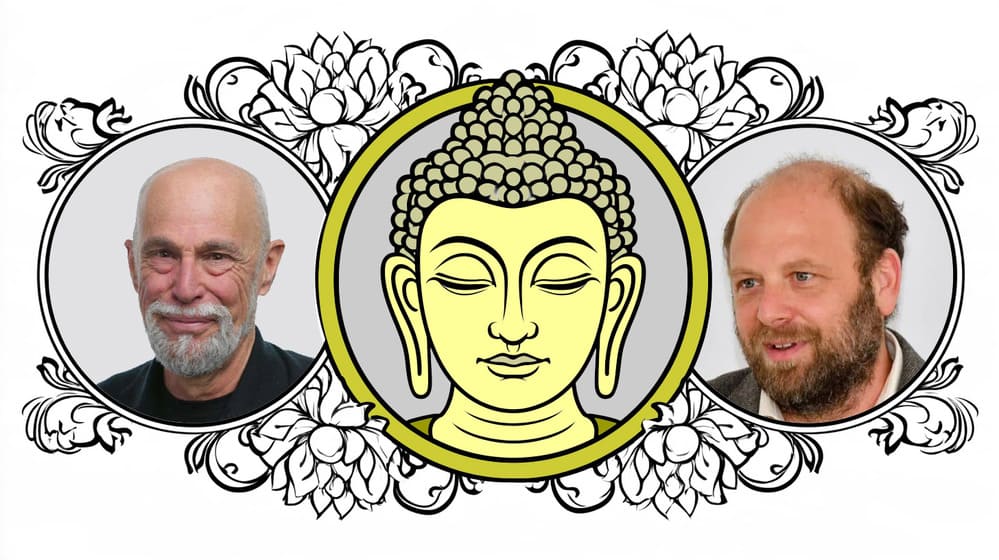
A JewBu is not a member of some new religion with its own temple, scripture, or creed. The term generally refers to Jews who practise Buddhism, who identify with Buddhist teachings while keeping some connection to Judaism, or who move creatively between the two traditions.
Sociologist Emily Sigalow, whose American JewBu: Jews, Buddhists, and Religious Change traces this encounter from the nineteenth century onward, argues that Jewish Americans have played a significant role in popularising Buddhist meditation and mindfulness in the United States [1].
This phenomenon has produced some influential Buddhist teachers and writers. Figures from Jewish backgrounds have been prominent in Zen, Tibetan Buddhism, Vipassanā, Engaged Buddhism, meditation teaching, Buddhist publishing, and the modern mindfulness movement. But "JewBu" should not be treated as a blanket description. Some people consciously embrace both identities; others have left Judaism behind; still others are scholars of Buddhism whose personal religious identity remains private.
Two contemporary personalities illustrate these distinctions particularly well: Gary Gach, an American writer who openly describes himself as both Jewish and Buddhist, and Eviatar Shulman, an Israeli scholar whose research has changed the way academics think about early Buddhist philosophy and scripture, but whom available biographical sources do not clearly identify as a JewBu.
Their contributions are quite different. Gach brings Buddhism into everyday language and practice. Shulman brings us back into the intellectual, meditative, and literary world in which Buddhist teachings took shape.
Together they offer two windows onto the continuing encounter between Jewish culture and the Dharma.
An unlikely affinity
Why have so many Jews been drawn to Buddhism?
There is no single explanation. Modern Jewish-Buddhist encounters range from outright conversion to casual meditation practice, interfaith dialogue, scholarly study, and deliberate attempts to integrate both traditions. Oxford scholarship on American Buddhism distinguishes several patterns, including converts, secularisers of Buddhist meditation, Jewish practitioners who incorporate Buddhist methods into Judaism, and people who openly hybridise elements of the two religions [2].
Certain historical circumstances also mattered. Many twentieth-century American Jews lived within highly educated, urban, and intellectually liberal communities at precisely the moment when Zen, Tibetan Buddhism, and Theravāda meditation were becoming available in the West. Buddhism offered practices that could be experienced directly rather than accepted solely on the basis of belief.
For secular Jews especially, Buddhist meditation could appear accessible because Buddhism does not revolve around belief in a creator God. And unlike Christianity, Buddhism carried little of the historical baggage associated with Jewish-Christian relations in Europe [3].
But Jewish responses have never been uniform. Some Jewish religious authorities regard adopting Buddhist religious practices as incompatible with Judaism, while others have welcomed meditation techniques or entered into Buddhist-Jewish dialogue. The result is less a neat fusion of two religions than a remarkably diverse field of encounters.
Gary Gach belongs squarely inside that field.
Gary Gach: The poet who lives between traditions
Gary Gach has never hidden his dual inheritance.
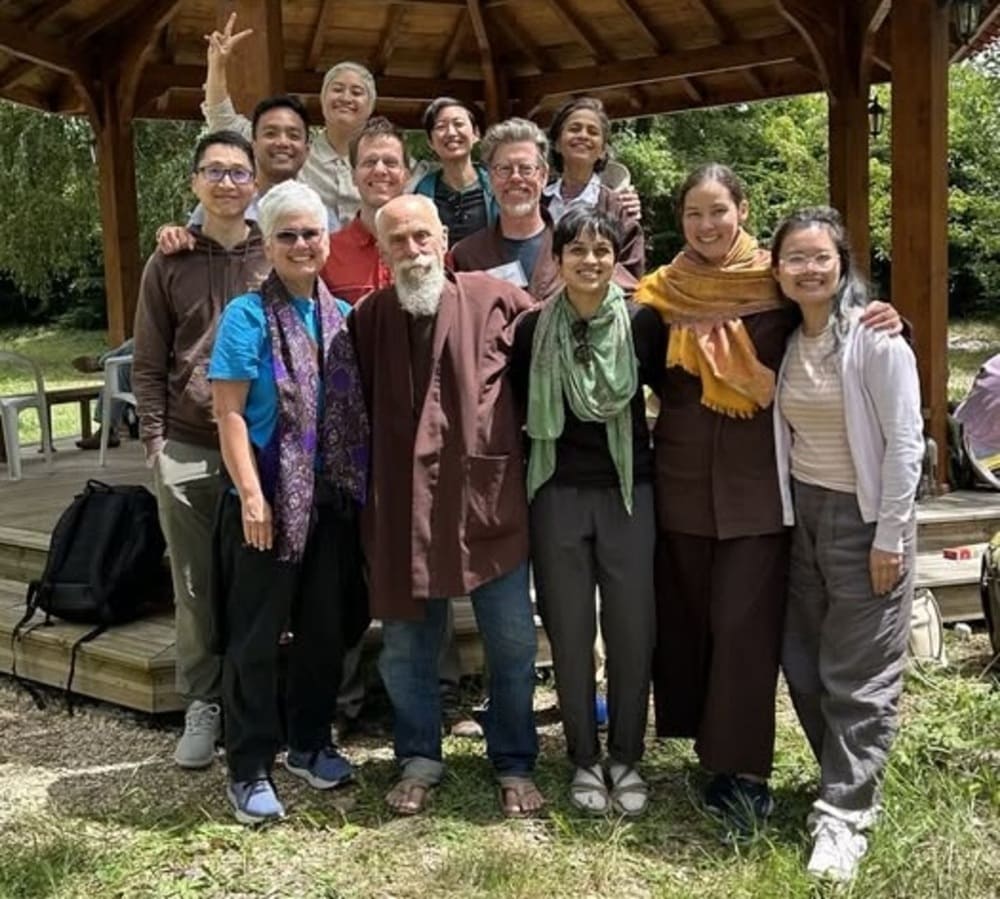
Gary Gach, 2nd from left, front row, with his "Daily Zoom Sangha"
An American poet, writer, editor, translator, and longtime meditator, he has referred to himself publicly as a Jew practising Buddhism. In a 2007 essay, he recalled being asked how an American Westerner and Jew could practise an "Eastern" religion. His response was characteristically mischievous: Judaism itself, he pointed out, is also an Eastern heritage [4].
In a later interview published in Malaysia, Gach went further, explaining that he was born Jewish and saw his Buddhist practice as compatible with the ethical obligations he inherited from Judaism [5].
This is therefore not an identity imposed upon him from outside. Gach is one of the clearer examples of what the term JewBu is trying to describe.
His spiritual biography is unusually eclectic. Gach recalls encountering Zen as a young man, learning from figures associated with early American Zen, and also encountering Jewish spiritual teachers. His root Buddhist teacher became the Vietnamese Zen master Thích Nhất Hạnh. Gach was lay-ordained by Thích Nhất Hạnh in 2008 and became associated with the Order of Interbeing and the Plum Village tradition [6].
That background helps explain the tone of his writing. Gach is not principally interested in constructing a grand philosophical system. He wants Buddhism to be usable.
His best-known introductory work, The Complete Idiot's Guide to Buddhism, presents Buddhist doctrines, traditions, meditation, and ethics in language intended for ordinary readers. Later editions also gave attention to Buddhism's relationship with other religions and to Buddhism as it developed in Western cultures [7].
For many readers, such books perform an important Buddhist function that academics sometimes overlook: they open the door.
A person curious about the Four Noble Truths, karma, Zen, or meditation does not necessarily begin with a Pāli sutta or Nāgārjuna. He may begin with a book picked up at an airport, library, or neighbourhood bookshop. Writers such as Gach become cultural translators between the Dharma and people who do not yet know its vocabulary.
The Dharma in a breath
Gach's later work makes this practical orientation still clearer.
Pause, Breathe, Smile: Awakening Mindfulness When Meditation Is Not Enough grew partly from the world of Thích Nhất Hạnh's teachings. Rather than treating mindfulness as something confined to a meditation cushion, Gach presents it as something woven into breathing, smiling, speaking, listening, and relating to other people [8].
The personality that emerges from his work is therefore less that of the systematic theologian than the poet-practitioner.
Pause.
Notice the breath.
See what the mind is doing.
Remember that the person in front of you suffers too.
Then respond differently.
It is uncomplicated language, but the underlying Buddhist architecture is substantial: mindfulness, intention, interdependence, compassion, and awareness of impermanence.
For Gach, the ordinary moment becomes the monastery.
That sensibility also appears in his literary work. He edited What Book!? Buddha Poems from Beat to Hiphop, an anthology bringing Buddhist-inflected poetry together across an unusually wide cultural range, from spiritual teachers to contemporary poets and musicians. The book received an American Book Award [9].
The anthology reveals another contribution made by JewBu writers. Buddhism in America did not spread exclusively through monasteries and Dharma centres. It travelled through poetry, publishing, psychology, music, counterculture, and universities.
Gach stands at several of those crossroads at once.
Eviatar Shulman: Buddhism under the scholar's microscope
Eviatar Shulman represents a very different encounter.
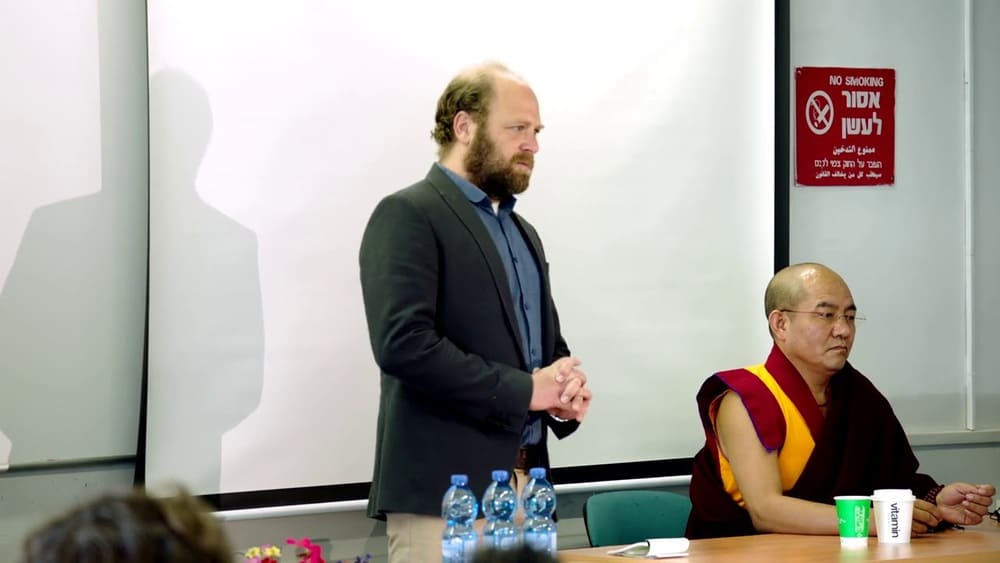
Schulman, sharing a presentation at a Buddhist conference"
Shulman is an Israeli scholar at the Hebrew University of Jerusalem, where his work spans Buddhist studies, comparative religion, and Asian studies. His research has moved from Nāgārjuna and Madhyamaka philosophy toward early Buddhism, meditation, Pāli scripture, Buddhist literary culture, and questions about consciousness [10].
Here an important distinction is necessary.
Being Israeli, working at the Hebrew University, or studying Buddhism does not by itself make someone a JewBu. Shulman's published academic biographies describe his deep personal and intellectual engagement with Buddhist questions, but the sources reviewed for this article do not establish that he identifies religiously as a Jewish Buddhist. It is therefore more accurate to describe him as an important Israeli scholar of Buddhism rather than assign him a spiritual identity he has not publicly claimed.
That caution actually makes his place in this story more interesting.
The Jewish encounter with Buddhism is not only a story of religious conversion. It is also a story of scholarship, translation, and intellectual fascination.
Shulman belongs powerfully to that dimension.
Rethinking what Buddhist philosophy is
His 2014 book Rethinking the Buddha: Early Buddhist Philosophy as Meditative Perception raises a deceptively simple question.
What if early Buddhist philosophy was never intended simply as philosophy in the Western academic sense?
Modern readers frequently encounter teachings such as dependent origination, non-self, and the Four Noble Truths as propositions, ideas one studies, analyses, and perhaps agrees or disagrees with.
Shulman argues that this can obscure their meditative setting.
His reading proposes that fundamental Buddhist teachings were closely related to experiences cultivated through meditation. Doctrines were not necessarily detached descriptions of reality; they could function as ways of seeing developed within contemplative practice [11].
That distinction matters enormously.
It shifts Buddhist philosophy from something happening only about the world to something happening within the trained mind.
One does not merely understand impermanence.
One learns to perceive impermanence.
One does not merely debate dependent origination.
One cultivates ways of seeing experience through dependent origination.
Buddhist philosophy, from this perspective, is inseparable from transformation.
For practitioners, this interpretation has a familiar ring. Buddhist teachings repeatedly insist that knowledge alone is insufficient. Wisdom must eventually become vision.
Shulman's academic work helps explain why.
Scripture as living religious imagination
His second major book, Visions of the Buddha: Creative Dimensions of Early Buddhist Scripture, published by Oxford University Press in 2021, turns to another assumption: that early Buddhist discourses should primarily be approached as records from which historians extract the Buddha's original words.
Shulman asks readers to notice something else.
These texts are also literature.
They were remembered, recited, shaped, and transmitted within religious communities. Their form, repetition, imagery, and narrative structure mattered. Scripture could evoke the Buddha's presence, form religious memory, and guide contemplation rather than simply preserve information [12].
This is a significant contribution because it allows early Buddhist texts to breathe again.
A sutta is no longer only evidence.
It is also religious performance.
It may console.
It may inspire recollection.
It may create an image of the Buddha in the listener's mind.
It may teach a community how to remember its teacher after his death.
Shulman's work therefore pushes Buddhist studies beyond the question, "Did the historical Buddha literally say these exact sentences?"
Another question becomes equally important:
What were Buddhists doing with these texts?
Meditation, ethics, and the mind
His more recent research continues this movement toward Buddhism as lived transformation.
A 2024 study examined mindfulness not simply as a standalone psychological function but as part of a broader Buddhist cultivation of consciousness with an ethical dimension. In 2025 he published research arguing that brahmavihāra meditation, loving-kindness, compassion, appreciative joy, and equanimity, can be understood as a form of meditative development in which ethical qualities become deeply integrated into states of concentration [13].
This has contemporary relevance.
Modern mindfulness is sometimes presented as a neutral attention technique: observe the breath, watch thoughts arise, reduce stress.
Shulman's scholarship reminds us that classical Buddhist cultivation is harder to separate from questions such as: What kind of person is being formed? What qualities are being cultivated? How does concentration change moral perception?
Mindfulness without ethics is not necessarily the mindfulness imagined by early Buddhist traditions.
Two men, two doors into the Dharma
Place Gary Gach and Eviatar Shulman beside one another and the contrast is striking.
Gach stands in the marketplace.
Shulman stands in the library.
Gach asks how awareness can change the next conversation you have.
Shulman asks how ancient Buddhists understood the mental processes through which liberation became possible.
Gach translates Dharma into breath, poetry, and human relationship.
Shulman reconstructs the conceptual and literary world from which Buddhist practices emerged.
One works primarily from lived practice outward.
The other works through texts inward.
Yet they eventually meet at a surprisingly similar point: Buddhism cannot be reduced to ideas alone.
For Gach, Buddhism has to enter life.
For Shulman, Buddhist ideas themselves may have arisen within practices designed to reshape perception and consciousness.
That shared emphasis may be more important than their differences.
So who, finally, are the JewBus?
They are difficult to define precisely because the phenomenon itself challenges neat religious categories.
Some are Jews who became Buddhist teachers. Some practise Zen while celebrating Passover. Some use Buddhist meditation to rediscover contemplative dimensions within Judaism. Some leave Judaism entirely. Some see the two traditions as complementary; others maintain a clear boundary between them.
And then there are people such as Eviatar Shulman, whose importance belongs primarily to the intellectual encounter between Jewish or Israeli society and Buddhist civilisation, without sufficient evidence to place a hybrid religious label upon them.
Gary Gach, by contrast, comfortably inhabits both worlds. His life suggests that religious identity need not always operate as an either/or proposition. He has spoken of Judaism and Buddhism as living traditions rather than sealed boxes, and his work embodies that conviction [14].
Perhaps that is the deeper significance of the JewBu phenomenon.
It is not that Judaism somehow became Buddhism, or Buddhism became Jewish.
Rather, when traditions meet, people ask new questions of both.
Meditation led some Jews to reconsider forgotten contemplative strands within Judaism. Jewish writers and teachers helped shape the language through which Buddhism entered Western culture. Buddhist ideas about suffering, compassion, attention, and mind entered Jewish conversations; Jewish histories of exile, ethics, and social responsibility entered Buddhist ones. Sigalow's research describes precisely this kind of two-way religious exchange [15].
Gary Gach represents that meeting as practice.
Eviatar Shulman represents it as inquiry.
One reminds us to pause and breathe.
The other asks us to look again at what the Buddha's teachings were originally asking the mind to do.
And somewhere between those two gestures, between breathing and questioning, the continuing Jewish encounter with Buddhism remains very much alive.
Citation List:
1. Sigalow, Emily. American JewBu: Jews, Buddhists, and Religious Change. Princeton University Press. Google Books. https://books.google.com/books/about/American_JewBu.html?id=R544EAAAQBAJ
2. "American Buddhism and Judaism." The Oxford Handbook of American Buddhism. Oxford Academic. https://academic.oup.com/edited-volume/56489/chapter-abstract/454285823
3. "The Jewish-Buddhist Encounter." My Jewish Learning. https://www.myjewishlearning.com/article/the-jewish-buddhist-encounter/
4. "Personality." Buddhist Channel. https://buddhistchannel.tv/index.php?id=9,4807,0,0,1,0
5. "Personality." Buddhist Channel. https://buddhistchannel.tv/index.php?id=9,4807,0,0,1,0
6. "About Gary Gach." https://garygach.com/about-gg-2/
7. Gach, Gary. Complete Idiot's Guide to Understanding Buddhism. Google Books. https://books.google.com.bn/books?hl=ms&id=arEFgUw-4b8C
8. "Book Review: Pause, Breathe, Smile." The Mindfulness Bell. Parallax Press. https://www.parallax.org/mindfulnessbell/article/pause-breathe-smile/
9. What Book!? Buddha Poems from Beat to Hiphop. Parallax Press. https://www.parallax.org/product/what-book/
10. "Eviatar Shulman." The Hebrew University of Jerusalem. https://eviatarshulman.huji.ac.il/
11. Shulman, Eviatar. Rethinking the Buddha: Early Buddhist Philosophy as Meditative Perception. The Hebrew University of Jerusalem. https://cris.huji.ac.il/en/publications/rethinking-the-buddha-early-buddhist-philosophy-as-meditative-per-2/
12. Shulman, Eviatar. Visions of the Buddha: Creative Dimensions of Early Buddhist Scripture. Oxford University Press, 2021. Oxford Academic. https://academic.oup.com/book/41373
13. "Ethics, Mindfulness, and Consciousness: A Study of Their Relation in Early Buddhism." Mindfulness. Springer Nature Link, 2024. https://link.springer.com/article/10.1007/s12671-024-02434-2
14. "Gary Gach: The Complete Idiot's Guide to Understanding Buddhism." The WELL. https://people.well.com/conf/inkwell.vue/topics/137/Gary-Gach-The-Complete-Idiot-s-G-page01.html
15. Sigalow, Emily. American JewBu: Jews, Buddhists, and Religious Change. De Gruyter Brill. https://www.degruyterbrill.com/document/doi/10.1515/9780691197814/html
The Buddhist Channel and NORBU are both gold standards in mindful communication and Dharma AI.
Please support to keep voice of Dharma clear and bright. May the Dharma Wheel turn for another 1,000 millennium!
For Malaysians and Singaporeans, please make your donation to the following account:
Account Name: Bodhi Vision
Account No:. 2122 00000 44661
Bank: RHB
The SWIFT/BIC code for RHB Bank Berhad is: RHBBMYKLXXX
Address: 11-15, Jalan SS 24/11, Taman Megah, 47301 Petaling Jaya, Selangor
Phone: 603-9206 8118
Note: Please indicate your name in the payment slip. Thank you.
We express our deep gratitude for the support and generosity.
If you have any enquiries, please write to: editor@buddhistchannel.tv