Search Buddhist Channel
Still Human: A Conversation with Pema Wangyel, Monk from Bhutan
by Robin Leo Hoffmann, The Buddhist Channel, 10 Oct 2026
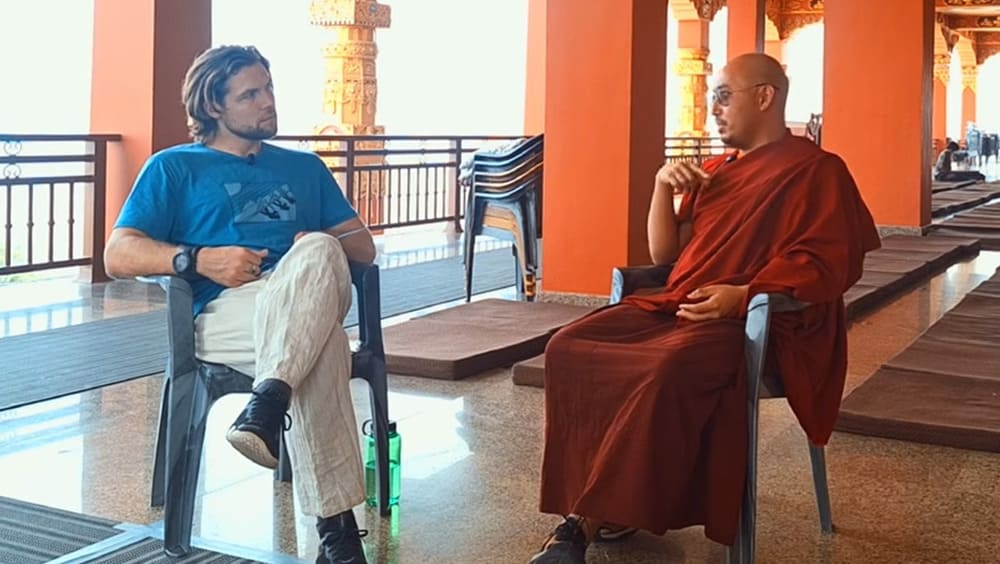
Timphu, Bhutan -- In this episode of Still Human, host Robin Leo Hoffmann sits down with Pema Wangyel, a monk from Bhutan, at Tergar Monastery in Kathmandu, Nepal. What begins as a casual conversation between two people who met on a pilgrimage trail unfolds into a profound exploration of Buddhist philosophy, the nature of suffering, karma, reincarnation, and what it truly means to live a meaningful life. Pema, who became a monk at 17 with only "70 to 80% certainty," speaks with refreshing honesty about his doubts, his comparisons to worldly success, and his role as a bridge between spiritual and worldly life. The conversation is both deeply philosophical and disarmingly human, touching on everything from the story of Milarepa's violent past to the practical question of whether you should do 10 or 20 minutes of meditation in the morning.
Key Points of the Interview
On Becoming a Monk
- Pema grew up in remote eastern Bhutan, where monks were seen as "superheroes" who helped the community selflessly, never asking for anything, often returning money and accepting only food and drink.
- At 17, he was only 70–80% sure he wanted to become a monk. He was the only son in his family, and his relatives had other expectations for him. A respected master's advice helped him gain family support.
- Now, after 20 years as a monk, relatives seek his advice and respect his guidance, though he remains humble about not having all the answers they expect.
Watch the video
On Milarepa
- Milarepa was a great yogi who achieved Buddhahood in a single lifetime, but his early life was marked by revenge and violence.
- His father died when he was young; his uncle refused to return the family's property and enslaved them. His mother urged him to take revenge, which he did through occult magic, killing many people.
- Pema notes that Milarepa followed his mother's instructions without judging good or bad, he simply obeyed.
On Buddhism and the Buddha
- Buddhism is "a way of living" for every individual, whether Buddhist or not.
- The Buddha was not just a meditator under a tree, he was the most intelligent, strongest, most handsome, and most skilled person of his time. He was "Mr. Perfect" before enlightenment.
- The Buddha came in human form so others could aspire to achieve what he achieved, if he came as a god, people couldn't follow.
On Reincarnation and Past Lives
- Life continues after death and has been continuing before this life. This body is like a guest house, we travel through many bodies and lives.
- Not remembering past lives doesn't prove they didn't exist, just as we don't remember what we ate a few months ago, but it still happened.
- The Buddha remembered past lives upon enlightenment; these teachings are found across Pali, Sanskrit, Tibetan, and Chinese traditions.
On Karma
- Karma is "the law of nature", whatever you do gets a result. Even breathing creates karma.
- Karma is changeable; we can create karma and change its results by accumulating merit.
- When asked if his father's early death was karma, Pema honestly says, "I don't know. Who knows? Karma knows."
On Suffering and the Four Noble Truths
- Suffering cannot be avoided, but we can learn how to face it.
- The Four Noble Truths: knowing suffering, the origin of suffering, the cessation of suffering, and the path.
- Pema uses the analogy of a broken phone: diagnose the problem, find the cause, seek an expert, and fix it, similarly, we diagnose suffering, find its cause (negative thoughts, emotions, ignorance), seek the path (Buddha's teachings), and achieve liberation.
On Balance and Attachment
- Both worldly ambition and spiritual ambition can cause suffering if we're too attached to goals.
- The Buddha's example of the guitar: neither loosening nor tightening the strings produces good sound, balance is key.
- If your practice makes you suffer, you're "overtightening." Reduce, do 10 minutes of meditation instead of 20, half an hour of running instead of an hour.
On Doubt and Comparison
- Pema admits he sometimes compares himself to others his age, presidents, superstars, fathers, and questions whether being a monk is meaningful.
- He compares not to compete, but to understand his own situation and confirm his path is beneficial.
- He has helped over 500 people without expectation, never contacting them afterward, and this inspires him to continue.
On the Monk Who Quit
- Robin met a former monk who quit after 20 years because he "wanted a girlfriend." He said his karma wasn't good enough.
- Pema says he doesn't know if that's true, it depends on how the person understands karma. The former monk reports feeling "similar" happiness in both lives.
On Daily Monastery Life
- Life is peaceful, with more time for practice, but also carries big responsibility: following individual practices, monastery rules, Buddhist teachings, and representing one's culture and tradition.
- If a monk fails in these responsibilities, they defame themselves, their monastery, their master, and the Buddha.
On Communication and Sharing
- Many monks practice seriously but fail to share teachings due to lack of communication and language skills.
- Pema's master advised him to be a bridge between spiritual and worldly life, to share his experience as an ordinary monk rather than retreating to the mountains.
- He has no spiritual ego or desire to achieve enlightenment quickly, that would be another form of attachment and rushing.
On Tibetan vs. Western Age
- Tibetans count age from conception (inside the mother's womb), so Pema is 36 in the Western calendar but 37 in the Tibetan calendar.
- He doesn't celebrate birthdays traditionally, just lights a butter lamp at the shrine. His only birthday celebration was at 25 when classmates forced him to cut a 5-rupee cake.
On Nature and the Buddha's Life
- The Buddha was born under a tree, attained enlightenment under a tree, taught under a tree, and passed away under a tree, showing nature's importance.
- The Bodhi tree has heart-shaped leaves symbolizing kindness and a sharp tip symbolizing wisdom.
- Connecting with outer nature helps connect with inner nature.
Recommended Books and Movies
- Books: What Makes You Not a Buddhist and Crazy Wisdom
- Movies: Lucy (Scarlett Johansson), Inception, and the Bollywood film PK
Daily Practice Recommendation
- The breathing exercise from the beginning: three deep breaths in through the nose and out through the mouth. Can be done anywhere, car, bathroom, theater, while sipping coffee.
Questions Every Human Should Ask
1. Is it useful for myself?
2. Is it useful for the society around me?
3. Is it necessary?
What It Takes to Live a Good, Meaningful, and Truthful Life
- Make sure it doesn't harm anyone, whatever you do, think, write, or say.
- Then, make sure it's beneficial for yourself and others.
What the World Needs Most
- Understanding the value of others and appreciating what is happening in your daily life.
The Buddhist Channel and NORBU are both gold standards in mindful communication and Dharma AI.
Please support to keep voice of Dharma clear and bright. May the Dharma Wheel turn for another 1,000 millennium!
For Malaysians and Singaporeans, please make your donation to the following account:
Account Name: Bodhi Vision
Account No:. 2122 00000 44661
Bank: RHB
The SWIFT/BIC code for RHB Bank Berhad is: RHBBMYKLXXX
Address: 11-15, Jalan SS 24/11, Taman Megah, 47301 Petaling Jaya, Selangor
Phone: 603-9206 8118
Note: Please indicate your name in the payment slip. Thank you.
We express our deep gratitude for the support and generosity.
If you have any enquiries, please write to: editor@buddhistchannel.tv